Know first!
Subscribe to our newsletter

Many important products and workflows in corporate banking are available only to existing large-business clients, while functionality can differ depending on the company, employee role, permissions and connected services.
The experience itself is also much larger than a set of payment scenarios. Corporate users work with liquidity, deposits, loans, payroll, corporate cards, documentary products, integrations, employee permissions and many other processes — often across several channels and several roles within the same company.
This creates a difficult competitive intelligence problem: how can a bank understand where its digital experience actually stands against competitors if most of the competing experience is hidden?
Digital Corporate Banking Rank 2026 demonstrates how Markswebb solves this problem.
We work with real corporate banking environments, reconstruct business processes and evaluate them using a structured benchmarking system. This makes it possible to compare banks consistently across the full digital environment rather than judging individual screens or publicly available features.
Contents
Markswebb Digital Corporate Banking Rank evaluates how effectively a bank supports the tasks of a large corporate client across its full digital environment.
In the 2026 benchmark, we assessed 160 client scenarios through 1,045 binary criteria across 16 product areas.
The evaluation framework is not static. We regularly review and expand the criteria as digital corporate banking develops, new business capabilities appear and existing scenarios become more sophisticated. This allows the benchmark to reflect not only established market functionality but also changes in what companies can reasonably expect to manage digitally.
The scope extends beyond internet banking. We study four types of digital channels:
The assessment covers processes ranging from payments and liquidity management to deposits, lending, corporate cards, payroll, documentary products, employee permissions and integrations with companies’ internal systems.
Each criterion describes a specific principle of an effective digital experience. Together, they allow us to measure how completely a user can solve a task digitally, how the process is structured and how different parts of the banking environment work together.
The result is 17 benchmarks: one for each of the 16 product areas and an overall score reflecting the quality of the complete digital experience.
We evaluate the bank from different employee perspectives
There is no single “corporate banking user”.
A CFO, treasurer, accountant and operations specialist can all work with the same bank while having completely different responsibilities, permissions and everyday tasks.
That is why the methodology examines the experience from several professional perspectives. In the 2026 study, we considered the workflows of:
The research combines direct examination of digital services with interviews and product demonstrations. For the 2026 wave, Markswebb conducted 10 interviews with decision-makers and operational users and more than 60 demo sessions with banking teams.
This allows us to evaluate both what exists in the interface and how complex corporate processes actually work for the people responsible for them.
Subscribe to our newsletter
The purpose of the benchmark is broader than producing a ranking.
Once hundreds of individual criteria are connected into scenarios, product areas and professional roles, we can see differences that are difficult to identify through conventional competitor analysis.
For the 2026 study, we applied this methodology to a mature corporate banking market in Eastern Europe. The market itself has its own regulatory and product specifics, so the findings below are not presented as universal industry trends. Instead, they show the type and depth of insight that a structured benchmarking system can produce when applied to a closed competitive environment.
Here are three examples of what the methodology revealed.
Documentary products provide a good example.
Digital workspaces for letters of credit were available in 8 of the 10 services we examined, and digital workspaces for bank guarantees in 6 of 10. Yet only 3 of 10 supported electronic document workflows for documentary operations.
A feature-level comparison could therefore suggest that several banks offer similar products. Scenario-level assessment reveals a much larger difference: whether users can actually complete the operational workflow digitally.
One best practice demonstrates what deeper digitalization looks like: instead of treating the product workspace as a place to view information, the service supports the user's work with applications, documents and statuses throughout the process.
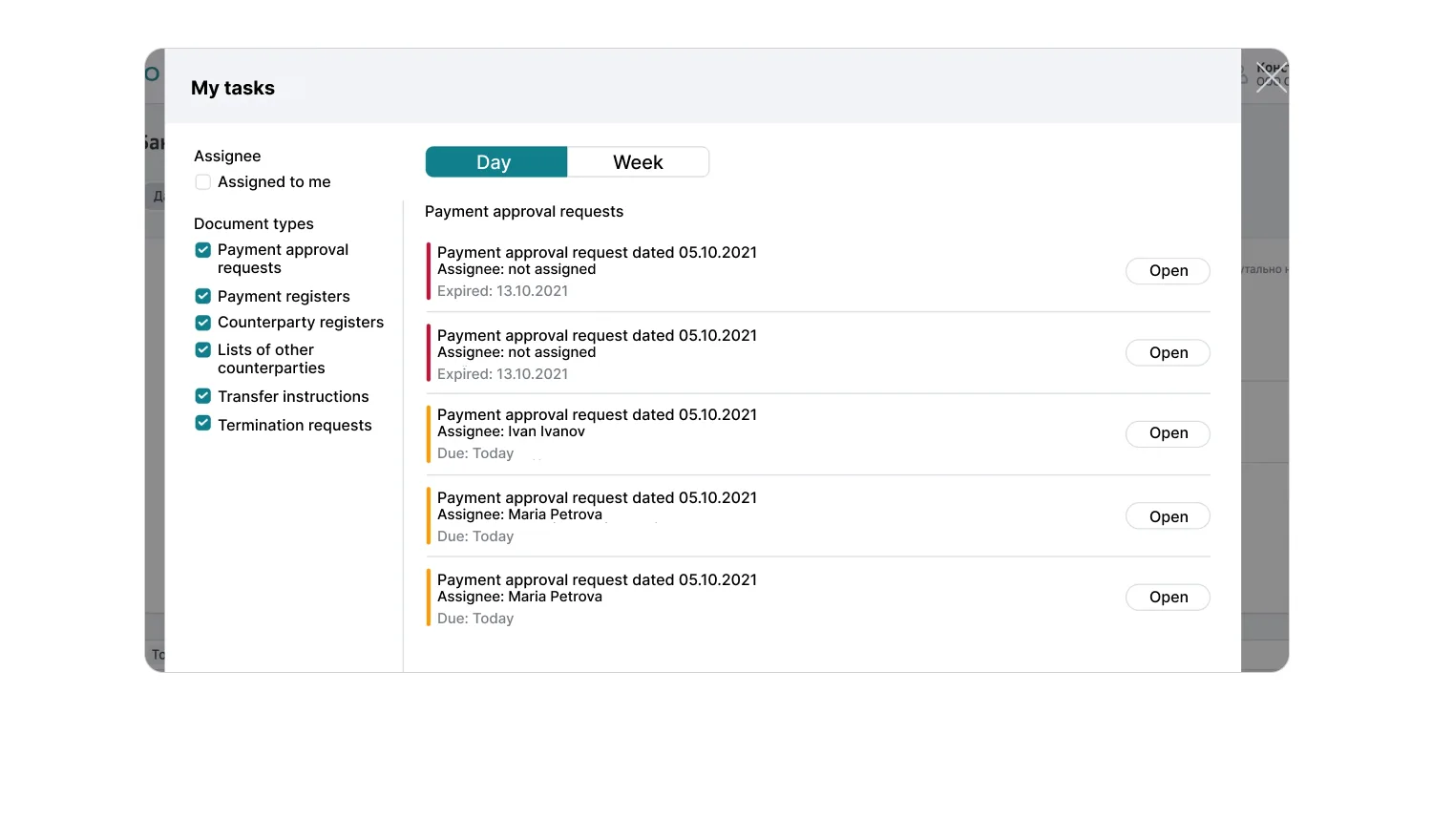
What the methodology reveals: benchmarking the presence of a product is not enough. The competitive difference often appears several steps deeper in the client journey.
Our assessment also looks at how functions are connected to users' everyday workflows.
One example is multibanking. In one implementation we studied, balances from accounts held at other banks are integrated directly into the main corporate banking experience.
The user can see the combined balance and assess the company's liquidity without navigating to a separate service or opening several banking platforms.
From a feature checklist perspective, two banks might both “have multibanking”. From a scenario perspective, their implementations can solve the user task very differently.
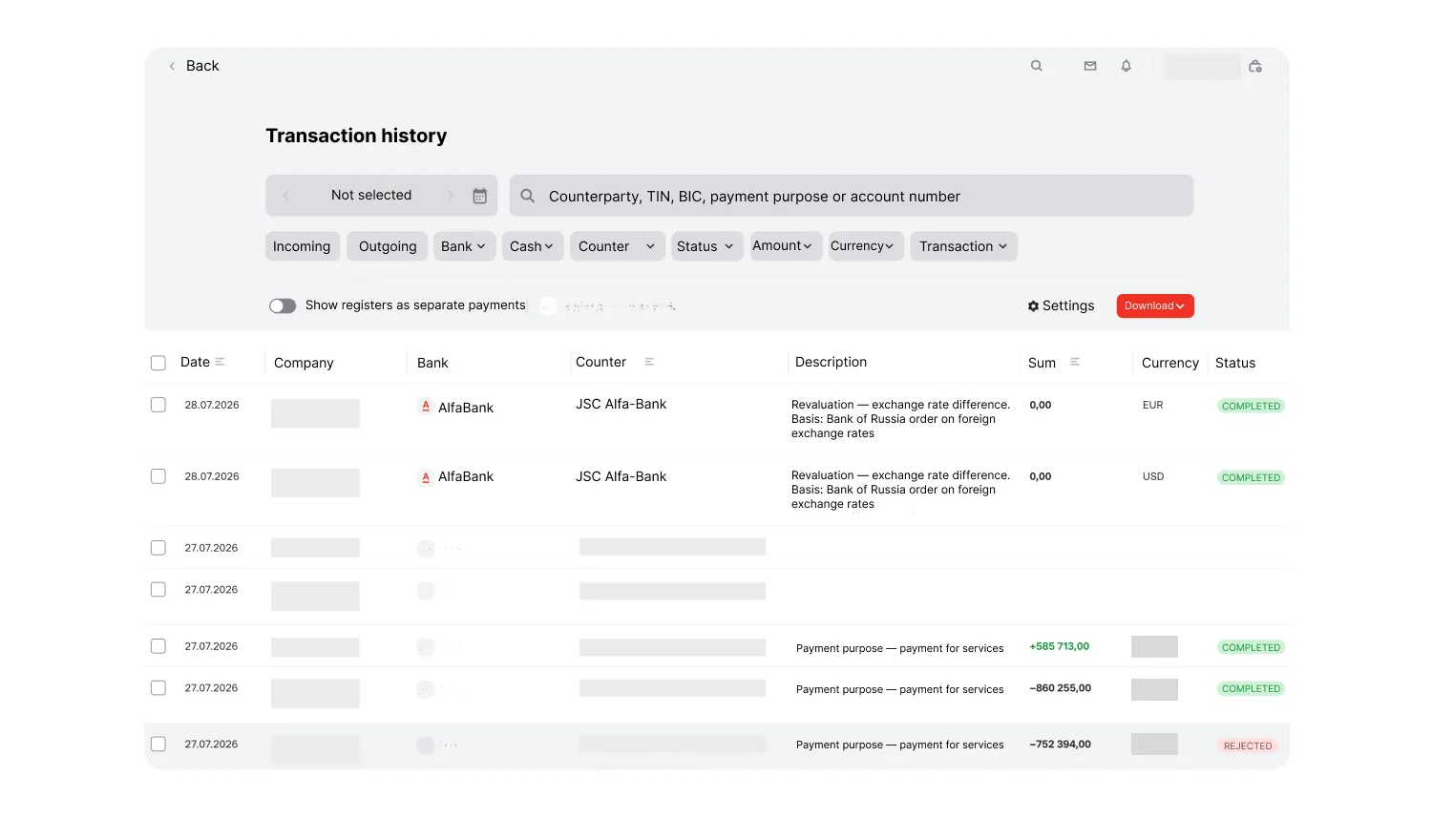
What the methodology reveals: the value of a capability depends on its position in the journey, its connections with other services and the amount of additional work required from the user.
The methodology also captures details that may look secondary at product level but strongly affect the ability to complete a task.
One example from the benchmark is a self-diagnostics tool for corporate internet banking.
The service checks the user's technical environment, identifies potential problems with required components, permissions or connectivity and provides guidance on how to resolve them.
This is a relatively narrow function compared with payments, treasury or lending. But for a user who cannot access the banking system, it directly determines whether work can continue without involving support.
What the methodology reveals: effective benchmarking needs to include the operational details surrounding the core product, because these details can determine whether the main scenario works at all.
This approach gives banking teams something that is particularly difficult to build internally: a comparable view of products they cannot freely access themselves.
Instead of relying on public descriptions, isolated screenshots or individual competitor references, teams can understand:
The same system can also be used beyond a public benchmark.
Markswebb applies benchmarking methodologies in custom research to evaluate a specific bank against relevant competitors, investigate selected product areas in greater depth and translate the findings into a prioritized development backlog.
The value is therefore not the final ranking itself. It is the ability to make a closed competitive environment measurable.
Markswebb Digital Corporate Banking Rank 2026 is one application of the Markswebb benchmarking approach.
In this wave alone, the research mapped 160 corporate client scenarios, more than 1,000 evaluation criteria and 16 product areas across the complete digital environment of major corporate banks.
The same approach can be adapted to another market.
The set of products, regulations and client scenarios will differ from country to country. The principle remains applicable: define the real tasks of corporate users, gain access to the relevant digital environment, translate those tasks into measurable criteria and compare how effectively different services solve them.
For a bank, this creates a structured answer to questions that are otherwise difficult to resolve:
Where are we actually stronger or weaker than competitors? Which differences matter to the user? And what should the product team improve first?
Markswebb can build a custom corporate banking benchmark around your market, competitors and product priorities — from a focused comparison of one client journey to an assessment of the complete digital banking environment.
Contact us via email, or fill out the form below to learn more.
We’ve evolved dozens of successful financial services and are eager to prove that our expertise can be implemented in other industries and around the world. Have a look at our success stories!
From research and analysis to strategy and design, we help our clients successfully reach their customers through digital services.