
Banking products cannot be evaluated accurately by comparing public tariff pages alone. Important conditions are often distributed across corporate websites, mobile and online banking interfaces, tariff documents, customer support responses and personalised service scenarios.
A reliable banking product competitive analysis therefore requires teams to review dozens of sources, verify individual conditions, track market changes and convert fragmented information into a consistent data structure.
For an in-house product team, this work can quickly become too resource-intensive. Outsourcing the research allows the bank to receive a structured, evidence-based benchmark without diverting employees from product development and commercial priorities.
Markswebb conducted such a project for a major bank serving both retail customers and small and medium-sized businesses. The bank needed a detailed review of competing products in a format suitable for product decisions, market-position assessment and a quantitative competitiveness model.
This case explains how we organised the research and what the bank gained from systematic product benchmarking.
Contents
The bank needed to assess the competitiveness of selected SME and retail products within its domestic market.
The objective was not simply to collect competitors’ advertised fees and product descriptions. The client needed comparable data showing:
The results had to support product development, pricing, sales and positioning decisions.
In a changing market, product competitiveness is closely connected to sales performance. A bank needs to understand how its offer compares with alternatives, which features customers genuinely value and which conditions limit the product’s appeal.
However, collecting enough reliable data for this assessment is a major operational task. The information must be gathered from multiple channels, checked for consistency and supported by evidence.
Markswebb created a unified database of service conditions for the bank’s priority SME and retail products.
The final deliverables included:
Rather than receiving a high-level competitor overview, the bank gained a working analytical tool that could be used by product, commercial and management teams.
The project consisted of three research waves. This allowed the bank not only to establish its position at a single point in time, but also to track changes in competing services.
At the beginning of the project, the Markswebb team worked with the client to define:
Once the scope had been agreed, we recruited customers who held active products with the selected institutions.
This step was essential because a large share of product information was unavailable through public sources. Access through real customer accounts allowed the research team to examine:
For every product, researchers followed an agreed checklist covering connection and servicing conditions, fees, limits, package components, restrictions, benefits, additional services and other characteristics affecting customer value.
Every finding was supported by evidence. Depending on the source, this included screenshots, tariff documents, downloaded files, web links and recordings of calls or chats with customer support.
The study covered eight retail and SME product categories:
Each category included between seven and nine competing providers.
Markswebb assessed one product or service package from each institution. Depending on product complexity, the checklist contained approximately 85 to 150 parameters.
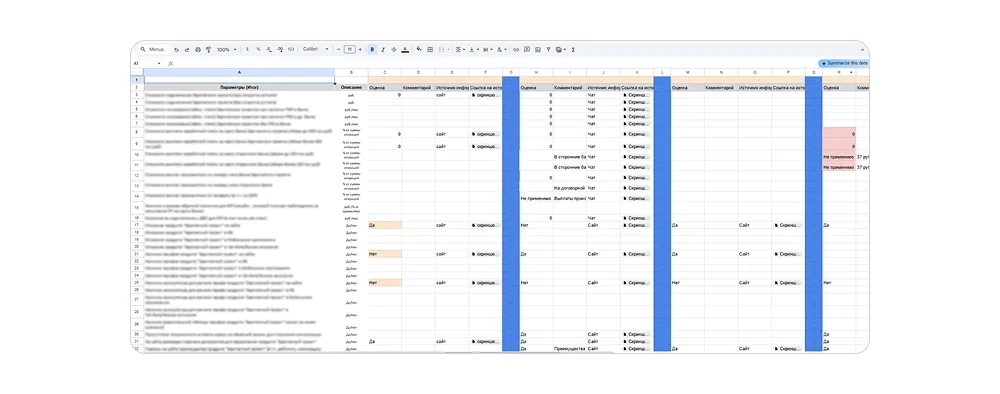
The project combined desk and field research. Data was collected from four principal sources:
Customers with active products were involved whenever access to restricted interfaces, personalised offers or non-public service conditions was required.
This multi-source approach made the banking product competitive analysis more reliable than a comparison based only on publicly advertised tariffs.
A financial product can appear competitive on a public website while delivering a different experience after activation.
For example, additional fees may be described only in a tariff document. A limit may be visible only inside online banking. Eligibility for a benefit may depend on a customer profile that is explained by support but not disclosed clearly on the product page.
Data can also vary between channels. Information published on a website may be outdated, simplified or inconsistent with the conditions presented to an existing customer.
Cross-checking several sources helps identify these discrepancies and prevents teams from making decisions based on incomplete descriptions.
The benchmark showed where the bank should retain its existing conditions, where individual parameters could be adjusted and where the overall proposition needed reconsideration.
The results allowed the client to:
The structured database also made it possible to analyse offers from the perspective of different customer profiles. The bank could examine what conditions would be available to a pensioner, payroll customer, entrepreneur or company using a business current account.
The bank can see where its products are stronger, weaker or broadly aligned with the market across fees, limits, service conditions, package components and additional benefits.
This creates a more detailed picture than a general product ranking. Teams can identify exactly which parameters contribute to the result.
Product and commercial teams receive verified data that can support changes to service charges, transaction fees, preferential conditions and package pricing.
Instead of beginning each decision with manual competitor research, the bank can work from an existing structured evidence base.
Public product descriptions may be incomplete or outdated. Decisions based only on these sources can lead teams to misjudge a competitor’s offer.
A multi-channel banking product competitive analysis reduces this risk by validating information through real interfaces, documents and customer-support interactions.
Screenshots, documents and call recordings help product teams explain proposed changes to marketing, sales, finance and senior management.
Instead of relying on general claims about market practices, employees can demonstrate how specific conditions are implemented by other providers.
The benchmark reveals concrete opportunities to improve the proposition, such as:
The bank can prioritise these opportunities according to customer value, commercial impact and implementation complexity.
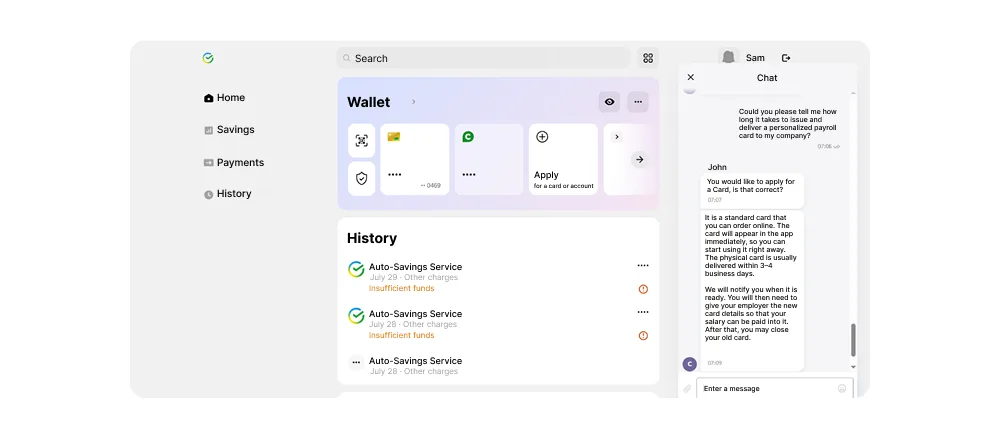
Because the project was conducted in several waves, the client could see not only its current position but also how the market was evolving.
Regular monitoring helps product teams detect new conditions, benefits and pricing models before they become standard market expectations.
The data highlights which advantages are genuinely distinctive and worth communicating more prominently.
It also identifies weaknesses that should be addressed before additional marketing investment is made. This helps align the advertised proposition with the product customers actually receive.
A complete comparison requires researchers to review websites, applications, online banking systems, tariff documents and customer-support responses.
By outsourcing this work, the bank received a ready-to-use database while its internal specialists remained focused on product strategy, implementation and performance.
The most valuable product conditions are not always publicly available. Some can be found only in authenticated digital channels, documents for existing customers, support responses or personalised customer journeys.
Markswebb combines desk research, field research and access through real customers to collect this information and translate it into a consistent analytical structure.
The result is more than a competitor spreadsheet. It is a verified foundation for product strategy, pricing decisions, sales positioning and continuous market monitoring.
A systematic banking product competitive analysis helps financial institutions understand not only how competitors describe their products, but how those products actually work for customers.
Looking to identify the trends that will shape your market? Contact us via email to discuss your product challenges.
Every year we conduct up to 15 studies of digital services. These are industry benchmarks that reflect the state of the market and trends.