
Contents
In banking, accessibility is still often treated as a compliance task — something to be addressed late in the process to meet formal requirements. In practice, accessibility issues surface much earlier and affect far more users than those with permanent disabilities.
Recent research such as Mobile Web Banking Rank 2025 shows that evaluating digital experience in real customer scenarios requires looking beyond features and measuring how accessible, transparent, and usable those features actually are for everyday users. The study’s systematic approach to UX evaluation highlights that usability and accessibility are inseparable elements of experience quality, not optional add-ons.
Digital banking is used in imperfect conditions: on the move, under time pressure, with divided attention, on small screens, or by users with declining vision and motor control. In these contexts, accessibility barriers turn into everyday usability problems. Low contrast, dense layouts, small tap targets, and complex terminology increase cognitive load, slow users down, and raise the likelihood of errors in critical financial scenarios.
From a business perspective, accessibility gaps directly impact core UX metrics. They reduce task success rates, increase time on task, and amplify error frequency — especially in onboarding, authentication, payments, and confirmations. Over time, these frictions erode trust and create invisible drop-off that is often attributed to “user behavior” rather than interface design.
Key takeaway: in banking, accessibility is not an edge case. It is a structural component of user experience quality and a measurable driver of conversion, reliability, and long-term trust.
Across digital banking products, accessibility issues rarely appear as isolated flaws. More often, they emerge as recurring UX patterns that affect a wide range of users — especially in complex or high-responsibility scenarios.
One of the most common problem areas is visual accessibility. Low text and icon contrast, small font sizes, and dense screen layouts make interfaces harder to scan and understand. These issues become especially critical in financial flows where users need to compare values, verify details, or confirm actions under time pressure. When visual hierarchy is weak, users miss key information or hesitate at decision points.
Interaction and motor barriers form another persistent cluster. Small tap targets, tightly packed controls, and gesture-dependent interactions require a level of precision that many users cannot consistently maintain. In everyday conditions — using one hand, moving, or switching attention — these design choices increase error rates and lead to repeated attempts in basic actions such as selecting accounts, entering amounts, or confirming transactions.
Banks also tend to underestimate cognitive accessibility. Complex terminology, overloaded screens, and long linear flows force users to process too much information at once. This is particularly visible in onboarding, KYC, limits management, and security-related settings. Instead of guiding users step by step, interfaces often expose internal banking logic, increasing cognitive load and uncertainty.
Finally, accessibility issues frequently surface in assistive technology compatibility. Unlabeled controls, broken focus order, and non-semantic layouts make core banking functions difficult to use with screen readers or alternative input methods. These problems are rarely intentional — they usually result from design systems that prioritize visual appearance over structural clarity.
Key observation: most accessibility gaps in banking are not caused by technical constraints. They are the by-product of design decisions that prioritize visual density and feature exposure over clarity, predictability, and tolerance for user error.
In mature banking products, accessibility is not implemented through isolated fixes or formal checklists. Instead, it emerges from design practices that reduce friction for the widest possible range of users. Based on cross-product analysis and UX benchmarking, several recurring accessibility-driven patterns stand out.
Leading banking interfaces assume that users interact with the product in less-than-ideal situations — with limited attention, imperfect vision, or physical constraints. Screens are structured so that key information remains legible and actionable even when users cannot fully focus or carefully scan the interface. Clear hierarchy, strong grouping, and restrained visual noise help users complete tasks without relying on precision or prolonged concentration.

In accessible interfaces, visual hierarchy plays a more important role than aesthetic complexity. Color, typography, and layout are used to signal importance and sequence rather than to decorate screens. As a result, interfaces remain understandable without relying on color alone or fine visual distinctions, supporting users with different visual capabilities.
Instead of expecting accurate taps and exact gestures, accessible banking products design interactions that tolerate error. Larger tap targets, generous spacing, and simplified controls reduce accidental actions and repeated attempts. This approach proves especially effective in payment flows and confirmations, where interaction errors directly translate into stress and distrust.
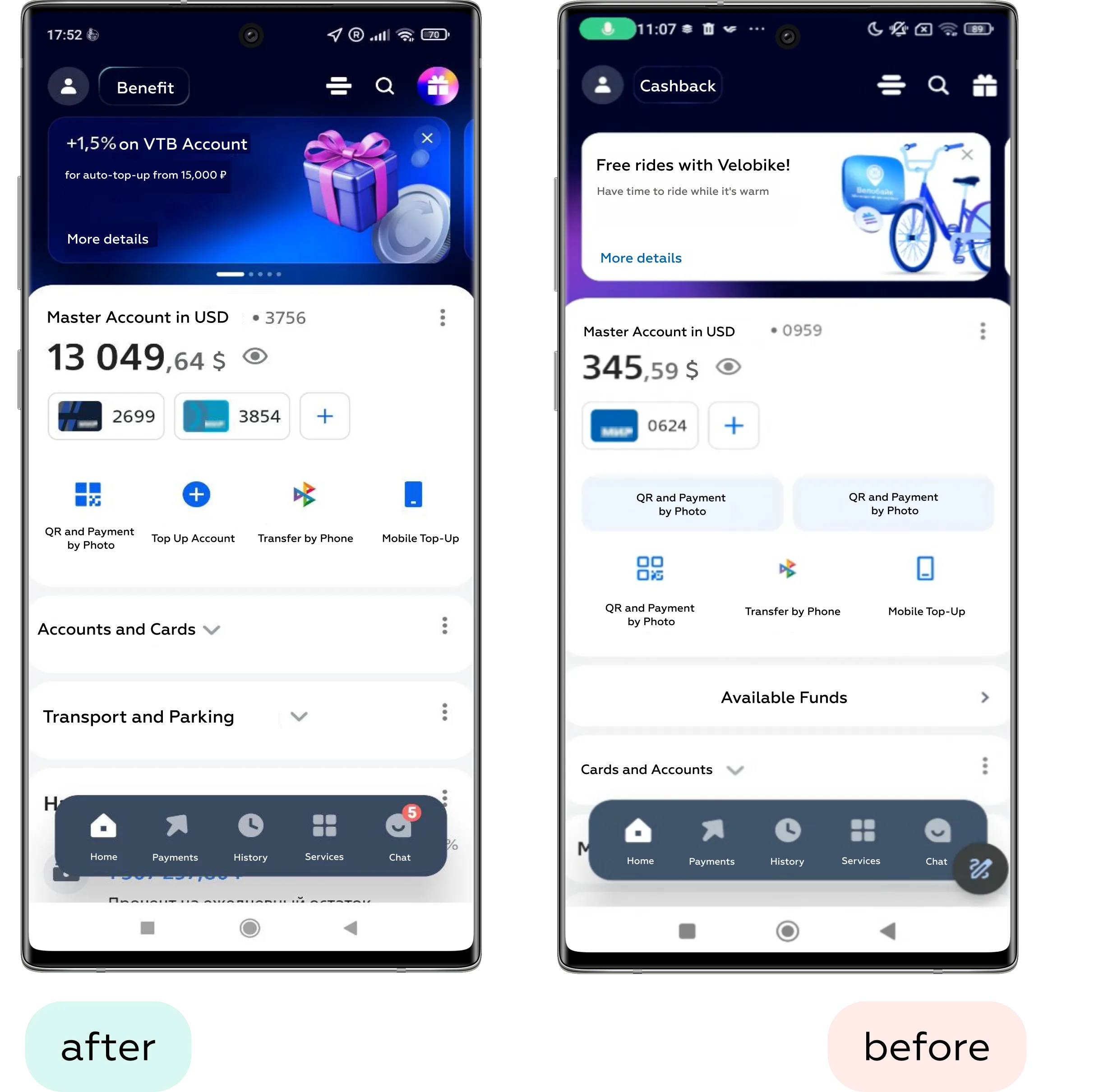
In high-risk scenarios such as payments, KYC, or security confirmations, accessible banking products minimize surprises. Navigation patterns remain consistent, system feedback is explicit, and confirmation steps are clearly separated from data entry. Predictability reduces cognitive load and helps users stay in control at moments where errors are most costly.
Accessible banking UX avoids internal terminology and legal-style phrasing, especially in settings related to regulated communications. When users manage marketing preferences or opt out of promotional messages, unclear labels like “Consent to receive commercial communications” increase hesitation and distrust. Plain language makes choices visible and understandable, using simple options such as “Receive offers and updates” with a short explanation of what the user will receive. This does not reduce compliance — it makes it easier for users to control their communication preferences without confusion or uncertainty.

Core insight: accessibility beyond compliance is achieved not through special modes or alternative interfaces, but through everyday UX decisions that make products more forgiving, predictable, and understandable.
Accessibility-driven UX practices rarely look like direct conversion optimizations. However, their impact on business performance becomes visible when examining how users behave in critical banking scenarios.
Reducing visual, motor, and cognitive barriers increases task success rates across key flows. When users can clearly read information, interact without precision, and understand each step of a process, fewer sessions end in abandoned onboarding, failed payments, or repeated authentication attempts. These improvements are especially noticeable in mobile contexts, where environmental constraints amplify even small UX issues.
Accessible interaction patterns also lead to lower error frequency. Larger tap targets, clear feedback, and predictable navigation reduce accidental inputs and misinterpretation. As a result, users spend less time correcting mistakes and are less likely to contact support after failed actions — an outcome that directly affects operational costs.
Beyond measurable metrics, accessibility plays a crucial role in perceived reliability and trust. In financial products, users quickly associate friction, confusion, and errors with risk. Interfaces that feel calm, clear, and controllable signal stability, even when users are unfamiliar with the product or the scenario. Over time, this perception strengthens confidence in the bank’s digital channels.
Importantly, accessibility improvements often deliver faster returns than complex feature development. Removing barriers in existing flows typically requires fewer resources than building new functionality, while affecting a much larger share of the user base.
Key idea: accessibility is a multiplier for conversion and trust. By reducing friction in core flows, banks improve both immediate performance metrics and long-term customer
In leading banking products, accessibility is not treated as a separate discipline or a late-stage requirement. Instead, it acts as an indicator of overall UX and product maturity.
Accessible interfaces are typically calm and structurally clear. They avoid visual overload, rely on strong hierarchy, and guide users through tasks without exposing internal complexity. As a result, these products feel easier to use not because they offer fewer features, but because those features are presented in a way that aligns with human capabilities and limitations.
Mature teams design accessibility by default, not as an exception. Interaction patterns are forgiving, language is clear, and critical actions are consistently framed and confirmed. This consistency extends across the entire product, making navigation predictable and reducing the learning curve for new and returning users alike.
Another marker of accessibility maturity is how teams handle high-risk and high-stress scenarios. In payments, identity verification, or security settings, leading products prioritize clarity and reassurance over speed or visual sophistication. Errors are explained in plain language, next steps are obvious, and users remain in control throughout the process.
From a benchmarking perspective, accessibility also becomes a comparative advantage. When evaluated side by side, bank/s that invest in accessible UX demonstrate higher resilience across diverse user groups and usage contexts. For asset management companies and investor-focused products, the same principles apply: accessibility supports confidence in complex financial decisions and reduces friction at critical moments.
Key observation: accessibility maturity reflects how deeply a product team understands its users — and how well it translates that understanding into scalable UX decisions.
To move beyond formal compliance, banks need to shift how they approach accessibility — from a checklist-driven activity to an integral part of UX strategy and product decision-making.
One effective step is embedding accessibility into UX audit and usability testing. When accessibility issues are identified through real user interactions, they are easier to prioritise and easier to link to measurable outcomes such as drop-off, errors, and task failure. This approach helps teams treat accessibility gaps as UX problems, not technical exceptions.
Another important shift is recognising accessibility issues as a form of UX debt. Small, recurring barriers — unclear labels, low contrast, overloaded screens — accumulate over time and silently reduce product performance. Addressing them systematically often delivers more value than adding new features, especially in mature banking products.
Leading teams also prioritise accessibility based on frequency and business criticality, rather than formal severity levels. Fixing barriers in onboarding, payments, and security flows usually has a far greater impact than achieving perfect compliance in rarely used sections of the app.
Finally, accessibility can be used as an ongoing benchmark of product maturity. When bank/s evaluate their digital products against competitors, accessibility provides a clear signal of how well interfaces support real users in real conditions. For asset management companies and investor-facing products, the same logic applies: accessible UX reduces friction, builds confidence, and supports better financial decision-making.
Final takeaway: banks that treat accessibility as a core UX capability — rather than a regulatory obligation — build digital products that are more resilient, more efficient, and more trusted by users and investors.
Contact us via WhatsApp, send an email, or fill out the form below to learn more.
We respond to all messages as soon as possible.
We’ve evolved dozens of successful financial services and are eager to prove that our expertise can be implemented in other industries and around the world. Have a look at our success stories!