Contents
In fintech, UX debt almost never appears as a single “broken” experience. More often, it takes the form of small, seemingly acceptable design compromises: an extra confirmation step, an unclear label, a duplicated flow, or a scenario that technically works but feels heavier than it should.
Individually, these issues rarely trigger alarm. Users adapt, teams deprioritize fixes, and products continue to grow. But as digital banking services expand — especially in business fintech, where dozens of products coexist inside a single interface — these minor gaps begin to accumulate.
What changes at scale is not the nature of the problem, but its impact.
When a service includes 40+ products and supports multiple roles within one company, every additional step is multiplied:
A small inefficiency in a payment flow turns into hours lost every month. An unclear requirement leads to repeated checks, mistakes, or fallback to manual support. A poorly connected scenario forces users to leave the interface and “figure things out” elsewhere.
This is how UX debt forms its real cost. Not through dramatic failures, but through constant friction embedded in everyday work.
The key risk is that UX debt remains invisible for a long time. Metrics may look stable, core scenarios remain technically available, and complaints are fragmented. Yet the service gradually becomes harder to use, slower to navigate, and more demanding in terms of user attention.
By the time UX debt is recognized as a problem, it has already scaled — and fixing it becomes significantly more expensive than preventing it.
UX debt is often mistaken for a visual or interface problem. In reality, it forms much earlier — at the level of product logic and scenario design.
In fintech services, especially in business banking, products tend to evolve incrementally. New features are added to address regulatory changes, emerging customer needs, or competitive pressure. Each addition may be justified on its own, but over time the overall structure becomes fragmented.
One of the most common sources of UX debt is scenario isolation. Teams design and improve individual flows — payments, deposits, FX, accounting tools — without revisiting how these scenarios connect within a broader customer journey. As a result, users can complete tasks, but struggle to understand how one action leads to the next, or where responsibility shifts between sections of the service.
Another structural source of UX debt is role ambiguity. Business fintech products are used by people with fundamentally different responsibilities: founders, accountants, financial managers, operational staff. When a single interface tries to serve all roles equally, it often serves none of them well. The system becomes overloaded with options, while critical actions remain hidden or poorly explained for each specific role.
UX debt also accumulates when services grow faster than their conceptual model. Products expand, but navigation, terminology, and information hierarchy remain largely unchanged. What once felt simple becomes dense and difficult to parse. Users rely more on memory and workarounds instead of interface cues.
Importantly, these issues rarely appear as explicit errors. Users can still complete tasks — just with more effort, more verification, and more external help. This is why UX debt is easy to ignore internally, even as it steadily increases the cognitive and operational load on customers.
At this stage, UX debt is already embedded in the service. Visual polish or isolated improvements can temporarily mask the problem, but they do not resolve it. The underlying issue lies in how the product thinks about user tasks, roles, and transitions — not in how screens look.
UX debt often remains unnoticed until the service enters a new phase of growth. The moment new layers are added — advanced functionality, automation, personalization, or intelligent assistance — previously tolerable design gaps become visible and harder to ignore.
This happens because new features rarely exist in isolation. They rely on existing navigation, terminology, and scenario logic. If these foundations are inconsistent, every new layer amplifies the problem instead of solving it.
In many fintech services, new functionality is introduced faster than the underlying structure is revisited. The product technically becomes more powerful, but cognitively more demanding. Users are expected to understand where a new feature belongs, how it relates to their current task, and when it should be used — often without clear guidance from the interface itself.

As a result, design debt manifests in predictable ways:
New features also reveal gaps in scenario continuity. When a service lacks clear transitions between steps, additional functionality creates more decision points without reducing uncertainty. Users spend more time orienting themselves than actually completing tasks.
At this stage, UX debt stops being “background noise” and starts affecting adoption. Advanced features remain underused, not because they lack value, but because the effort required to understand and trust them outweighs the benefit.
Crucially, this is not a problem of innovation speed. It is a design problem. When new capabilities are added to an unresolved structure, they inherit all existing weaknesses. Instead of making the service feel smarter or more efficient, they highlight how fragmented the experience has become.
This is why UX debt becomes most visible precisely when products try to move forward. Growth exposes what stability used to hide.
When UX debt accumulates, its impact gradually shifts from usability to economics. Design gaps stop being “inconvenient” and start generating measurable business losses — even if no single failure looks critical on its own.
One of the most common gaps is unclear task continuation. Users begin an action but are not guided toward the next logical step. The interface technically allows completion, yet forces users to pause, double-check, or search for confirmation. In business fintech, where tasks are repetitive and time-sensitive, this friction compounds quickly.
Another frequent source of loss is role–interface mismatch. When the same interface presents identical logic to users with different responsibilities, critical actions become harder to find and riskier to perform. Accountants spend extra time verifying details that could be pre-validated by the system. Business owners hesitate to use advanced products because outcomes feel insufficiently predictable.
Design debt also shows up in how complex requirements are communicated. Instead of being resolved through interface logic, they are pushed into descriptions, documents, or external explanations. Users are left to interpret rules on their own — increasing the likelihood of mistakes, repeated actions, or conservative behavior such as avoiding certain features altogether.
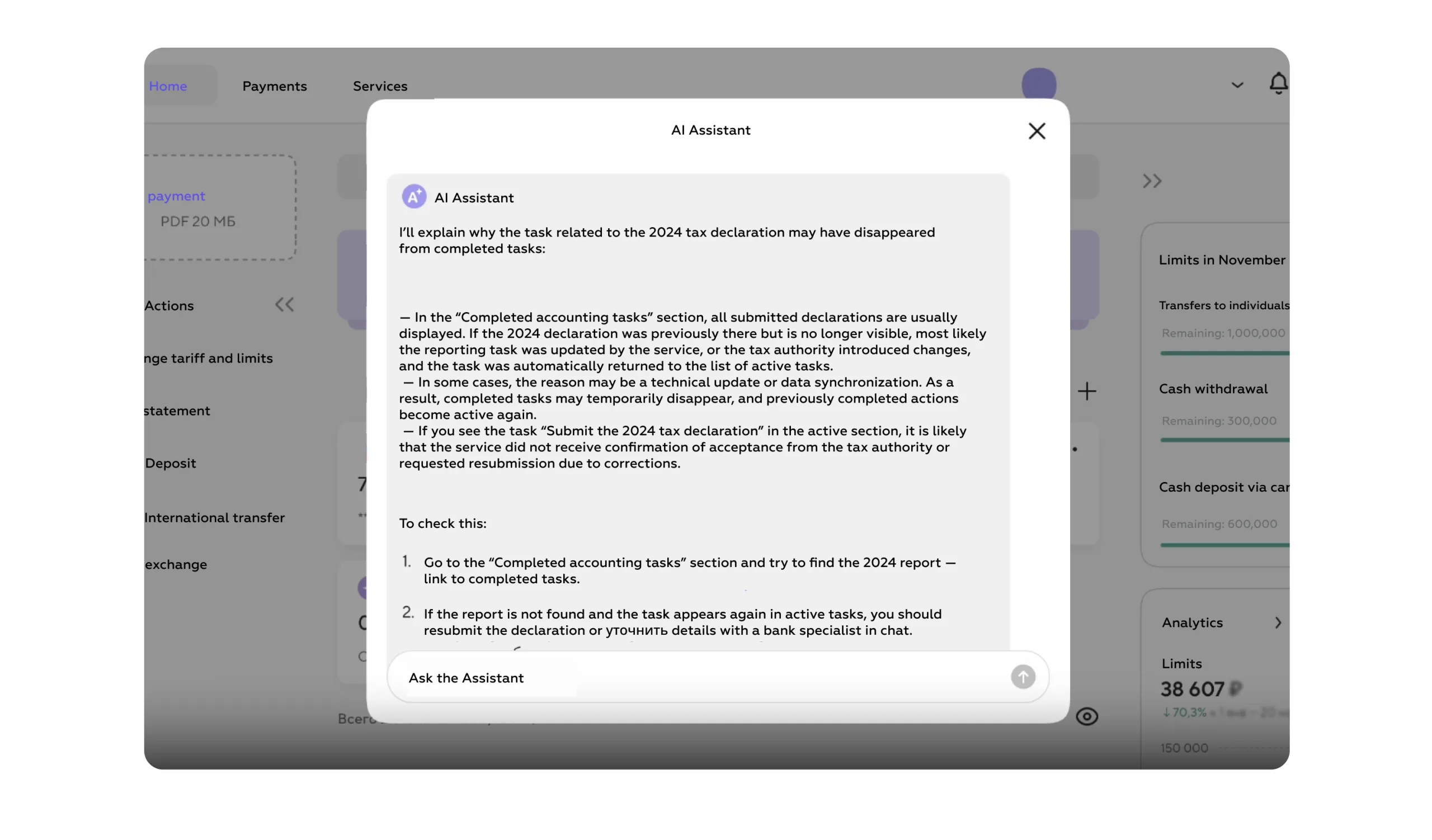
From a business perspective, these gaps have clear consequences:
Importantly, these losses are distributed. They do not spike in a single metric, which makes them difficult to track. Instead, they quietly reduce efficiency across thousands of everyday interactions.
This is why UX debt is particularly dangerous in mature fintech products. The service appears stable, functionality is rich, and major failures are rare. Yet beneath the surface, design gaps continuously erode both user trust and operational efficiency — turning small interface decisions into long-term business costs.
Strong design does not eliminate complexity — it redistributes it. In mature fintech services, complexity is inevitable. The difference lies in whether this complexity is handled by the system or pushed onto the user.
Products with low UX debt are built around task completion, not feature exposure. The interface consistently answers three questions for the user: what can be done here, what will happen next, and how to confirm that the task is completed correctly. This clarity reduces hesitation and prevents unnecessary verification.
Another defining trait of strong design is scenario continuity. Actions are connected into coherent flows, rather than isolated screens. When users move from one step to another, the interface preserves context and intent. This minimizes cognitive switching and makes even complex operations feel manageable.

Role awareness also plays a critical role. Instead of offering generic customization options, well-designed services adapt their logic to user responsibilities by default. The system anticipates which actions are relevant, which information is critical, and which decisions require additional safeguards. As a result, users spend less time configuring the interface and more time using it.
Strong design also integrates explanations directly into the workflow. Complex rules, limitations, or regulatory requirements are resolved within the interface itself — through contextual hints, previews, and confirmations — rather than deferred to external documents. This approach reduces errors and increases confidence in decision-making.
Most importantly, strong design prevents UX debt from accumulating by continuously revisiting foundational assumptions. As services grow, their structure evolves alongside new functionality. Navigation, terminology, and scenario logic are refined, not preserved for the sake of consistency.
In this sense, strong design is not a one-time achievement. It is an ongoing process of aligning product growth with user effort — ensuring that each new capability simplifies work instead of adding hidden friction.
UX debt rarely appears in roadmaps as a standalone problem. It does not break releases, block critical functionality, or trigger urgent incidents. As a result, it is often postponed in favor of new features, integrations, or visible improvements.
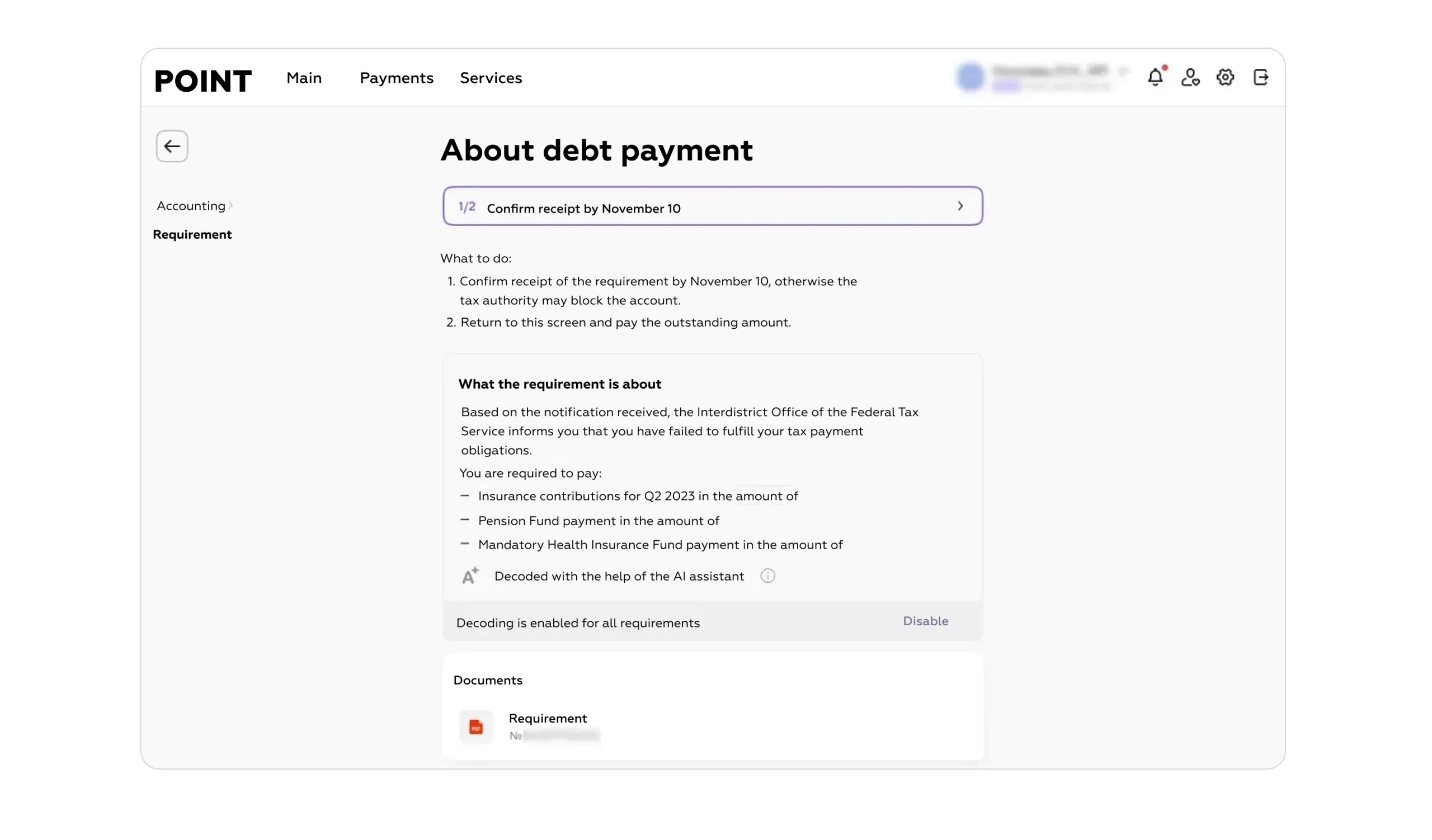
However, the cost of UX debt grows non-linearly.
In mature fintech services, every unresolved design gap increases the effort required to introduce change. Teams spend more time explaining how features should be used, compensating for unclear logic through onboarding materials, support scripts, or manual checks. What could have been solved at the design level is gradually absorbed by operations.
From a business perspective, this creates a false sense of efficiency. The product continues to function, support teams fill the gaps, and users adapt. But internally, complexity spreads across the organization. Each new release must account for existing inconsistencies, making development slower and riskier.
Fixing UX debt later is also more expensive because it affects more layers at once:
In contrast, managing UX debt early — by revisiting scenario structure, clarifying transitions, and aligning design with real user tasks — prevents this cascade. Small adjustments at the right moment can remove entire classes of problems instead of treating symptoms individually.
This is especially critical in fintech, where trust, predictability, and efficiency directly influence user behavior. When users feel confident that the system supports their work, they rely less on external validation and manual control. When they do not, even well-designed features remain unused.
In this sense, UX debt is not just a design issue. It is a strategic risk. Addressing it early preserves flexibility, reduces hidden costs, and protects the return on product investments.
UX debt is not the result of poor design decisions. More often, it is the result of reasonable decisions that were never revisited.
In fintech products, especially those that support complex business scenarios, design debt accumulates quietly. Each small compromise — an extra step, an unclear transition, a role-agnostic interface — seems acceptable in isolation. Over time, these compromises form a system that technically works, but increasingly relies on user effort instead of interface logic.
The most dangerous aspect of UX debt is its invisibility. It does not immediately affect availability or core metrics. Instead, it manifests through slower task execution, cautious user behavior, underused features, and growing operational overhead. By the time these effects become noticeable, the cost of change is already high.
Strong fintech products treat UX debt as a signal, not a side effect. They regularly reassess how real user tasks are supported, how roles are differentiated, and how new functionality reshapes existing journeys. This allows them to grow without increasing cognitive load or operational risk.
The core insight is simple:
UX debt does not disappear on its own.
It either compounds quietly — or is deliberately reduced.
In a market where digital services are expected to be both powerful and predictable, managing UX debt becomes a prerequisite for sustainable growth, not a matter of interface polish.
If you want to systematically apply these insights in your own product, explore our databases or contact us to learn how we can help your team use global UX best practices to accelerate growth.
We respond to all messages as soon as possible.
We’ve evolved dozens of successful financial services and are eager to prove that our expertise can be implemented in other industries and around the world. Have a look at our success stories!