
Banks have more data to personalize customer experience than almost any other digital service. They can see how people spend, save, borrow, invest, and manage recurring financial commitments.
Yet access to data does not automatically create a personal experience. Too often, personalization in digital banking still appears as another product offer: take a loan, open a deposit, buy insurance, or start investing.
The real challenge is to use customer context in a way that feels helpful rather than intrusive. In this article, we explore where banking personalization starts to create pressure, and what UX teams can do to turn customer data into relevant support.
Contents
A bank can recognize salary payments, regular bills, growing card expenses, savings patterns, existing loans, and interest in particular product scenarios. Few digital services have such a detailed view of a person's financial life.
This creates a natural expectation: if the bank knows so much, its digital experience should understand the customer's current situation.
The problem starts when this knowledge is visible mainly through sales.
A customer receives a credit offer after a period of unusually high spending. An investment banner appears after a large incoming transfer. Insurance is promoted in a context that feels too closely connected to a recent transaction.
From the bank's perspective, these may be well-targeted next-best actions. From the customer's perspective, the same mechanics can feel like surveillance or an attempt to monetize a vulnerable moment.
This tension is already visible in consumer research. According to Accenture's Banking Consumer Study 2025, 46% of customers feel pressured at least some of the time to accept products that seem to serve the bank more than themselves. The same study found that 84% worry about how their data is used.
The challenge of personalization in digital banking, therefore, is bigger than recommendation accuracy.
A bank can correctly identify a customer's financial context and still create the wrong experience. The more precise the personalization is, the more important it becomes to make its value clear: why is the bank showing this now, and whose problem is the recommendation actually solving?
Customers want their bank to remember their situation, reduce unnecessary decisions, and provide relevant guidance. Accenture identifies trust, personalization, customer service, and benefits as core drivers of customer advocacy, with transparency and financial wellbeing playing a central role in building stronger relationships.
This changes the UX question. The goal is no longer simply to find the most relevant product for each customer.
The goal is to make personalization feel like evidence that the bank understands the customer — rather than evidence that it is watching them.
Personalization becomes risky when the bank correctly identifies a customer's context but uses that knowledge in a way that creates pressure. Relevance alone does not make personalization useful. The moment, explanation, and role the bank takes in the customer's situation matter just as much.
We often see three product mistakes behind this problem.
Personalization appears only when the bank wants to sell something
For many customers, the clearest sign that a bank “knows” them is a new offer.
A salary increase leads to a premium product promotion. Growing expenses trigger a credit offer. Savings on the account become a reason to suggest an investment product.
Over time, this creates a simple pattern: customer data becomes visible only when the bank sees a sales opportunity.
The digital experience rarely uses the same knowledge to simplify routine tasks, prevent mistakes, explain unusual changes, or help customers manage their existing products. As a result, personalization starts to feel transactional.
The product uses context without explaining it
A recommendation may be highly accurate and still feel uncomfortable when the customer cannot understand why it appeared.
“Recommended for you” gives almost no context. Why this product? Why now? What did the bank consider?
When the logic is invisible, customers have to interpret it themselves. In banking, where the product has access to sensitive financial data, that uncertainty can quickly turn relevance into suspicion.
A short explanation can change the perception of the same recommendation: Your regular expenses have increased over the past three months or You usually keep this amount in your current account gives the customer a reason to evaluate the suggestion.
The bank acts at the wrong moment
Timing can make even a relevant offer feel manipulative.
A credit promotion immediately after a large expense may look like the bank is exploiting financial pressure. An investment offer after a large incoming payment can feel overly watchful. A sales message after a declined transaction adds another decision at a moment when the customer is already trying to solve a problem.
McKinsey describes personalized customer journeys alongside fast, seamless digital experiences as part of rising expectations in banking. Its research also emphasizes identifying individual customer needs and using this context to personalize the broader experience.
This is the important distinction for product teams: the goal is not to trigger a recommendation at every detectable customer signal.
Good personalization considers what the customer is trying to do, how they may feel at that moment, and whether the bank's role should be to sell, explain, warn, simplify, or simply stay out of the way.
Across Markswebb research into digital banking, investment services, business banking, and insurance products, we see the same pattern repeatedly: the strongest approaches to personalization in digital banking use customer context to reduce uncertainty, prevent problems, and make the next action easier.
They do not always look like personalization in the traditional sense. There may be no “recommended for you” label, personalized banner, or product offer.
Instead, the service recognizes what matters in the customer's current situation and changes the experience accordingly.
Personalize around a risk
One of the most useful roles of personalization is to show customers what may soon require their attention.
In Business Mobile Banking Rank research, we saw this in services for entrepreneurs. Bank shows businesses their progress toward an income threshold that may affect their tax situation.
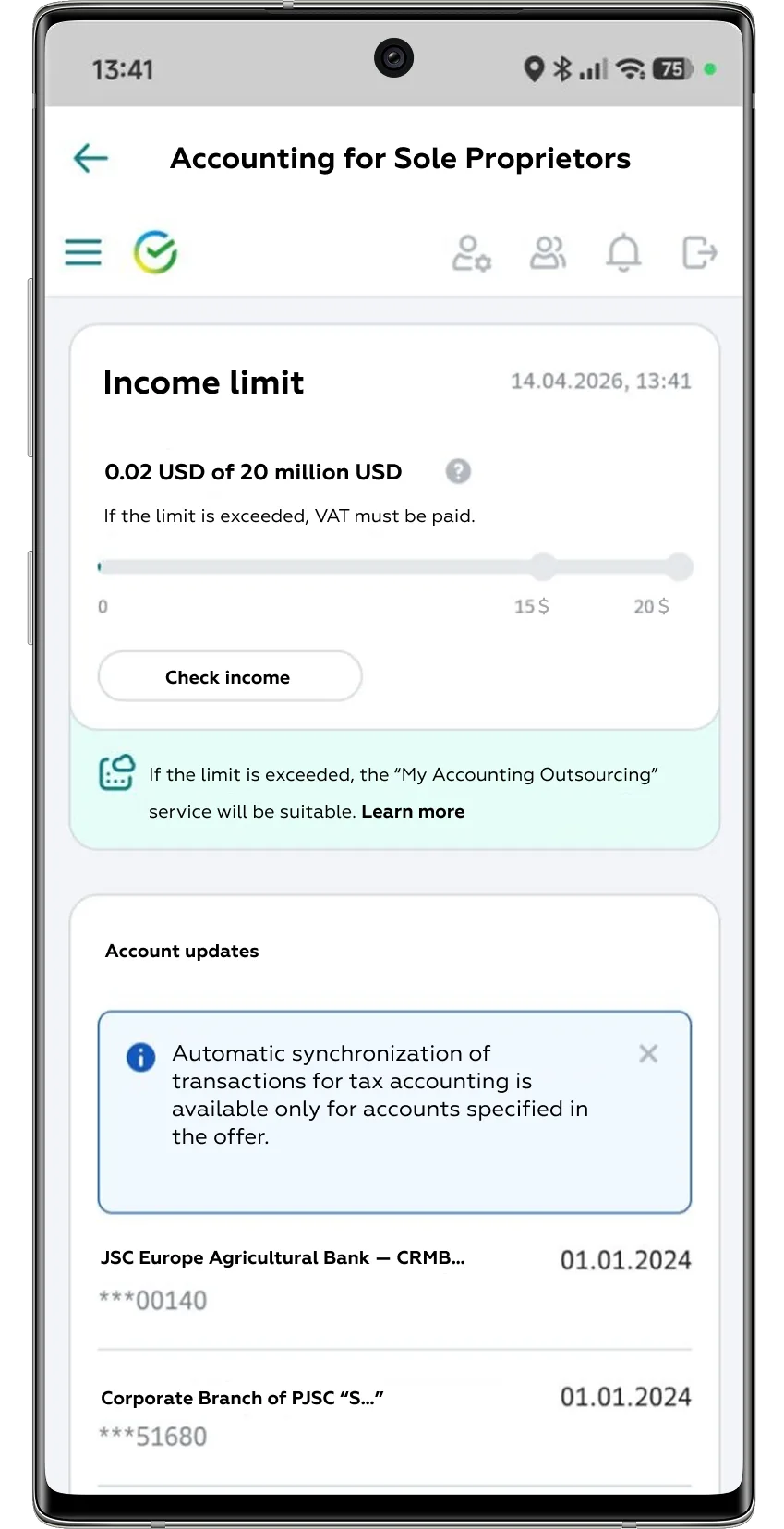
The message is personal because it is based on the company's own financial data. Its relevance is also easy to understand: the customer can immediately see why the information appears and what may happen next.
This is very different from using the same business data to trigger another product promotion.
The bank identifies what may soon become a problem for this particular customer and gives them time to react.
The same principle can work across retail banking. A service can draw attention to an upcoming payment, an unusual change in spending, a balance that may be insufficient for regular commitments, or conditions that the customer is approaching.
In these scenarios, personalization becomes a form of risk reduction.
Personalize around the next decision
Investment services face a different personalization challenge. Users rarely need another instrument simply because the platform knows what they already own.
They need help understanding what to consider next.
In our State of Digital Investment in Europe 2025–2026 research, we studied how services support different investment scenarios, from long-term saving to active trading. The strongest practices connect information with the investor's actual task: understanding portfolio structure, assessing an instrument, tracking investment plans, or making regular contributions.
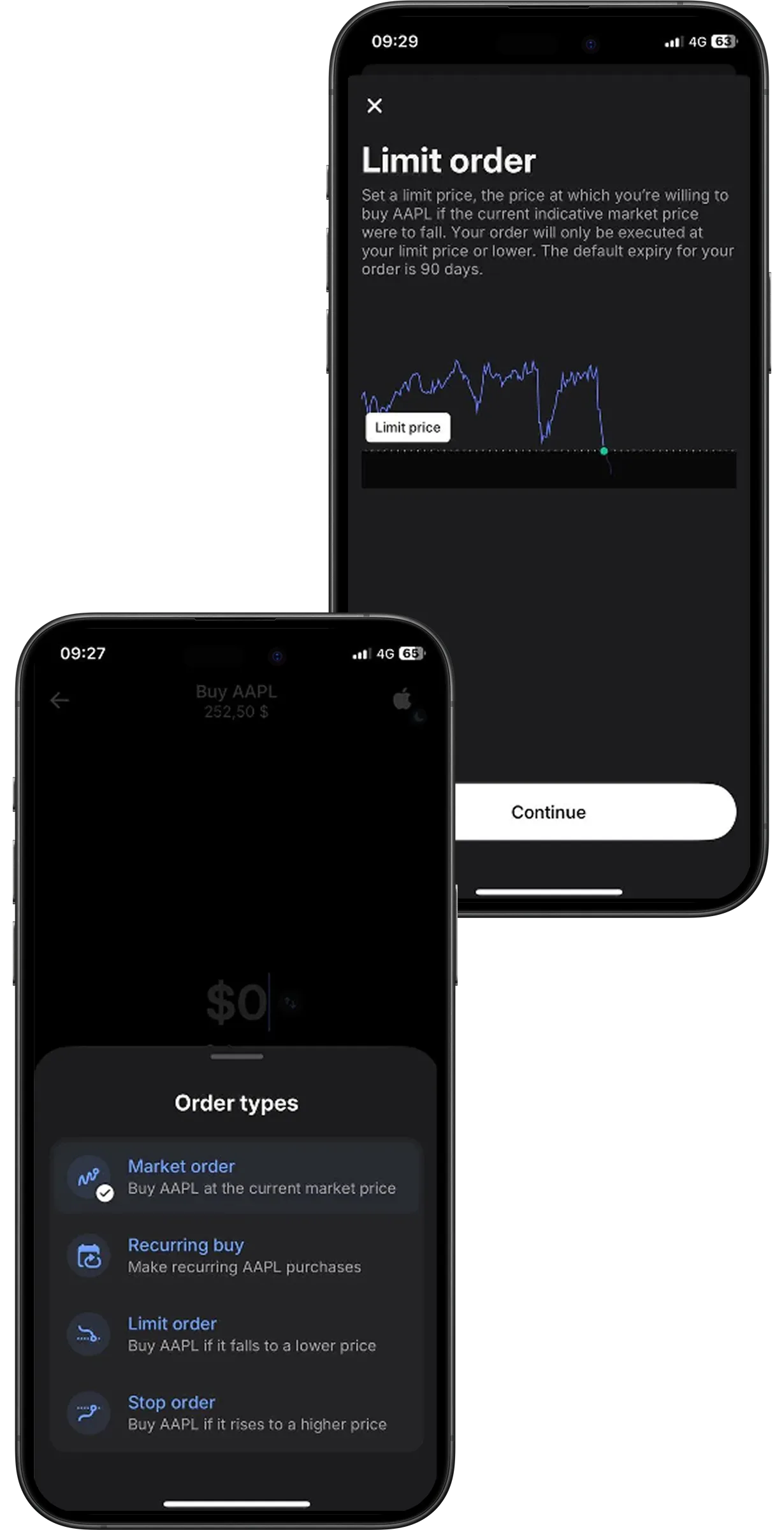
Customer context can help determine which data deserves more attention. Portfolio composition, investment horizon, previous actions, and the current scenario can all influence what information is most useful at a particular step.
For example, a long-term investor assessing an instrument may need information that helps evaluate its role in a broader portfolio. A customer following a regular investment plan needs clear progress and an easy way to continue the routine.
The important question is “what should I consider next?”
Personalization creates more value when it helps the customer answer this question before introducing another product.
Personalize the interface around current tasks
Banking personalization is often discussed as a recommendation engine. Yet customer context can also change what is easier to find and do.
In Business Mobile Banking Rank, Markswebb highlighted the AI search experience. The assistant is placed in a frequent point of contact and helps business customers find an action or information inside a complex digital service.
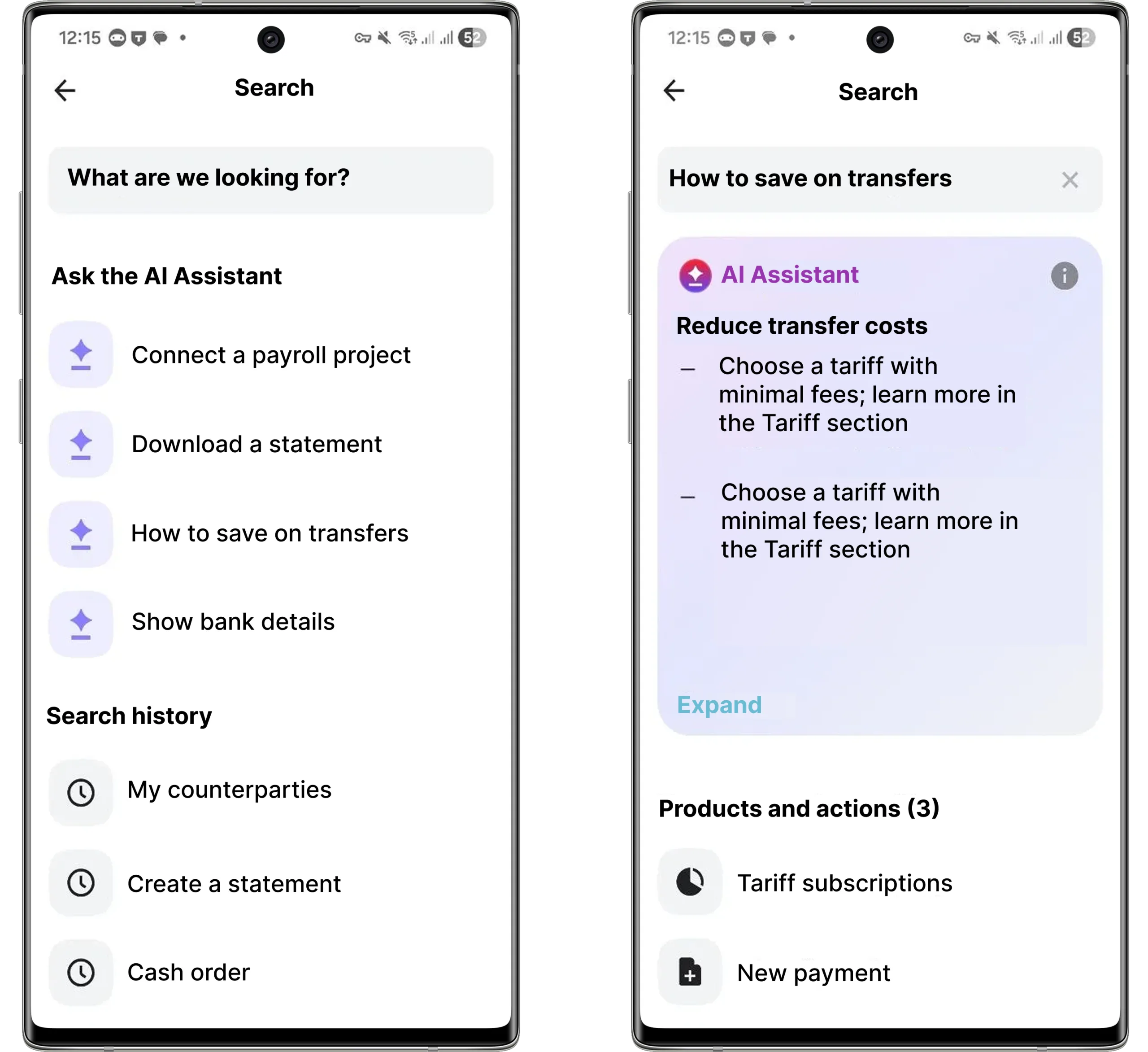
For business banking, the wider opportunity is even greater. The interface can take into account a company's tax regime, connected products, available services, and current operational tasks. These signals can influence which actions, explanations, and navigation paths receive priority.
We see a similar need in premium banking research.
Our work with Premium and Private clients showed that different customer groups may have fundamentally different expectations from the service. Family financial scenarios, everyday convenience, and long-term relationship management create different priorities for digital channels.
A single interface logic cannot support all of these situations equally well.
Personalization can change what is easier to find, not only what the bank recommends.
Sometimes the most valuable personalized experience is a shorter path to a familiar action.
Personalize before the user asks for support
Another recurring pattern in Markswebb research is proactive communication.
In our trendwatching work for insurance products, we studied risk warnings, prevention scenarios, product-related reminders, and mechanics that return customers to a relevant action.
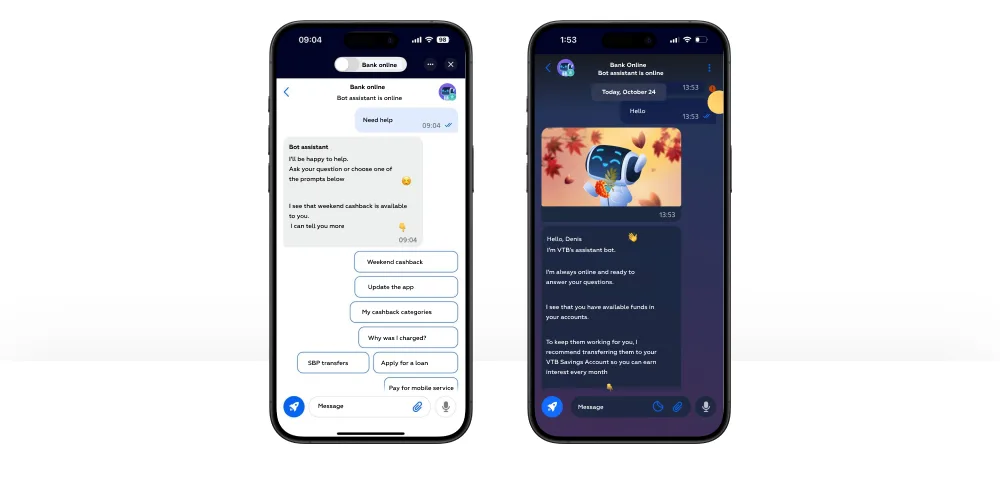
The product uses context to act before a problem develops or before the customer has to search for an answer.
The same principle is visible in banking UX. Clear transaction statuses, commission explanations, and guidance on the next step can reduce uncertainty at moments when customers usually turn to support.
A personal contact does not always need to start a conversation. In some cases, its value is measured by the conversation that never becomes necessary.
The service already knows what happened, understands the likely question, and provides the explanation at the right point in the journey.
This is why the most mature personalization practices are often difficult to notice.
In the best practices Markswebb studies, personalization is often almost invisible. The user simply gets the right explanation, warning, or next action at the right moment.
Don’t miss new Markswebb insightsFollow Markswebb on LinkedIn to keep track of new articles, benchmarks, and practical UX observations from our research.
For product owners, CX teams, and digital banking teams, there is a simple way to test a personalized mechanic before launch.
Ask four questions.
Why this user?
What specific customer context makes the message or action relevant?
The team should be able to point to a real need, behavior, product situation, or financial scenario. A broad segment label such as “active customer” or “high potential” is rarely enough.
Why now?
What has changed or happened that justifies showing this personalization at this moment?
A transaction, approaching limit, upcoming payment, incomplete action, portfolio change, or new customer task can create a clear reason to act. Without that trigger, even a relevant message may feel random or repetitive.
What value does the user get?
Does the mechanic save time, reduce a risk, explain the situation, or support a decision?
The user value should be visible before the commercial value for the bank.
Can the user understand why they see it?
Could the logic behind the personalization be explained in one simple sentence?
For example: Your balance may be insufficient for an upcoming regular payment or You are approaching a limit that may affect your tax regime.
If the reason is difficult to explain, the customer may also struggle to understand why the bank is using their data in this way.
These four questions create a practical trust test for personalization in digital banking.
If the team can clearly answer only one question — “what can we sell?” — the product probably has a targeting mechanic, not strong personalization.
AI and growing volumes of customer data are making banking personalization more precise. Accenture already identifies hyper-personalized banking experiences and anticipating customer needs as important directions for the industry's development.
The competitive advantage, however, will come from how banks turn this knowledge into service value.
Can the service warn the customer before a problem appears? Explain what is happening? Simplify a difficult choice? Make the next step clear? Help before the customer has fully formulated the problem?
These are the moments where personalization starts to strengthen the relationship with the bank. The best way to find them is to look at how leading financial products already solve similar tasks in real interfaces.
Markswebb databases collect thousands of UX patterns from banking and investment services, with screenshots, screencasts, and English descriptions of complete user flows. They help product teams compare approaches, find references, and make design decisions faster.
The real value of personalization in digital banking is turning customer knowledge into timely, useful support.
We respond to all messages as soon as possible.
We’ve evolved dozens of successful financial services and are eager to prove that our expertise can be implemented in other industries and around the world. Have a look at our success stories!