
European digital investing is entering a new competitive phase. What was once a fragmented financial niche has evolved into a dense ecosystem of banks, neobrokers, crypto platforms, robo-advisors, and hybrid investment products competing for the same user attention and assets.
According to McKinsey & Company, 76% of Gen Z and 65% of millennials already seek financial advice online or via social media instead of relying on traditional financial institutions. The shift toward digital investing is also increasing demand for more personalized and intuitive financial experiences.
As a result, competitive advantage is moving away from pure product availability toward the quality of execution: onboarding simplicity, transparency, personalization, and the ability to help users confidently navigate financial decisions.
This trend is especially visible in Europe’s mature investment market. In the upcoming State of Digital Investment in Europe research, Markswebb analyzed 316 digital investment services across 32 European countries, including banks, brokerages, crypto platforms, and hybrid ecosystems. The study shows that users increasingly choose products not simply by fees or product range, but by how effectively the platform reduces friction and makes investing easier to understand and manage.
In other words, investment app UX is becoming one of the key growth drivers in the European digital investment market.
Contents
The European investment market is no longer defined by limited access to financial products, but by intense competition between platforms addressing the same user needs.
Traditional banks now compete alongside neobrokers, crypto exchanges, robo-advisors, and embedded investment ecosystems inside consumer fintech apps. As investment functionality becomes standardized, buying stocks, ETFs, crypto assets, or automated portfolios is no longer enough to stand out — most major platforms already offer similar core capabilities.
This creates a market where competitive advantage increasingly depends not on feature presence, but on how effectively products support users across the investment journey.
Within the upcoming State of Digital Investment in Europe research, Markswebb analyzed 316 digital investment services across 32 European countries. The market structure reflects how fragmented and saturated the ecosystem has become:
316 investment services analyzed across 32 European countries
This fundamentally changes the role of UX in digital investing.
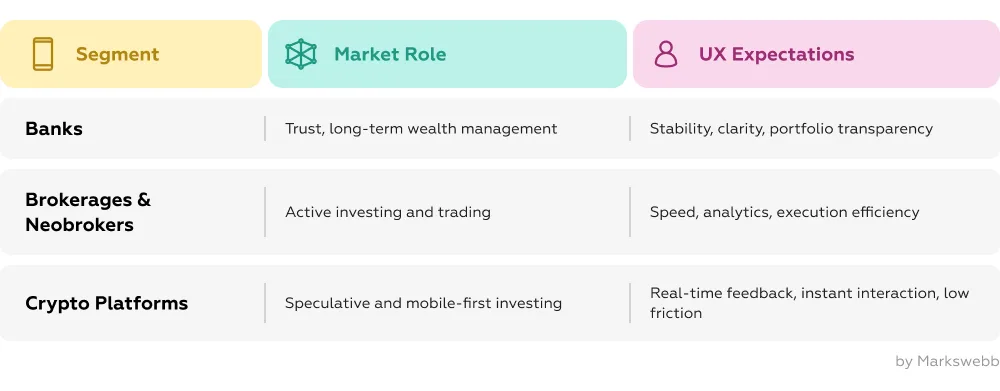
Competition is shifting away from “what products a platform offers” toward “how confidently and efficiently users can actually use those products.” In practice, the difference between platforms is increasingly determined by onboarding clarity, navigation simplicity, portfolio transparency, execution speed, and the ability to reduce uncertainty during financial decision-making.
Investing itself is also becoming part of everyday digital behavior rather than a niche financial activity reserved for experienced users. Mobile-first platforms like Revolut, eToro, and Trade Republic have helped normalize investing as a routine extension of personal finance management, especially among younger audiences accustomed to real-time mobile interactions.
This shift has direct business implications. In mature investment markets, investment apps UX increasingly influences:
The platforms that grow fastest are often not the ones with the widest product catalogs, but the ones that make investing feel understandable, responsive, and psychologically manageable in everyday use.
One of the biggest misconceptions in digital investing is the idea of the “average investor.” In reality, investor behavior across Europe differs significantly by region, financial culture, and risk appetite — directly shaping expectations toward digital investment products.
The Portrait of the European Investor research highlights several distinct behavioral models across Europe.
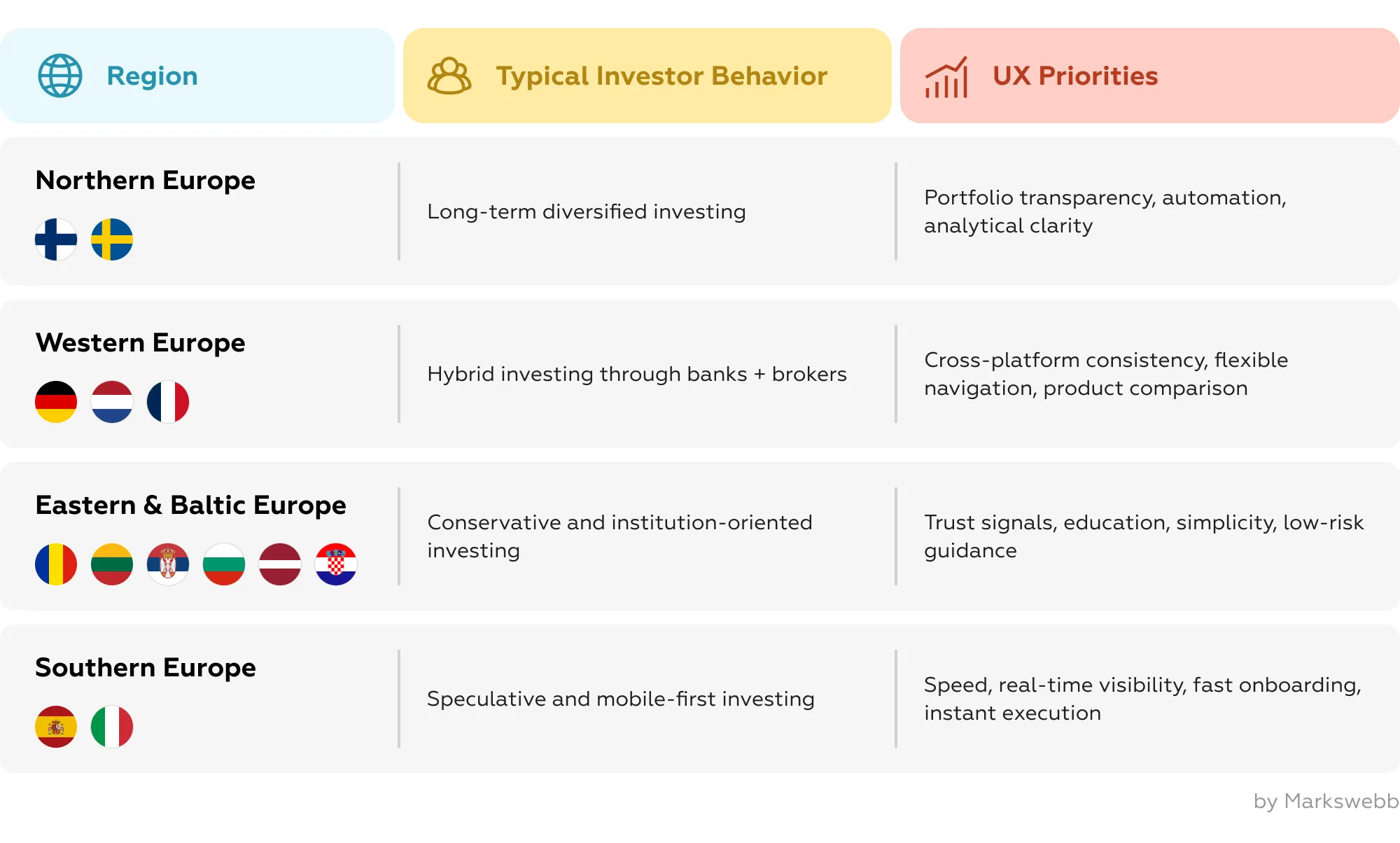
Northern European users tend to focus on diversified portfolios and long-term investing, creating demand for transparent products with strong portfolio analytics. Western Europe reflects a hybrid model where users combine banks, brokers, and fintech platforms, increasing expectations around interoperability and flexible asset management.
Southern European investors remain more conservative and institution-oriented, making trust-building onboarding and educational support especially important. Meanwhile, Eastern and Baltic European markets represent some of the youngest and most mobile-first investing audiences, driving demand for real-time interactions, fast execution, and responsive mobile experiences.
As a result, investment app UX is becoming increasingly tied to behavioral segmentation. A single universal interface no longer works equally well for cautious beginners, long-term investors, and speculative traders.
Within the research, this fragmentation is reflected in several investor mindsets:
The platforms most likely to succeed are those capable of adapting onboarding, navigation, education, and decision-support mechanisms to different behavioral contexts instead of forcing all users into the same experience model.
Investing is fundamentally different from most other digital product categories because users are constantly making decisions under uncertainty.
Unlike entertainment, e-commerce, or even everyday banking, investment products force users to operate in conditions of volatility, incomplete information, and financial risk. Every action — buying an asset, reallocating a portfolio, entering a volatile market, or simply deciding whether to wait — carries psychological pressure alongside financial consequences.
This makes investing not only a financial activity, but also a cognitive one.
Market volatility, information overload, and product complexity significantly increase cognitive load, especially for less experienced investors. Under these conditions, poor UX does not simply create inconvenience — it amplifies hesitation, emotional stress, and decision paralysis.
Users begin postponing actions, abandoning onboarding flows, reducing trading activity, or leaving platforms entirely because the experience itself feels psychologically unsafe.
As a result, modern investment apps UX is increasingly focused not on interface aesthetics, but on reducing uncertainty throughout the decision-making process.
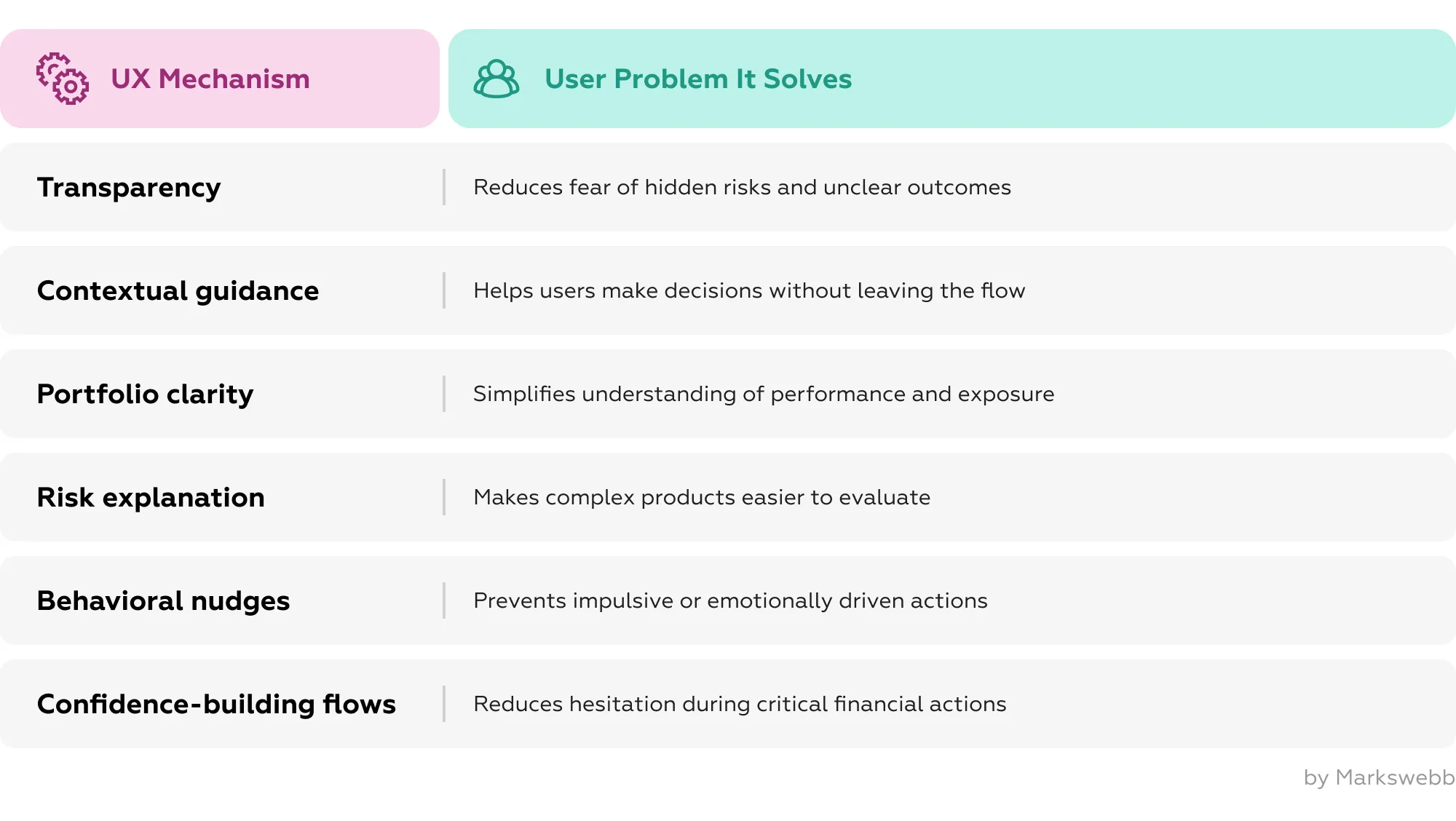
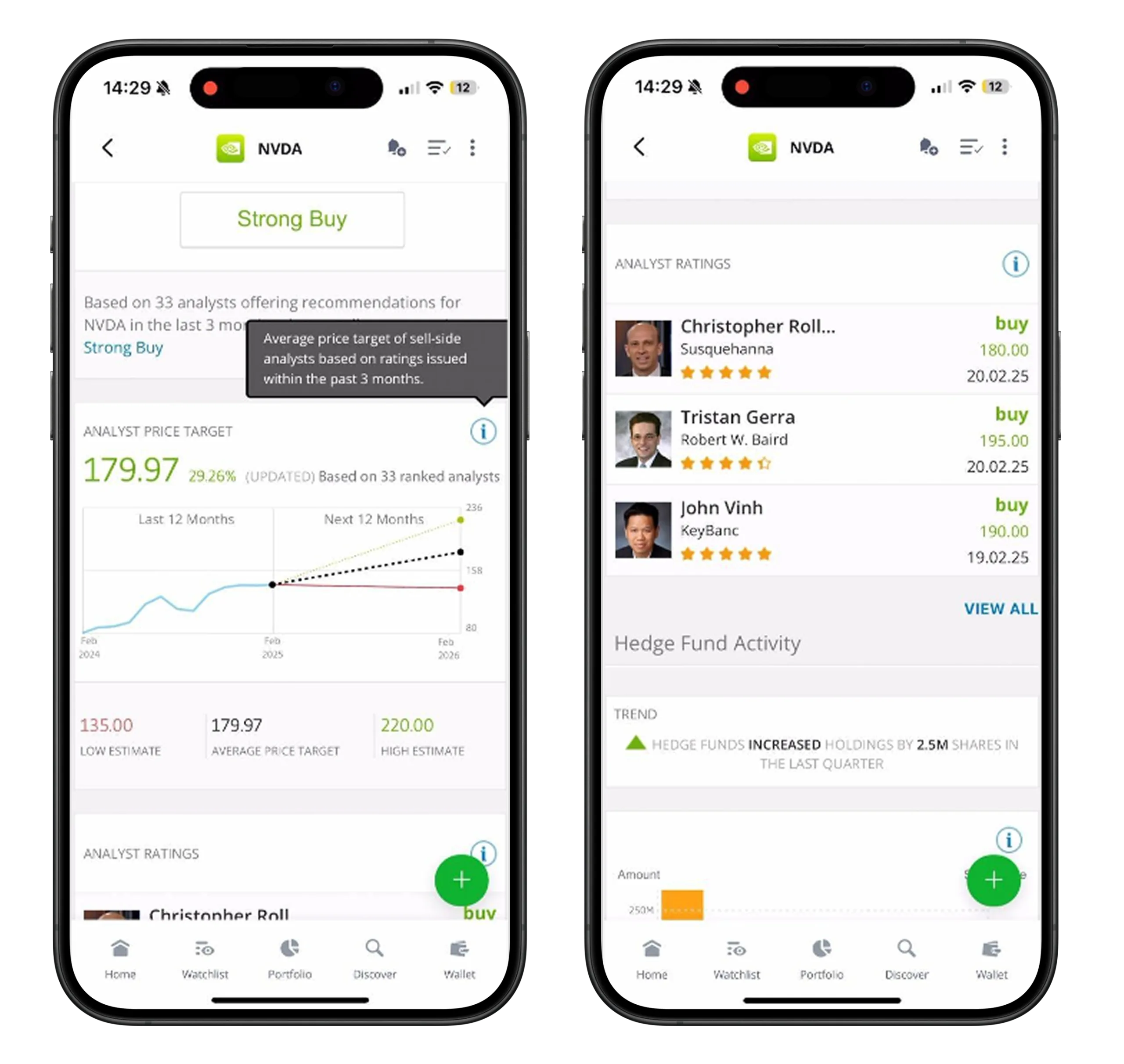
The strongest investment platforms increasingly function as decision-support systems rather than simple transaction interfaces.
Instead of forcing users to interpret financial complexity on their own, modern products explain risks in context, simplify terminology, visualize portfolio exposure more clearly, and guide users through investment decisions step by step.
This becomes especially important during periods of market volatility, when interface quality directly influences user confidence and behavior.
Platforms such as Interactive Brokers, Trading 212, and Scalable Capital increasingly combine execution flows with contextual explanations, portfolio insights, educational layers, and behavioral guidance mechanisms that help reduce emotional friction during investing decisions.
In this environment, UX becomes closely tied to trust. Users are often willing to tolerate market volatility itself, but struggle with uncertainty created by the product experience: unclear portfolio states, unexplained risks, delayed feedback, confusing terminology, or interfaces that fail to support confident decision-making.
Users do not struggle with investing itself — they struggle with products that fail to support decision-making.
The biggest shift in European digital investing is happening outside traditional banking.
Even when users invest through established financial institutions, their expectations are increasingly shaped by crypto apps, neobrokers, and consumer fintech ecosystems. This changes the competitive benchmark for the entire market.
Platforms such as Binance, Coinbase, Trade Republic, and Revolut have normalized interaction standards built around immediacy, responsiveness, and low-friction engagement. As a result, investment apps are no longer compared only with other wealth-management products, but with the best mobile experiences users encounter anywhere in the digital economy.
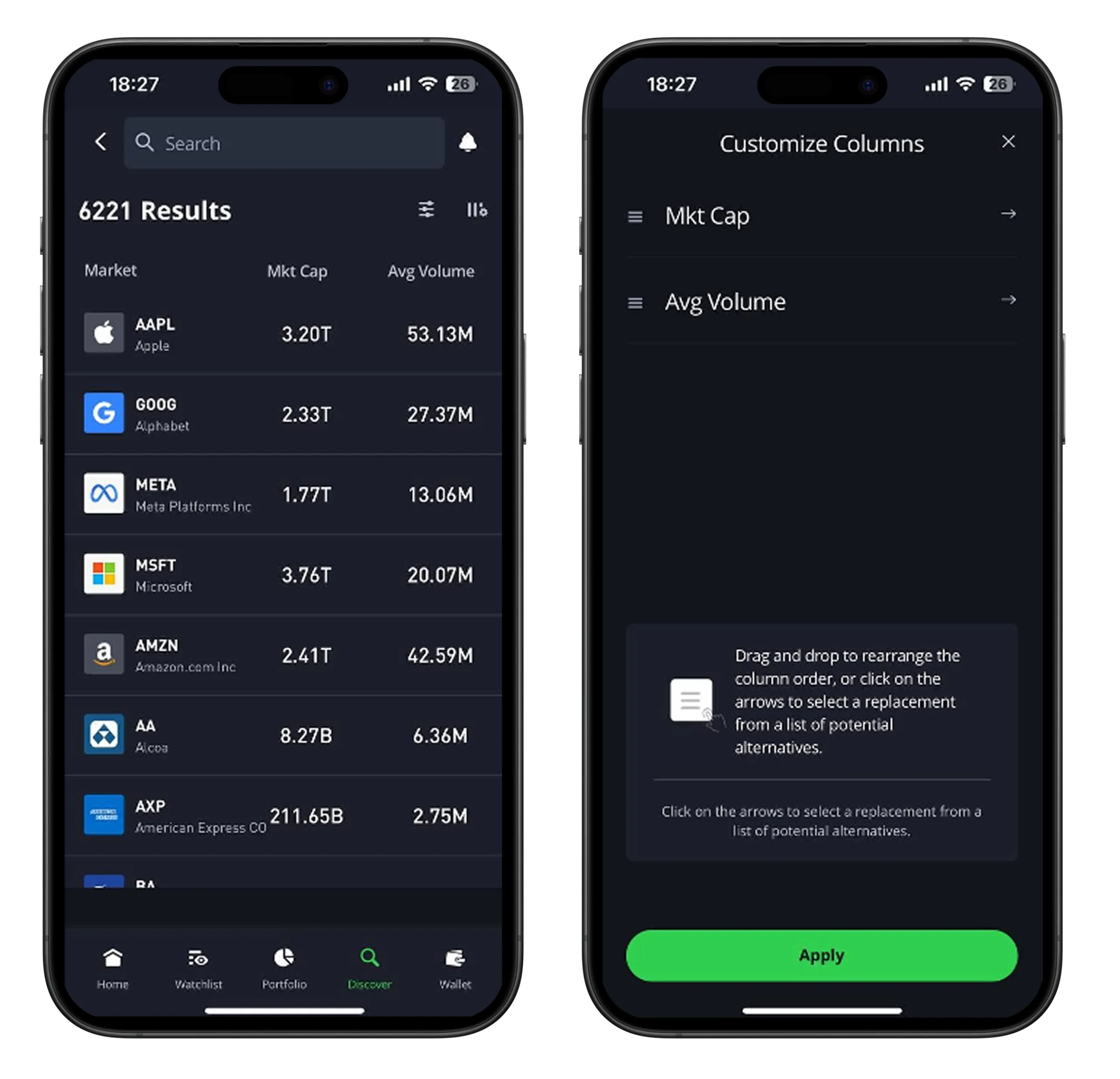
Users increasingly expect onboarding to take minutes instead of days, transaction feedback to appear instantly, and portfolio information to update in real time. Mobile-native navigation and simplified interaction patterns are becoming standard expectations across investing products, especially among younger audiences who treat investing as part of everyday mobile behavior rather than as a separate financial activity.
This creates growing pressure on traditional banks. The problem is often not missing functionality, but perceived usability:
Meanwhile, crypto and neobroker platforms continue optimizing around interaction speed, instant feedback, and responsiveness. Within the research landscape, this shift is reflected in the growing role of crypto ecosystems: more than 30% of analyzed investment services in Europe belong to crypto-related segments, showing that crypto investing has already become a structural part of the European digital investment market.
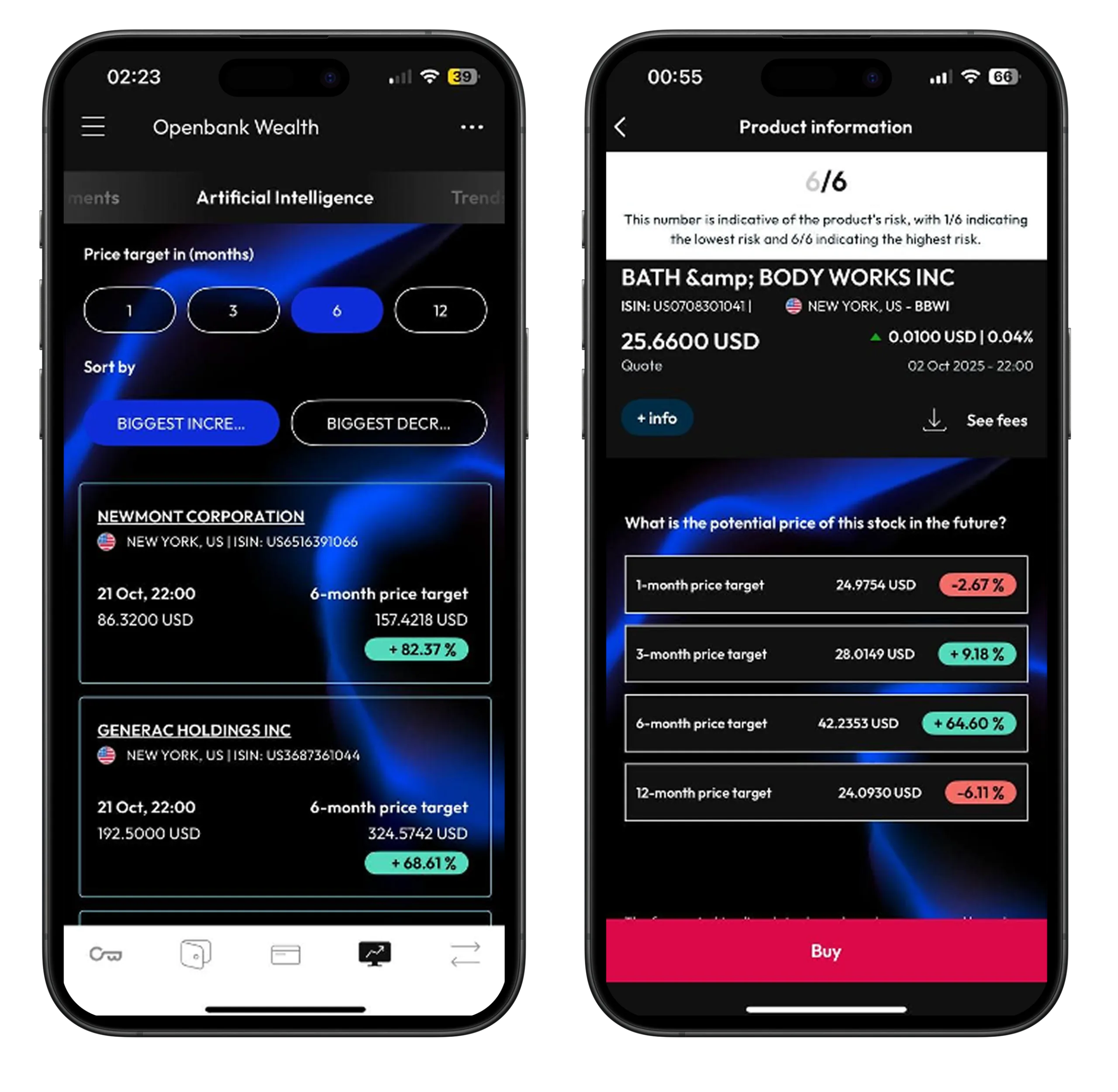
These expectations increasingly spread beyond crypto itself, influencing how users evaluate traditional investing, savings, and wealth-management platforms as well.
As the European investment market matures, growth is becoming harder to achieve through product expansion alone.
Most major platforms already offer similar investment functionality, making UX a key competitive factor. The gap is increasingly defined by how effectively products help users navigate financial decisions with confidence and minimal friction.
In digital investing, even small UX inefficiencies create measurable business impact: confusing onboarding reduces activation, unclear portfolio structures lower engagement, and delayed feedback weakens trust and retention.
As a result, investment app UX now directly influences:
This is especially important in saturated markets like Europe, where feature-based differentiation becomes less sustainable and customer acquisition costs continue to rise.
These market shifts are explored in the upcoming State of Digital Investment in Europe research by Markswebb.
The full research includes:
We also recently published Portrait of the European Investor — an insight exploring how investor behavior differs across European regions and how these differences shape digital product strategy.
In European digital investing, UX is increasingly becoming infrastructure for growth.
We respond to all messages as soon as possible.
We’ve evolved dozens of successful financial services and are eager to prove that our expertise can be implemented in other industries and around the world. Have a look at our success stories!


