
Contents
The market has moved beyond experimentation. AI agents are no longer pilots — they are embedded into onboarding flows, support systems, financial operations, and internal tooling across large enterprises. Agentic UX is becoming a strategic layer of product design, as boards and executives now expect measurable outcomes, not demos.
Within a short time, most major companies implemented AI agents in an attempt to reduce operational costs, increase automation rates, and improve scalability. The business logic was straightforward: automate routine interactions, decrease human workload, and optimize service efficiency.
But post-launch data revealed a different pattern.
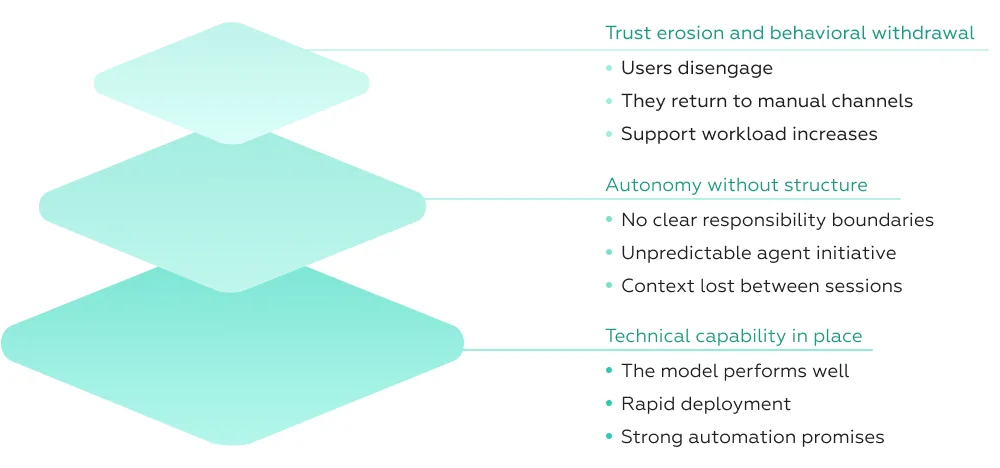
Instead of consistent cost reduction and seamless adoption, many organizations discovered that autonomy introduces complexities they had not anticipated:
Several high-profile companies have publicly acknowledged such challenges. In 2025, Klarna’s aggressive automation strategy backfired, leading to engineers and marketing staff being reassigned to handle customer support calls because the deployed AI agents could not reliably resolve inquiries. This shift marked a significant return to human involvement in frontline service delivery.
Similarly, enterprise software giant Salesforce — after laying off around 4,000 support staff with plans to automate using AI — reported internal trust and reliability issues with large language model-driven tools**. Executives admitted confidence in AI outputs had declined as challenges with complex instructions and model drift became apparent.
Even industry data shows a gap between AI ambitions and reality. A recent report noted that over 70% of organizations acknowledge a disconnect between their AI agent goals and actual outcomes, with trust issues and unclear business value cited as key barriers to scaling autonomous systems.
This is the moment where AI agents lose user trust.
Not because the models are incapable — in many cases they perform well for discrete tasks — but because interaction design, control boundaries, and delegation logic were never fully architected for real-world workflows.
The core issue is structural.
There are no mature, standardized methodologies for designing AI agents as trust-based systems inside real customer journeys. No widely adopted frameworks define:
Without such frameworks, many companies approached implementation as a technical deployment challenge rather than a behavioral systems design problem. They measured success in throughput and accuracy, not in perceived control, clarity, or trust.
Today, the market is no longer asking, “What are AI agents?”
The question has shifted to:
“How do we implement them without killing adoption?”
This shift is precisely what Agentic UX addresses — transforming the conversation from launch metrics to long-term trust and from automation volume to calibrated, experience-centric control.
The real damage does not start with hallucinations.
It starts when users stop relying on the agent.
In our studies of AI agents and chatbots across major banks and enterprise services — including large-scale evaluations within the Chatbot Rank framework and dedicated research into onboarding and mixed-initiative flows — we consistently observed the same pattern: adoption collapses long before technical capability does.
The problem is rarely that the agent “cannot answer.” The problem is that it behaves in ways users cannot anticipate or control.
When we analyzed AI agents in high-stakes financial journeys, several recurring friction points emerged.
First, context fragmentation. Agents frequently failed to inherit session history, user preferences, or previously resolved issues. Users were forced to repeat information or re-explain their intent. In banking environments, where requests often involve sensitive financial details, this repetition significantly reduced trust.
Second, overconfident communication of uncertain outcomes. In our evaluations, we found agents that presented probabilistic suggestions as definitive actions. Instead of signaling uncertainty or offering alternatives, they implied correctness. Users perceived this not as intelligence, but as risk.
Third, unclear delegation boundaries. Many agents initiated actions — such as preparing forms, suggesting transfers, or drafting requests — without clearly distinguishing between recommendation and execution. Users were unsure whether something had already been processed or still required confirmation.
Fourth, weak escalation architecture. In several products studied, escalation to human support was technically available but buried within interaction layers. Users had to “fail” multiple times before reaching a human operator. This created the perception that the system prioritized automation metrics over user resolution.
Across both domestic and international cases reviewed in our projects — including findings summarized in From Chatbot Skeptics to Advocates and Chatbot Rank 2025 — one insight stood out: the strongest-performing agents did not necessarily have the most advanced AI models. They had the clearest interaction contracts.
High-trust implementations shared three characteristics:
This distinction is critical.
In deterministic systems, users tolerate minor errors because responsibility is obvious. The system responds to explicit commands. In autonomous systems, responsibility becomes diffused. When an AI agent acts unexpectedly, the error feels intentional. Emotional impact increases. One poorly communicated action can redefine the entire perception of reliability.
The business implications are measurable. In environments where agentic UX is weak, we observe:
In other words, the organization pays twice: once for building the AI infrastructure, and again for compensating for lost trust.
This is why the conversation must move beyond hallucination rates and model benchmarks. Technical performance is necessary, but not sufficient.
The real question is no longer whether the agent can complete tasks.
It is whether users feel safe delegating those tasks to it.
And that is not a model problem.
It is an Agentic UX problem.
The conversation around AI agents sounds sophisticated. Technical teams debate orchestration layers and evaluation pipelines. Strategy leaders discuss autonomous ecosystems and productivity gains.
But when we moved from theory to real interfaces — analyzing AI agents in financial services and enterprise environments — we found something different.
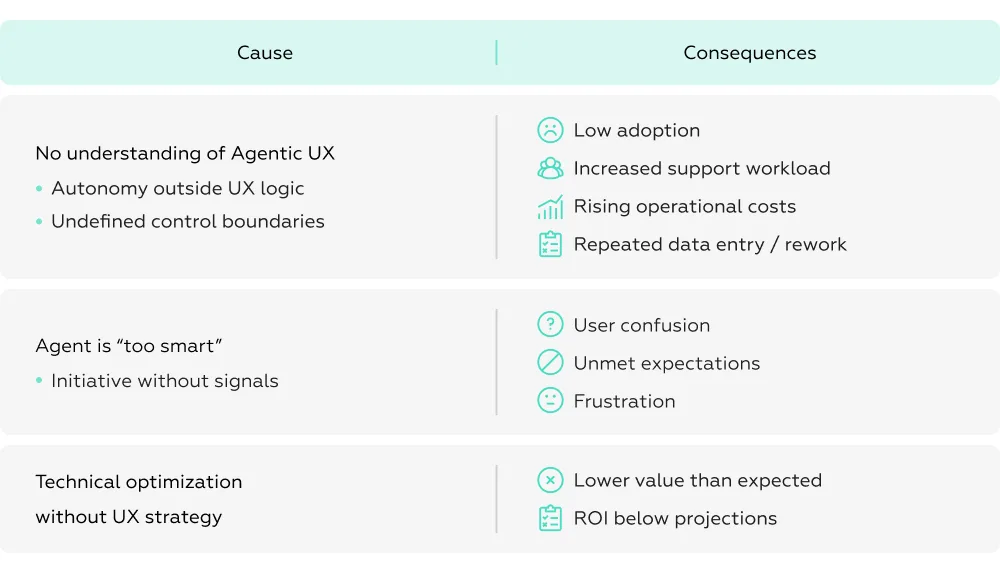
The gap is not conceptual. It is operational.
Across our research — including large-scale evaluations of banking agents and in-depth analysis of onboarding flows — we repeatedly encountered the same structural issues. These are not abstract concerns. They are observable patterns that directly correlate with declining adoption.
First, autonomy is introduced without an interaction contract. Users are not clearly told when the agent is suggesting, when it is preparing, and when it is executing. The system acts, but the boundaries are invisible.
Second, metrics measure throughput and resolution rate — not perceived control. Organizations celebrate automation percentages while ignoring intervention frequency and behavioral withdrawal. Yet in our studies, repeat usage and voluntary delegation proved to be stronger indicators of long-term success than raw task completion.
Third, uncertainty is treated as a backend problem rather than a design decision. Models generate probabilistic outputs, but interfaces present them as deterministic. In high-performing implementations, uncertainty was framed constructively — through options, previews, or confirmation layers. In weaker implementations, it was either hidden or exposed abruptly after failure.
Fourth, mixed-initiative behavior is rarely choreographed. Agents shift between reactive and proactive modes without signaling transitions. Users cannot anticipate when the system will take initiative, which increases cognitive load instead of reducing it.
These are not philosophical concerns. They are practical design failures we documented while studying real products.
The market still discusses AI agents primarily through two lenses: technological capability and strategic potential. What remains underdeveloped is a structured UX discipline that governs how autonomy behaves inside a real customer journey.
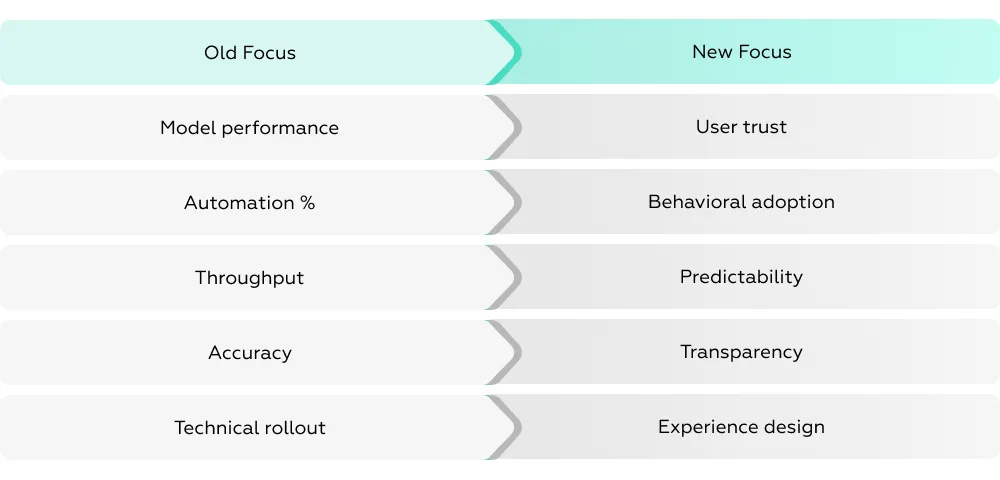
There is no widely adopted framework defining:
As a result, organizations often optimize intelligence before optimizing interaction logic. They expand model capabilities, increase data coverage, and refine prompts — while leaving the experience architecture largely unchanged.
In practice, this creates a paradox: the smarter the agent becomes, the more fragile adoption grows if its autonomy is not designed deliberately.
What is missing is not ambition. It is structure.
And without structure, AI agents remain technically impressive but behaviorally unstable.
Through our recent applied research into early agentic implementations in digital banking and service platforms, we observed a recurring pattern central to Agentic UX: adoption stalls not because the agent fails technically, but because users feel a loss of control at key moments.
Mixed-initiative interaction — where both system and user can initiate actions — is often described as seamless collaboration. In practice, it frequently produces tension. Across usability sessions and scenario-based evaluations, we recorded consistent friction points:
These patterns are not isolated. Similar findings have been reported in studies by research groups at Stanford University and MIT Media Lab exploring mixed-initiative systems and human-AI collaboration. The core issue is not intelligence — it is initiative transparency.
In several evaluated B2B and financial flows, even minor autonomy shifts — such as auto-triggering document generation or adjusting transaction parameters — led users to pause, re-check inputs, or restart the process entirely. Session recordings showed increased verification behavior immediately after unexpected proactive actions. The system was “helping,” yet users switched into defensive mode.
In high-stakes domains like finance, insurance, and enterprise tools, the threshold for perceived intrusion is extremely low. Users need three immediate signals:
When any of these signals are missing, initiative shifts feel like overreach. Trust erosion follows quickly — even if outcomes are technically correct.
Our research indicates that mixed-initiative systems require explicit choreography. Authority cannot drift implicitly between user and agent. It must be staged, signaled, and reversible.
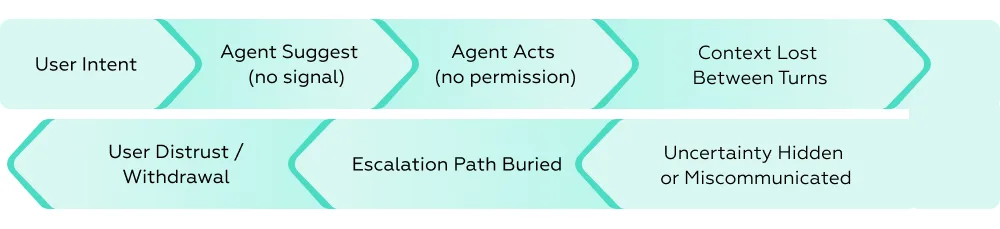
The paradox becomes operational: the more autonomous the system becomes, the more visible its boundaries must be.
Agentic UX is not about limiting autonomy. It is about designing how initiative transitions occur — so collaboration feels structured rather than contested.
To move beyond theory, we analyzed real deployments in banking and enterprise ecosystems where errors carry financial, legal, and reputational consequences.
In our recent project with a major Eastern European bank (PSB), we conducted qualitative and quantitative research with 120+ real users, testing mixed-initiative AI scenarios embedded into financial workflows. In parallel, we studied agent-supported service environments within Philip Morris International, focusing on how AI-driven assistance influences decision-making and compliance-sensitive interactions across international markets.
Across these contexts, the patterns were remarkably consistent.
Users do not primarily react to technical errors. They react to behavioral inconsistency.
When an agent:
trust declines sharply — even if the final outcome is correct.
In the PSB study, we observed measurable increases in verification behavior immediately after unexpected proactive actions. Users rechecked data fields, re-read system messages, or restarted flows. The system’s intelligence triggered defensive interaction.
Participants expected the agent to retain memory across session steps and interaction modes. When context dropped — even partially — users interpreted it as negligence rather than limitation.
In enterprise environments at Philip Morris International, fragmented context between support modules led to repeated clarifications, which users described as “starting from zero again.” In terms of agentic UX, the emotional reaction was disproportionate to the technical fault. What failed was not logic — it was continuity.
We consistently observed anthropomorphization. When an agent behaved unexpectedly, users described it as:
Unexpected autonomy was interpreted as deliberate overreach. This significantly amplifies the emotional cost of small design flaws.
Across high-performing cases, we identified recurring best practices:
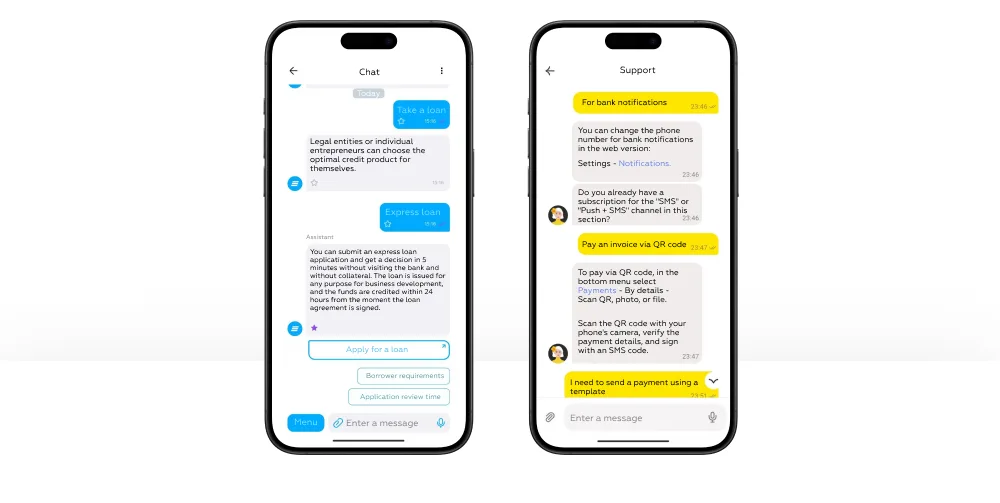
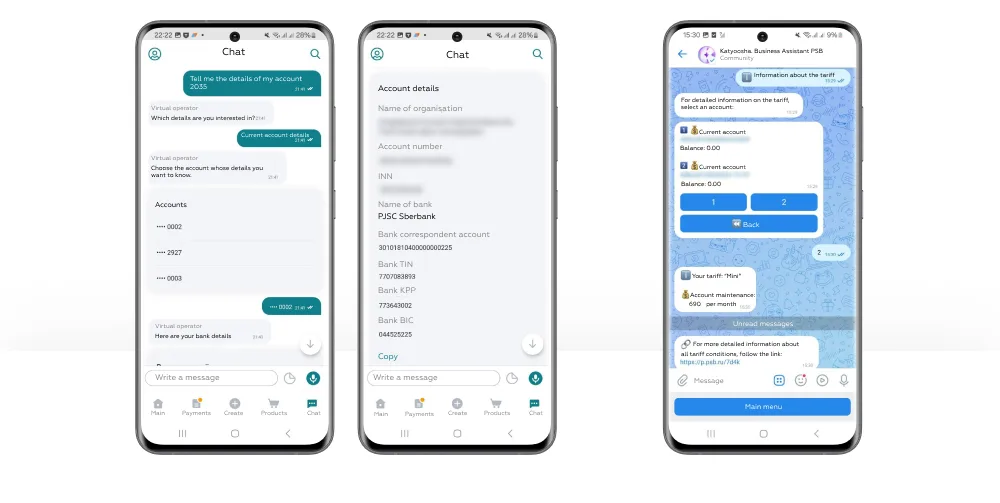
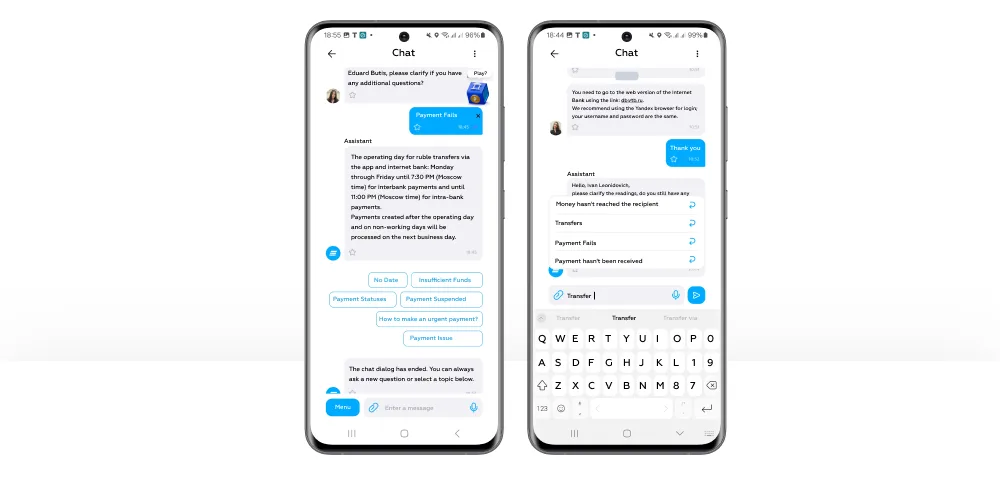

In both banking and enterprise settings, systems that applied these principles showed significantly smoother task completion and lower perceived risk — even when functionality was comparable to less structured competitors.
These findings form the applied foundation of Markswebb’s Agentic UX framework.
They demonstrate that trust in AI agents is not built through intelligence alone. It is built at the intersection of autonomy, transparency, and control — precisely where human expectation meets system initiative.
Designing trust into AI agents requires a deliberate approach to how autonomy is introduced, communicated, and negotiated. Markswebb distilled a framework around three core principles: visibility, control, and progressive autonomy.
Visibility ensures users understand what the agent is doing and why. Microsoft recommends transparent explanation of AI actions, and Google’s A2UI project advocates signaling agent intent clearly.
Control gives users straightforward ways to intervene. Even highly autonomous agents must allow modifications or cancellations, with clear escalation to human support.
Progressive autonomy introduces initiative gradually, starting with guidance and suggestions before enabling full delegation. Users internalize the agent’s patterns, building trust before high-stakes actions.
A practical checklist includes:
By applying these principles, agents become trusted collaborators rather than unpredictable automation.
For more on application in real contexts, see AI agents in practice: why onboarding defines adoption.
Scaling an AI agent successfully is not just about technical performance; it is about user trust. Markswebb identifies four dimensions to assess readiness: predictability, transparency, control, and progressive engagement.
Predictability ensures users can anticipate actions. Transparency clarifies why the agent behaves as it does. Control allows easy intervention. Progressive engagement ramps up autonomy gradually.
Our recommended test: pilot with real users in mixed-initiative scenarios, track engagement and trust metrics, review interface clarity, and iteratively adjust before full rollout. Early verification prevents low adoption, duplicated support costs, and missed strategic opportunities.
Adopting AI agents is no longer a futuristic idea — it is fast becoming a baseline expectation for competitive organizations. However, many companies still underestimate the financial risks of delaying structured Agentic UX design or mischaracterize ROI expectations in their business cases.
Real-world industry data highlights the scale of this disconnect. Recent market research shows that for many organizations, AI initiatives fail to deliver measurable returns: up to 42% of AI agent projects report zero ROI, and 88% of proof-of-concepts never transition into production, with median ROI far below initial targets. Additionally, comprehensive analysis suggests that 73% of agentic AI implementations fail outright, while the minority that succeed can deliver over 300% ROI within 18 months when aligned with a sound methodology.
Beyond adoption failure, there are direct financial consequences of getting Agentic UX wrong or delaying investment:
These figures underline an important truth: costs accrue faster than value if adoption stalls or trust breaks down. Poorly designed agentic experiences not only erode user confidence, they inflate support costs, extend change management timelines, and undermine strategic goals.
On the flip side, organizations that align their AI agent initiatives with robust UX frameworks — including clear autonomy boundaries, progressive delegation, and transparent escalation paths — significantly improve their outcomes. Some enterprises report expected operational cost reductions of 40 % or more once AI agents are integrated into core workflows with trust-centric design. In advanced cases, early adopters achieve rapid ROI payback in under 12 months by focusing on both capability and experience.
This growing gap creates a competitive imperative:
Markswebb has spent years developing a structured methodology that bridges the gap between technical implementation and experiential reliability. By combining insights from real-world deployments, rigorous user research (e.g., PSB banking studies, enterprise agent evaluations), and industry best practices, our framework helps teams reduce wasted cycles, minimize hidden costs, and unlock measurable ROI more quickly.
Now is the time to act. Contact Markswebb to learn how our Agentic UX framework can transform your AI initiatives, increase adoption, and create autonomous systems your users can trust.
We respond to all messages as soon as possible.
We’ve evolved dozens of successful financial services and are eager to prove that our expertise can be implemented in other industries and around the world. Have a look at our success stories!