Know first!
Subscribe to our newsletter

For many banks, chatbots are no longer just a support tool — they are becoming a central entry point into digital customer service. Customers expect chatbots to understand requests in natural language, offer relevant solutions, and execute actions without requiring users to switch to a human operator or search through the app themselves. When the bot fails, the experience feels frustrating and inefficient; when it works well, it becomes a seamless extension of the banking service.
Yet, the maturity of chatbot solutions varies significantly across the market. Some bots operate as simple FAQ engines, while others are evolving into proactive financial assistants capable of predicting needs and initiating support before the user asks.
About the research
Chatbot Rank 2025 is a comparative study of digital experience quality in the chatbots of 10 largest retail banks in one Eastern European country. The selection includes banks with the highest volumes of retail deposits and loans, representing a full spectrum of business models — from mobile-only challengers to traditional banks with extensive branch networks.
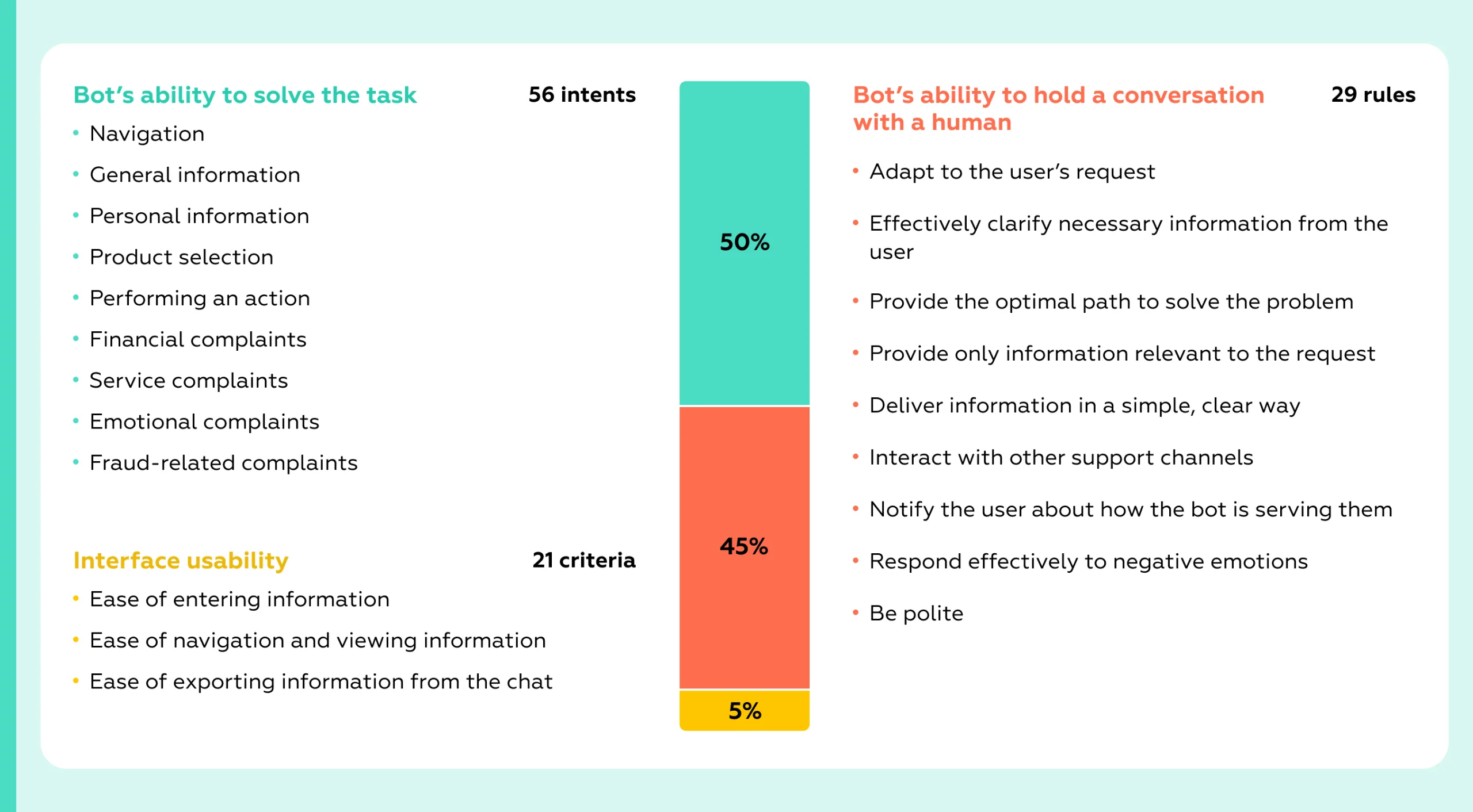
Each chatbot is evaluated using a proprietary Markswebb framework that measures:
These dimensions are operationalized into over 150 binary criteria, ensuring consistent comparison across all banks.
To capture realistic customer behavior, researchers model user scenarios manually, testing how chatbots respond to common and critical situations. In addition, usability tests on real users help validate where friction occurs and what drives successful interaction.
The research focuses on everyday retail customers managing common financial tasks via mobile banking chatbots. These users often seek quick, low-effort solutions: to block a card, clarify a transaction, request account details, or resolve an unexpected issue. When the bot handles these interactions confidently, customers feel supported; when it fails, trust deteriorates quickly.
The study does not evaluate technical backend performance, security systems, or advanced financial product capabilities beyond common everyday banking tasks.
Unlike general reviews of chatbot technologies, Chatbot Rank 2025 provides a structured, scenario-based assessment of how effectively banking chatbots support real customer needs — not only whether a function exists, but how usable and comprehensible it is in context.
The research shows:
This page presents only a portion of the public results; the full set of insights, best practices, and comparative analytics is available in the complete report.
Contents
In this study, all chatbots are evaluated using Markswebb’s proprietary scenario-based assessment system. It does not rely on subjective impressions; instead, it is grounded in a structured set of heuristics that reflect how users interact with chatbots in real situations:
The evaluation system describes both what the chatbot can do and how it communicates:
All criteria in the system are binary (met / not met), which ensures consistent comparison and eliminates subjective scoring.
This allows us to evaluate not only feature presence, but the quality and clarity of interaction.
For Chatbot Rank 2025, the evaluation system includes 150+ criteria structured around typical customer intents — from card and account management to payments, onboarding, and issue resolution.
To ensure that the evaluation reflects real user experience, researchers:
We do not involve end users in scoring the checklist directly: subjective impressions do not reliably reflect functional depth or conversational quality. Instead, we incorporate user feedback separately to understand tone, confidence, and perceived support.
The result is a detailed capability map that shows:
Because the dataset is comprehensive, the full report also includes interpretation and prioritization — helping product teams understand not just what to fix, but why, and in what sequence.
This approach transforms chatbot evaluation from a “feature review” into a strategic development tool. Banks receive actionable insights on:
The strength of the system is its ability to replace assumptions with evidence.
It gives product teams a clear, measurable roadmap — from quick wins to long-term enhancements — while allowing progress to be tracked year-over-year.
Subscribe to our newsletter
The key finding is that conversational banking is evolving unevenly. While some institutions have advanced their chatbots into proactive, context-aware assistants, others remain stuck in FAQ-style scripts that handle only the simplest requests. As a result, the gap in customer experience between leading and lagging chatbots now exceeds 2× in Markswebb scoring, with the most pronounced differences appearing in:
In practice, this means that in some banks, a customer can resolve a time-sensitive issue (e.g., suspected fraudulent charge) within one conversation—quickly, clearly, without leaving the chat. In others, the chatbot fails to interpret the request or responds in vague or circular patterns, pushing the user to call or visit a branch.
Usability tests reveal why:
The business impact is direct:
At the same time, several strong patterns demonstrate that closing the gap is achievable. Leaders in this study rely on consistent dialog structure, context retention, and UI support embedded directly into the conversation interface. These reduce effort, improve confidence, and enable users to complete tasks in chat—even under stress.
The following examples illustrate practical approaches that improve both completion rates and user confidence.
The full report includes 47 best practices and detailed implementation breakdowns.
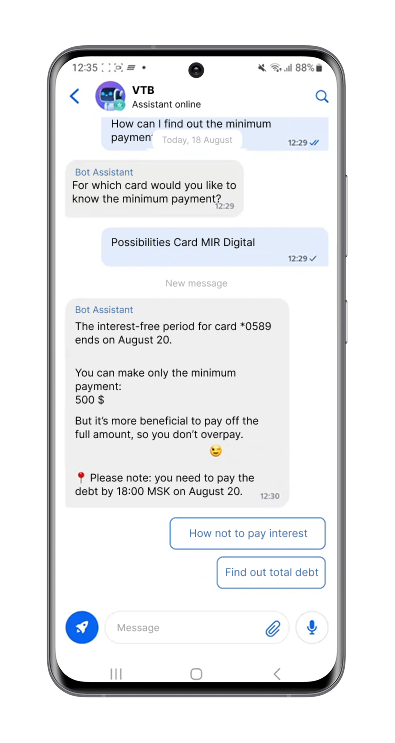
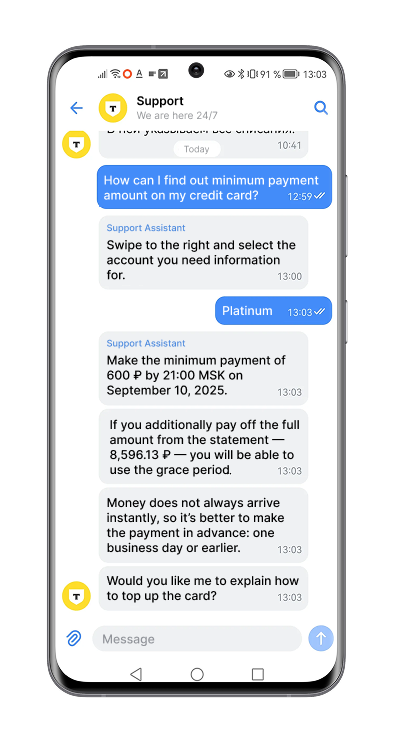
When the bot does not fully understand the request, the leading approach is not to retry the same interpretation or escalate immediately. Instead, the bot:
Why it works:
This avoids failure spirals (“I didn’t get that, please rephrase”) and reduces escalation. Users feel guided rather than blocked.
When customers ask about connected services or subscriptions, advanced bots instantly show all active subscriptions in a single widget and suggest quick actions — enable, disable, check terms, or report a problem.
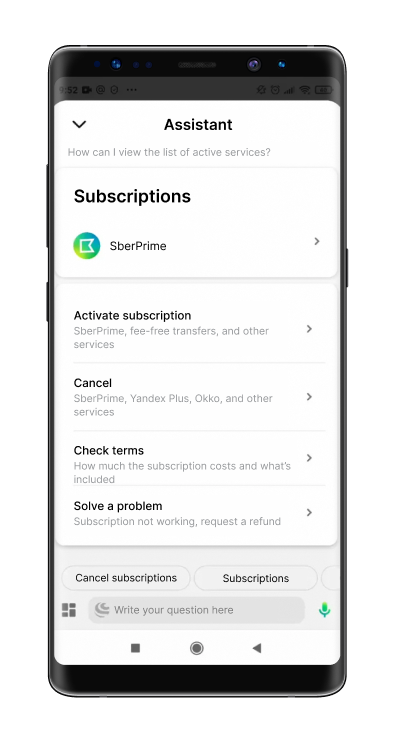
Why it works:
This creates transparency and saves time. Users see everything at a glance and can manage their services without leaving the chat, turning the chatbot into an effective self-service hub.
Some banks are redesigning chatbot interfaces to feel more like familiar messengers. Users can react with emojis, reply to specific messages, save favorites, and view media and history — all inside the same interface.
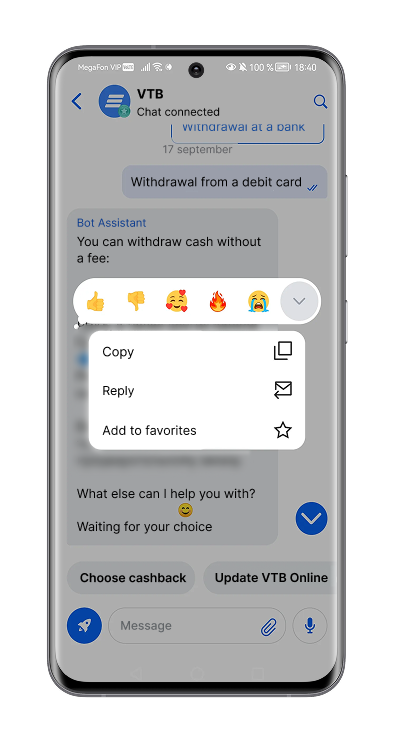
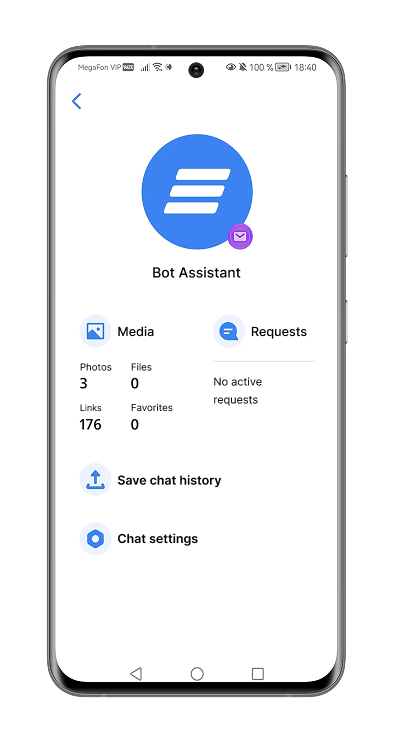
Why it works:
The familiar environment reduces friction and makes interaction more personal. It strengthens emotional engagement and encourages users to treat the chatbot as a natural communication channel rather than a support form.
In the best implementations, chatbots display estimated operator wait times when escalation is needed. For example, “All specialists are busy — expected wait time: 10–15 minutes.” Users can then decide to wait or continue resolving the issue with the bot.
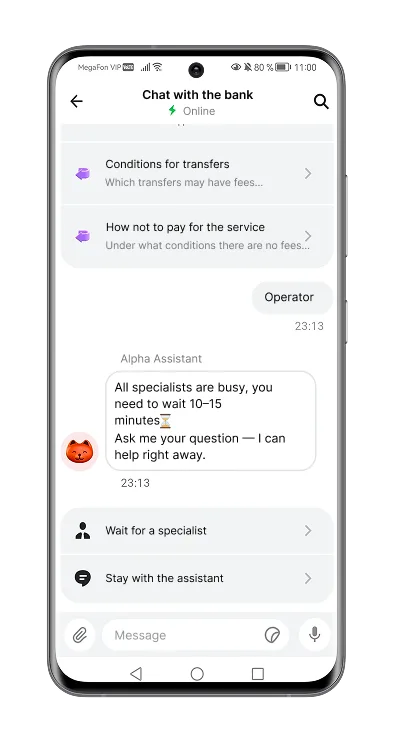
Why it works:
Setting clear expectations eliminates uncertainty, reducing the number of abandoned chats and increasing conversion to resolved cases. Transparency about response time keeps users in control and maintains trust in the channel.
Chatbot Rank 2025 shows that conversational UX maturity remains uneven. A few banks already deliver assistants that recognize intents reliably, complete actions end-to-end, and maintain context; others still behave like searchable FAQs with limited execution and fragile dialog. The gap translates directly into first-contact resolution, automation rate, and user trust.
Markswebb’s evaluation system helps teams to:
Teams that invest in conversational UX—clarifying dialog flows, exposing transparent confirmations, strengthening recovery paths, and embedding actionable UI cues—see measurable gains: higher first-contact resolution, lower escalations, and more confident self-service.
Contact us via WhatsApp, send an email, or fill out the form below to learn more: WhatsApp, Email, Contact form.
We’ve evolved dozens of successful financial services and are eager to prove that our expertise can be implemented in other industries and around the world. Have a look at our success stories!
From research and analysis to strategy and design, we help our clients successfully reach their customers through digital services.