
Contents
Mobile web banking is entering a new stage of maturity. Leading financial institutions are moving beyond the idea that browser-based services should simply replicate native apps. Instead, they are developing both channels in parallel, with a shared focus on usability, accessibility, and consistent customer experience.
The Mobile Web Banking Rank 2026 by Markswebb examines how effectively mobile web applications support everyday financial tasks and more complex banking operations. The study reveals a market where some services have achieved near-parity with native apps, while others continue to struggle with fundamental functionality and usability.
The findings highlight what separates mature mobile web experiences from less developed solutions, which barriers remain specific to the browser environment, and where banks should focus their next investments.
Mobile Web Banking Rank 2026 is the fourth wave of Markswebb's comparative benchmark of mobile web banking experiences. The study covers browser-based banking services for retail customers, with a focus on how effectively users can complete financial tasks on iOS devices.
The assessment is based on two independent evaluation systems:
The methodology combines structured expert assessments with usability testing and interviews, providing both measurable performance indicators and insights into real customer behavior.
Each criterion evaluates a specific functional capability or interface quality. Weighted scores reflect how fully and conveniently users can complete important banking tasks.
The research helps financial institutions identify competitive gaps, prioritize product improvements, and build development strategies informed by measurable customer experience.
The Markswebb evaluation framework measures banking experience through hundreds of weighted binary criteria. Each criterion describes either a capability available to customers or the quality of its implementation.
The 2026 framework includes:
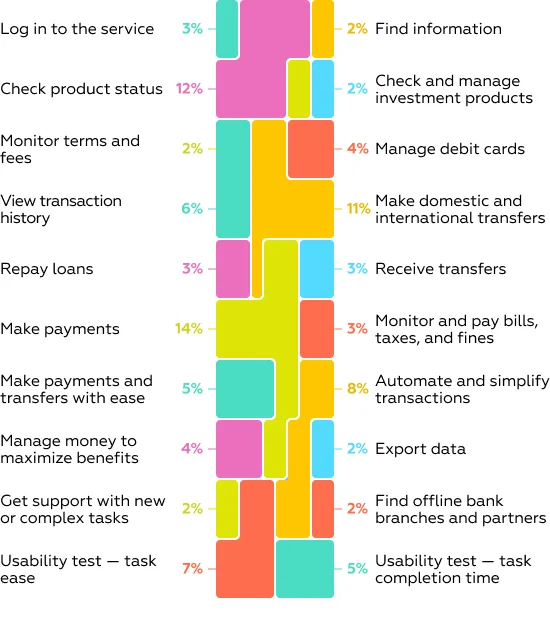
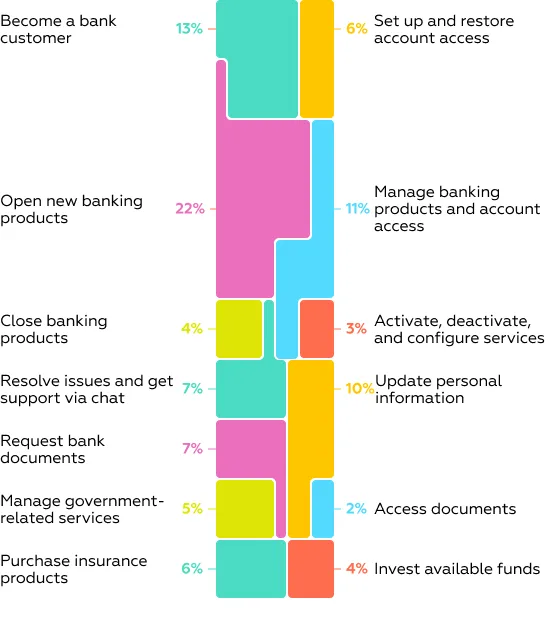
Criteria are weighted according to the importance, frequency, and relevance of the underlying customer needs.
Researchers independently complete banking scenarios, assess the interfaces, and document the results. Usability tests provide additional evidence of actual customer difficulties, while interviews help explain channel preferences and development priorities.
This approach enables banks to move from broad UX observations to specific product decisions: which scenarios require improvement, which barriers cause friction, and where existing market practices offer effective solutions.
One of the most important findings of the 2026 study is a shift in how financial institutions approach mobile web development.
Since 2023, the gap between browser-based and native banking applications has been narrowing. All five banking experts interviewed confirmed a transition toward parallel development of both mobile channels.
For more mature institutions, mobile web banking has become part of a unified digital product strategy.
Importantly, progress is increasingly driven by targeted interface improvements rather than major functional expansion. Smoother transitions, clearer navigation, and better interaction patterns help browser-based services deliver experiences comparable to native applications.
The implication for product teams is significant: mobile web development requires its own UX priorities while remaining aligned with the broader digital banking strategy.
The most advanced banking services demonstrate that browser-based applications can provide a customer experience comparable to native apps.
Among the leading group, mobile web and native applications achieve approximately 80 points in Daily Banking and 90 points in Digital Office on Markswebb's 100-point evaluation scale.
This level of performance indicates that the browser channel can support both routine financial management and complex banking operations.
However, maturity remains uneven across the market.
Less developed services score around 40–47 points, with gaps of up to 11–15 points compared with their native counterparts.
For institutions in the middle of the market, everyday financial functions are becoming more comparable across channels, while Digital Office remains a major development opportunity.
The difference between market segments shows that achieving parity is possible, but it requires consistent investment in functionality, interaction design, and user journey optimization.
Despite significant progress among leading providers, approximately 40% of the market still faces the fundamental challenge of narrowing the gap between mobile web and native applications.
The largest differences are found in complex customer journeys, including:
But gaps also remain in everyday activities such as finding information, repaying loans, and checking service fees.
These limitations affect customers' ability to complete essential tasks independently.
For banks with less mature mobile web services, improving the fundamentals remains the most effective starting point: clearer navigation, more accessible information, and complete support for frequently used scenarios.
Functional parity does not automatically guarantee a comparable customer experience.
The study identified 11 recurring usability problems specific to mobile web applications on iOS, including:
Several of these problems have persisted across multiple research waves.
Performance is particularly important. Users frequently perceive native applications as faster and more predictable, while mobile web services may require additional waiting or repeated actions.
For mature banking services, addressing these issues can be as important as introducing new capabilities.
Browser-based banking applications face platform constraints that native apps can handle more easily.
These include restricted access to certain device capabilities, limitations around push notifications, and repeated requests for permissions.
Camera and location permissions illustrate the problem.
In a native application, customers can generally grant access once and continue using the relevant functionality. In a browser-based service, permissions may need to be confirmed again after a session ends.
This creates additional steps and interrupts otherwise straightforward journeys.
The 2026 findings suggest that overcoming platform limitations requires carefully designed alternatives, optimized input methods, and consistent interaction patterns.
The priority is to reduce the effort required to complete a task, even when technical constraints cannot be fully eliminated.
Although leading mobile web applications are approaching native-app parity, there is still room for substantial improvement.
The leading group's average scores are:
The remaining gap represents opportunities to expand scenario coverage, improve usability, and support customers with different products, needs, and behavioral patterns.
The longer-term goal is to approach a comprehensive digital benchmark: a banking service where customers can independently complete almost any relevant task through a convenient and consistent interface.
For less mature services, this journey begins with essential functionality. For leaders, it increasingly involves refining advanced scenarios and removing friction from the customer experience.
The 2026 study highlights practical interface solutions that help banks improve accessibility, task completion, and customer confidence.
Effective onboarding supports both first-time customers and existing users exploring unfamiliar features.
Leading implementations combine contextual tips, interactive labels, informational banners, and short educational content.
These elements help customers understand available functionality without navigating extensive help sections.
For product teams, onboarding is an opportunity to increase feature discovery and encourage the adoption of valuable digital services.
A well-designed search experience gives customers direct access to relevant features instead of requiring them to navigate multiple menu levels.
Advanced solutions include popular searches, query suggestions, search history, and voice assistance.
These capabilities shorten the path to the desired action and make complex banking interfaces easier to navigate.
Search becomes particularly valuable as digital services expand and the number of available products and operations increases.
Signing in is one of the most important customer journeys in mobile web banking.
Effective implementations minimize the number of required credentials and support convenient data entry, including camera-assisted card number recognition.
Providing access to customer support before authentication is another valuable practice, particularly when users experience difficulties recovering access.
By simplifying entry, banks can reduce unnecessary steps and make the browser channel more accessible.
Customers need clear and convenient access to product terms, fees, and service conditions.
When essential information is available only in lengthy PDF documents or buried inside complex menus, users must spend additional time finding answers.
More effective implementations organize key product information directly within the interface, making it accessible through simple navigation.
This improves transparency and allows customers to understand and manage their financial products with less effort.
The research identifies three distinct development priorities depending on the maturity of the service.
For less mature mobile web applications, the immediate objective is to close fundamental gaps in functionality and usability. Authentication, navigation, product access, and information availability should be addressed first.
For developing services, the focus shifts toward expanding Digital Office capabilities and improving the consistency of experience across browser and native channels.
For market leaders, the opportunity lies in eliminating browser-specific friction, refining advanced customer journeys, and approaching a comprehensive digital self-service benchmark.
Across all maturity levels, the findings reinforce the value of structured UX measurement. Comparing specific scenarios and identifying proven interface solutions allows financial institutions to prioritize improvements with greater precision.
Mobile Web Banking Rank 2026 demonstrates a meaningful transition in digital banking development.
Leading services have shown that browser-based banking can achieve a level of maturity comparable to native applications. At the same time, persistent usability problems, platform constraints, and incomplete customer journeys continue to create substantial differences across the market.
The next stage of development will depend on how effectively banks combine functional completeness with reliable performance, intuitive navigation, and seamless customer journeys.
For financial institutions, mobile web banking is becoming an increasingly important component of a unified digital experience. Its maturity should be evaluated through the same lens as any other primary customer channel: the ability to help users complete their tasks efficiently and independently.
The Markswebb study provides insights into mobile web banking trends, key UX challenges, and best practices for improving digital customer experience.
Explore the findings to understand how mobile web banking is evolving, what distinguishes market leaders, and which opportunities can help financial institutions improve their digital services.
Discover the key findings and practical insights from Mobile Web Banking Rank 2026.
We’ve evolved dozens of successful financial services and are eager to prove that our expertise can be implemented in other industries and around the world. Have a look at our success stories!
From research and analysis to strategy and design, we help our clients successfully reach their customers through digital services.