
Premium banking customer experience depends on service quality, personalization, and trust. For banks, understanding the needs and behavior of affluent clients is critical for influencing key business metrics — engagement frequency, share of wallet, customer loyalty, and long-term client value. To explore these questions, one of the leading banks in Eastern Europe partnered with Markswebb to conduct research into the expectations and behavior patterns of affluent Premium and Private Banking clients. The goal was to reassess the existing service approach and validate new value proposition ideas before implementation.
In this case study, we explain how Markswebb researched premium banking customer experience through in-depth interviews and identified what affluent clients expect from modern financial services.
Contents
The bank approached Markswebb to gain a deeper understanding of premium banking customer experience and the behavior of Premium and Private Banking clients, in order to design more relevant services and reduce the risks associated with product decisions.
The research helped uncover:
“It was important for us to understand which of the planned initiatives would create the most value for our premium clients. Even though we know this market well, we hoped the research would uncover new perspectives. As a result, some of our product hypotheses were confirmed and moved into implementation, while others were refined based on user feedback,” — Head of Premium Banking Development, one of the leading Eastern European banks.
The research provided the bank with a practical framework for improving premium banking customer experience — from product mechanics and service design to long-term relationship strategies for affluent customers.
The research helped reduce the risks associated with launching new initiatives by validating ideas against real customer behavior and expectations before implementation. The insights became a strategic foundation for designing services aligned with the logic, priorities, and decision-making patterns of affluent clients.
The findings showed how improvements in premium banking customer experience could help increase share of wallet, grow assets under management, and improve customer engagement by focusing investments on solutions with proven relevance for the premium audience.
To understand premium banking customer experience from the client’s perspective, we began by studying the broader financial context of affluent customers through in-depth interviews with Premium and Private Banking clients. The goal was to understand their financial lives through real-world scenarios: how they choose banks, distribute financial activities across providers, and make decisions about everyday banking, investments, and wealth management.
Recruiting participants was one of the key challenges of the project. Affluent clients are typically a highly private audience that is less willing to openly discuss personal financial behavior, making trust and communication especially important during the research process. For this reason, it was essential to analyze not only relationships with a single bank, but the customer’s entire financial ecosystem and behavior model.
The research sample included:
— Premium and Private Banking clients from the partner bank as well as competing financial institutions;
— respondents from different cities across Eastern Europe;
— users with different financial strategies, ranging from daily spending and lifestyle banking to wealth management, investing, and premium privilege usage.
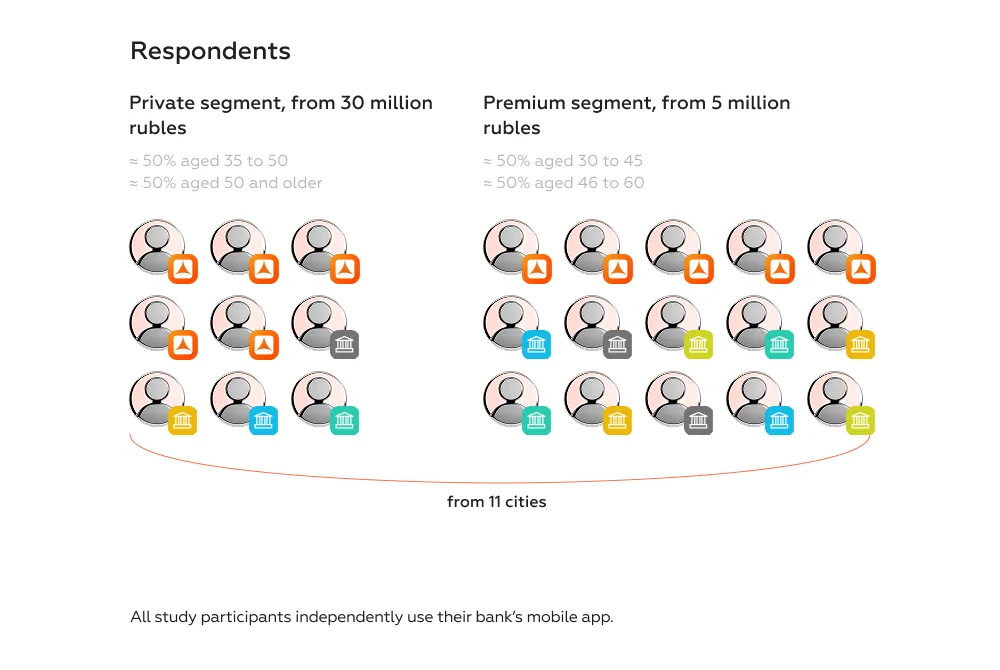
The first stage of the research focused on understanding how affluent clients already operate within the banking ecosystem and how premium banking services fit into their everyday financial behavior. We explored their current experience through real actions and scenarios, including:
— which banking operations they perform most frequently;
— which financial products they use and across which banks;
— which tasks they prefer to handle independently and which they delegate to advisors or managers;
— which service elements increase loyalty and keep them engaged with a bank;
— which situations create frustration and lead clients to reconsider or switch providers.
During the interviews, we asked participants to:
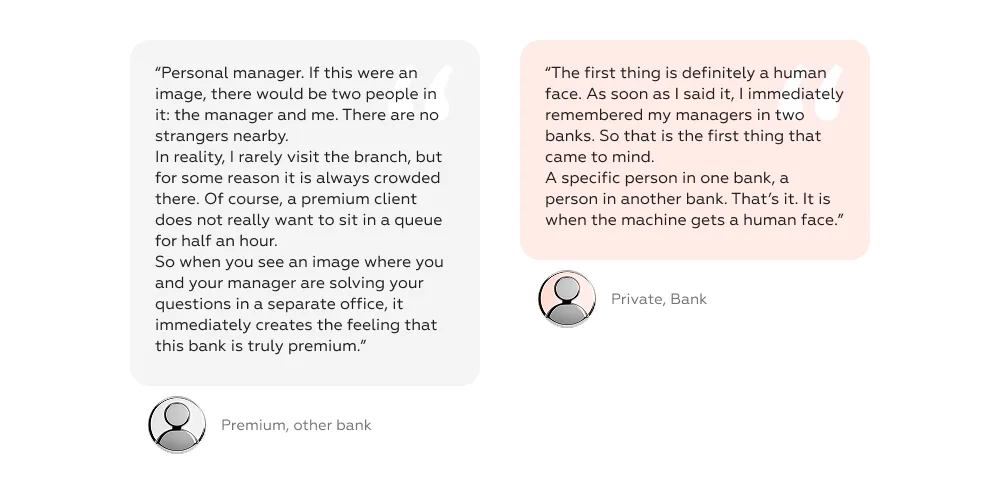
These conversations helped us build a detailed map of customer expectations and understand which characteristics affluent clients associate with a truly premium financial experience.
One of the key findings was that, for many participants, traditional status markers mattered less than practical factors such as feeling in control of their finances, having seamless service interactions, and trusting that the bank could quickly resolve any issue when needed.
We also explored the role of digital channels in premium banking customer experience, since affluent customers increasingly use mobile banking as the primary point of everyday interaction with the bank. For affluent customers, digital channels increasingly become the primary point of interaction with the bank in everyday scenarios and strongly influence the perception of service quality — including how quickly tasks are completed, how much control clients feel they have, and whether additional effort is required from them.
In this part of the research, we explored:
— how clients use mobile banking applications;
— which digital features they consider a basic expectation rather than a competitive advantage;
— where frustration and friction appear in digital journeys;
— which factors make a premium digital banking experience stand out.
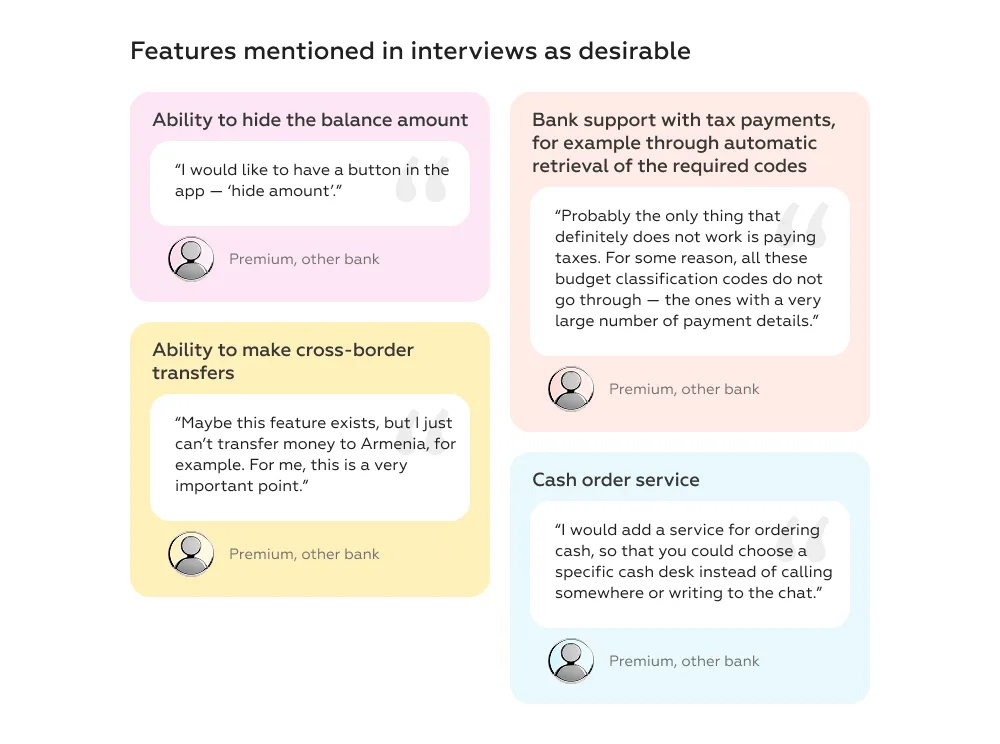
This allowed us to establish an important baseline: not how banks describe premium service internally, but how affluent clients actually perceive and experience it in practice.
The research helped uncover key behavioral patterns among affluent banking clients, identify what truly matters to them, and better understand how Premium and Private Banking audiences differ in their expectations and financial behavior.
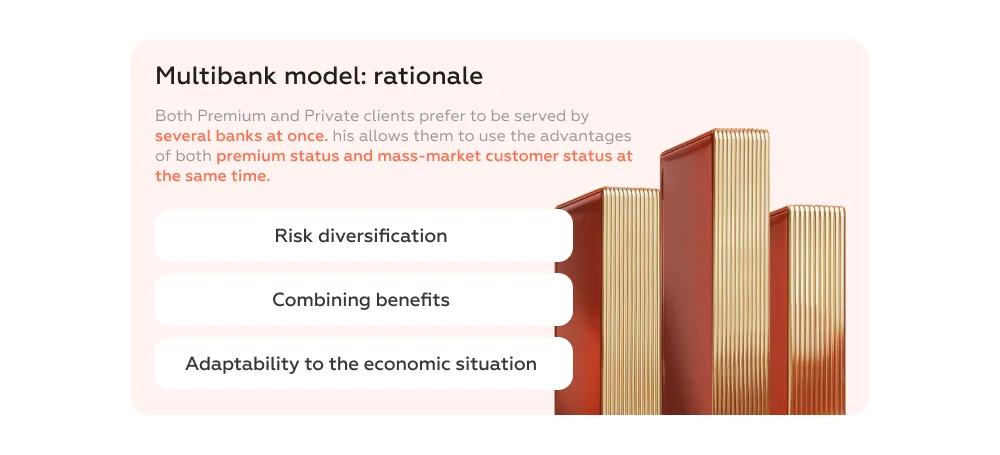
For Premium and Private Banking customers, using multiple banks simultaneously is the norm rather than the exception. The same client may hold premium status in one bank while relying on mass-market products from another provider for specific tasks.
In this model, a bank is not perceived as a single “main choice,” but rather as part of a broader personal financial system where each provider serves a different role: daily banking, investing, wealth preservation, international transactions, or lifestyle privileges.
As a result, banks are not competing for the customer as a whole, but for individual financial scenarios — and they win where they solve a specific task better than others. Increasing customer share therefore depends on becoming the preferred tool within at least one important area of the client’s financial life.
For Private Banking clients, the bank is perceived as a long-term strategic partner. This audience values trust, stability, and personalized support, with the relationship often centered around a dedicated manager as the primary point of contact.
For Premium Banking clients, the bank is seen more as an efficient service platform. Expectations are built around convenience, speed, flexibility, and immediate value, while loyalty remains more fluid and transactional.
This distinction requires fundamentally different product and service strategies:
This segmentation helps banks develop more precise service models without overcomplicating the Premium experience while still investing sufficiently in personalization and relationship management for Private Banking clients.
Once the research team mapped customer behavior patterns and key expectations, the next stage focused on testing specific concepts that could strengthen the bank’s future premium banking customer experience.
The objective was to understand how affluent customers would react to concrete product ideas before implementation. This approach helps reduce the risks of investing in weak or misaligned concepts, avoid negative effects on engagement and conversion, and focus resources on mechanisms with the strongest potential impact on customer activity, transaction volume, and retention.
The research explored:
— how customers perceived the proposed ideas;
— which concepts strengthened the perception of premium service;
— which ideas required refinement or repositioning.
While the first phase helped explain customer motivations, expectations, and frustrations, this stage provided direct feedback on actual product concepts.
One of the hypotheses explored by the bank was a premium family and children’s club — a service concept connected to financial education, family banking scenarios, and involving children in financial life. Below is an example of the insights generated around this concept.
The purpose of this part of the research was to understand whether a family-oriented concept could genuinely strengthen premium banking services CX — and which factors would determine its success.
The findings showed that customers perceived the idea as potentially valuable, but within a much broader context than traditional “children’s financial education.”
The key insight was that family-related scenarios remain one of the least developed loyalty drivers in premium banking.
For affluent clients, family finance is not an additional feature — it is a central part of their financial life that current banking services often fail to support properly.
At the same time, the value of family-focused services differs across segments:
— for Private Banking clients, family banking is connected to long-term wealth management: transferring assets, involving children in financial decision-making, and building financial responsibility across generations;
— for Premium Banking clients, the focus is more practical: simplifying everyday family financial management and integrating children into daily financial activities.
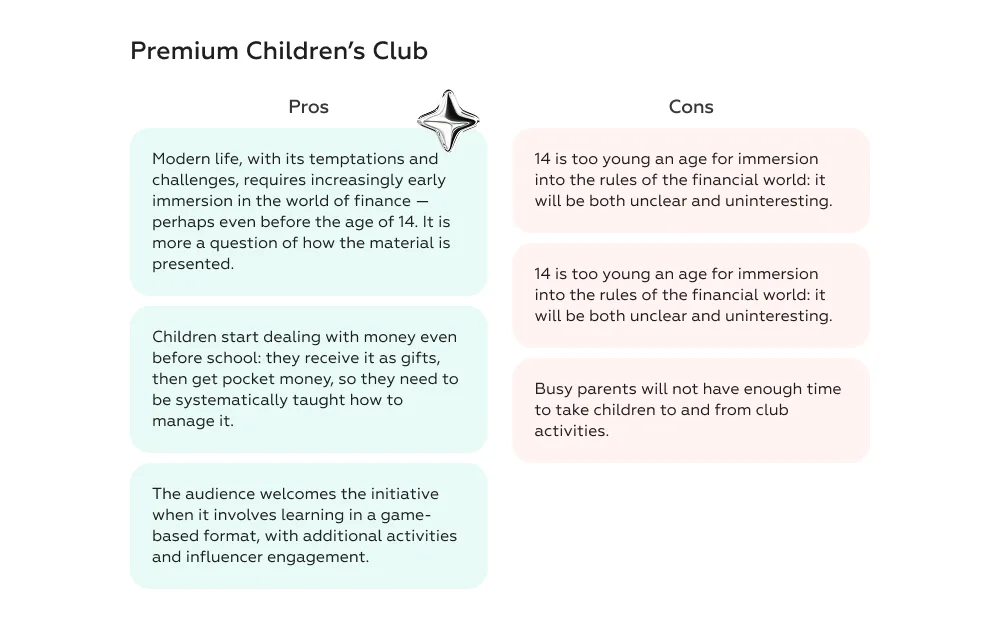
The interviews also revealed an important limitation: customers were skeptical toward abstract “financial education” concepts, especially when disconnected from real-life situations.
The value emerged elsewhere:
— when children participate in real financial processes such as spending, saving, or setting goals;
— when families gain tools for collaborative money management;
— when services help build financial habits and behavior instead of simply delivering educational content.
Within this logic, a family-oriented club can become part of a premium banking proposition not as a standalone educational product, but as a service embedded into the everyday financial life of the family.
As a result, family-related scenarios should not be viewed as an optional premium add-on, but as a separate strategic direction capable of strengthening loyalty, engagement depth, and long-term relationships with affluent customers.
Based on all stages of the Premium and Private Banking research — from behavioral analysis to concept validation — we developed a comprehensive premium service model that reflects not only customer expectations, but also the real-life financial scenarios and interaction patterns of affluent clients.
The framework was structured into seven interconnected blocks, covering everything from core service principles to digital experience requirements and personalization strategies.
Each block combined several layers of analysis:
— behavioral observations and recurring patterns;
— interpretation of why customers behave this way;
— practical conclusions that can be directly translated into product and service decisions.
Below are the seven strategic blocks delivered to the client. The first two include examples of how customer insights were transformed into concrete product and service principles.
The research provided the bank not with abstract recommendations, but with a practical decision-making framework directly connected to business growth objectives. Approximately 70% of Markswebb’s recommendations were incorporated into product and service development initiatives.
The insights immediately influenced several strategic directions within the bank’s premium segment team:
This case demonstrates how premium banking customer experience research can reduce product uncertainty and help financial institutions make more informed, data-driven decisions about service development.
Through in-depth interviews and expert analysis, the bank was able to:
— identify new growth opportunities;
— validate ideas before implementation and reduce investment risks;
— focus on solutions that directly influence engagement, transaction activity, and customer loyalty.
As a result, the bank received a strategic roadmap and a data-driven foundation for developing its premium banking proposition, where every major decision was validated against real customer behavior and linked to measurable business outcomes.
If you want to better understand the needs of your Premium and Private Banking clients, validate new service concepts before launch, and build a premium proposition grounded in real customer behavior — reach out to us on WhatsApp or send us an email, and we’ll help you define the right research approach.
Every year we conduct up to 15 studies of digital services. These are industry benchmarks that reflect the state of the market and trends.