Mobile banking markets across Central Asia are developing at different speeds. To stay competitive, banks need more than an internal view of their digital products: they need objective benchmarks, relevant international references, and a clear understanding of how well their apps support real customer needs.
As part of its digital transformation strategy, Bank of Asia commissioned an independent mobile banking UX audit based on the Markswebb Mobile Banking Rank methodology. The evaluation framework was adapted to the Kyrgyz market and the bank’s product priorities.
The project helped the team assess the current maturity of its mobile app, identify opportunities to improve customer experience, and define a structured roadmap for further development.
Contents
The bank needed to understand how its mobile app compared not only with local competitors, but also with more mature digital banking services in neighboring markets.
The project focused on several business objectives:
The goal was not simply to create a list of UX issues. The mobile banking UX audit had to show which improvements could have the greatest impact on customer activity, product conversion, and operational efficiency.
The project delivered a comprehensive view of the app’s current performance and its development potential.
Markswebb:
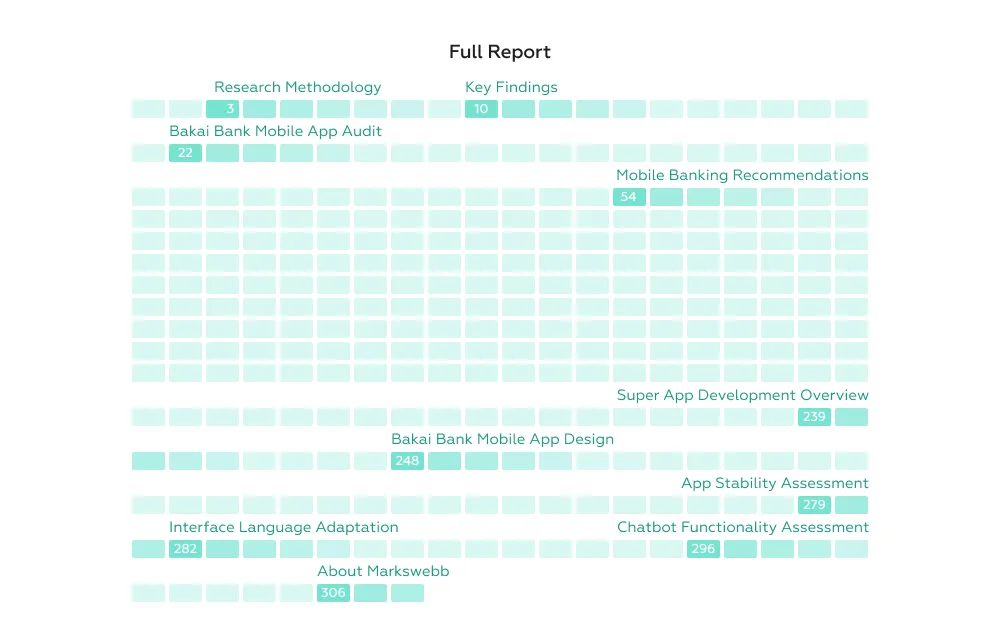
The bank received a structured foundation for prioritizing its digital roadmap based on objective evidence rather than isolated market examples or internal assumptions.
Markswebb has an established framework for evaluating digital banking services. However, the value of the methodology lies not in applying a fixed checklist, but in adapting it to a specific market, customer segment, product, and business objective.
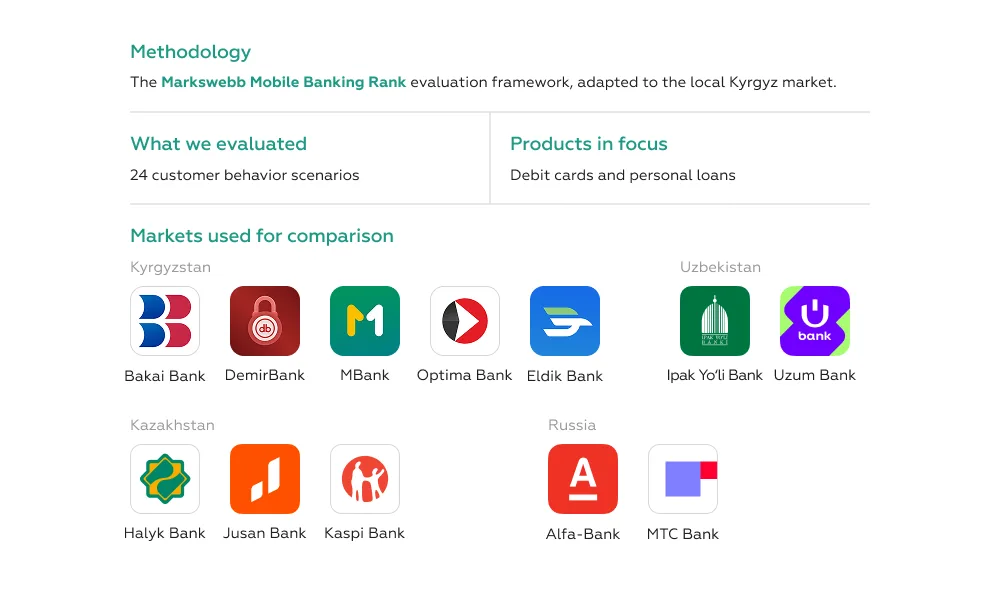
For this project, the Mobile Banking Rank framework was adjusted to reflect:
The evaluation focused on debit cards and personal loans. The benchmarking perimeter included major digital banking services from Kyrgyzstan and selected market leaders from Kazakhstan, Uzbekistan, and other markets with relevant mobile banking practices.
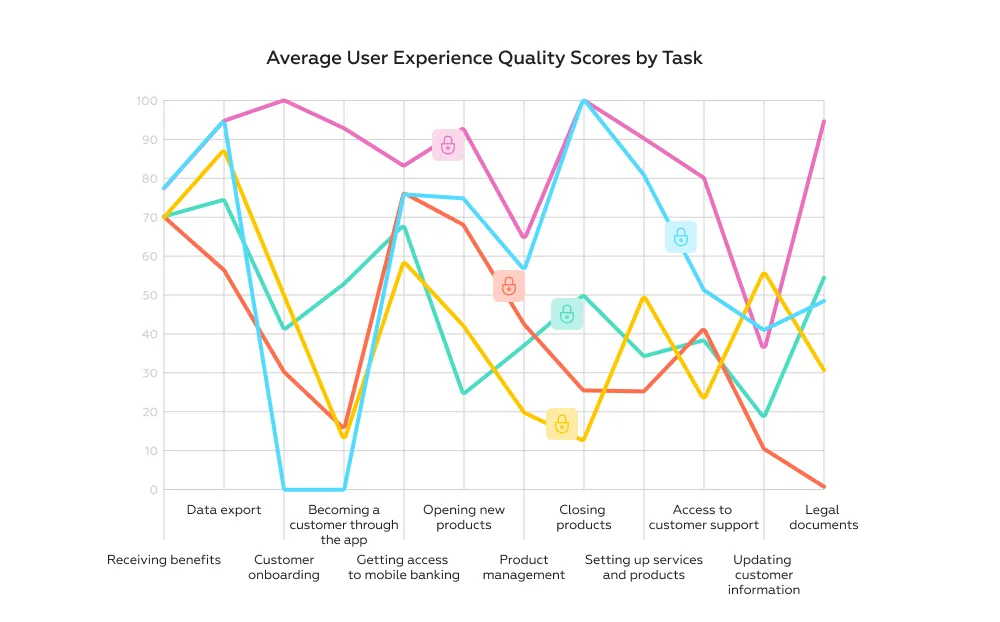
The project team also reassessed the weight of different customer tasks. This ensured that the final score reflected their actual importance to the customer experience rather than treating all app functions as equally significant.
A function can exist in an app and still be difficult to use. For this reason, the evaluation measured not only feature availability but also the quality of the complete customer journey.
Researchers obtained access to banking products, opened debit cards and loans, completed offline and digital operations, made payments and transfers, created templates, and enabled notifications.
Experts then worked through real-life scenarios in each app. They analyzed interfaces, documented usability barriers, and used supporting sources such as help materials, product pages, instructions, and contact center interactions.
The results were recorded in detailed checklists and analyzed using the adapted scoring system.
This approach allowed the mobile banking UX audit to reveal where customers could complete a task, where they might encounter friction, and how the experience compared with relevant market leaders.
The research highlighted three areas in which mobile banking improvements could contribute directly to business performance.
The evaluation confirmed that Bank of Asia had established a strong foundation in payments and transfers. At the same time, it identified further opportunities to make frequent operations faster and more convenient.
The priority development areas included:
These improvements can reduce the number of actions required for routine tasks and give customers stronger reasons to use the app as their primary banking channel.
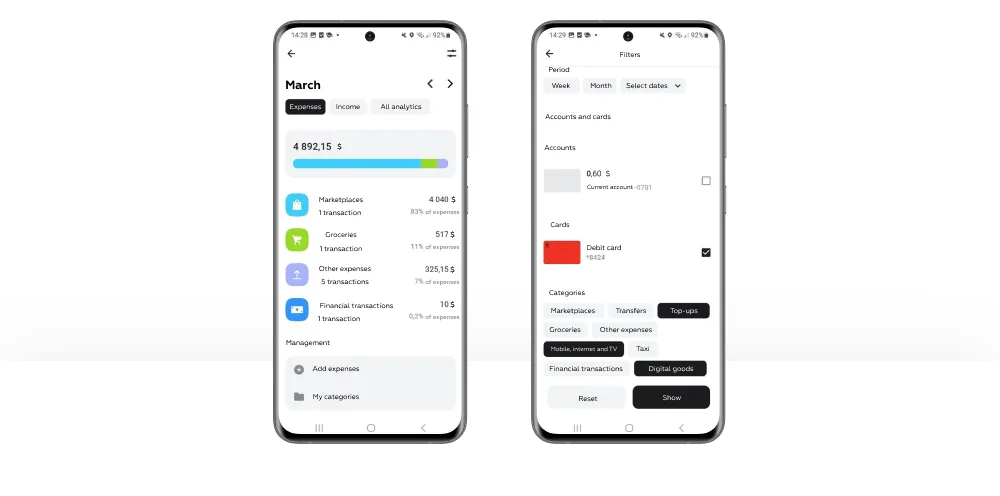
For example, a more advanced transaction history can help users filter expenses, understand spending patterns, find specific operations, and view financial activity across products. Instead of serving only as an archive, transaction history becomes a financial management tool.
When customers cannot quickly understand the terms of a card, loan, or other banking product, they may postpone the decision, contact support, visit a branch, or compare offers elsewhere.
This weakens the conversion potential of the mobile channel.
The research showed that banks can strengthen digital sales by improving journeys before registration and before the customer starts an application.
Relevant practices include:
With these capabilities, a mobile app can evolve from a service channel for existing customers into a complete acquisition and sales channel.
The mobile banking UX audit therefore examined not only transactional scenarios but also how effectively the app supported product discovery and decision-making.
One of the major trends in digital banking is enabling customers to complete as many tasks as possible without visiting a branch or contacting a call center.
The more issues customers can resolve independently, the more valuable the mobile app becomes. At the same time, the bank can reduce pressure on assisted and offline channels.
The audit paid particular attention to scenarios in which users need transparency, control, and clear next steps.
The recommendations included:
These practices help customers complete more journeys independently and reduce avoidable support requests.
A traditional interface review may reveal individual usability problems. A scenario-based benchmark provides a broader view: it connects those problems with customer needs, competitive gaps, and business priorities.
For Bank of Asia, the project resulted in 11 strategic development areas and a structured collection of international best practices that could be evaluated for implementation.
The findings helped the team distinguish between:
This made it possible to approach the product roadmap systematically rather than treating each UX issue as an isolated design task.
Digital banking maturity differs significantly between markets. Practices that work in one country cannot always be transferred directly to another because customer habits, payment infrastructure, regulation, product penetration, and competitive conditions vary.
An effective mobile banking UX audit must therefore combine a consistent evaluation methodology with local adaptation.
For the bank, this means that the research reflects:
This balance makes international benchmarking practical. Instead of copying individual features, product teams can understand which practices are relevant, why they work, and how they should be adapted.
The Bank of Asia case demonstrates how an independent mobile banking benchmark can support digital transformation.
By evaluating real customer scenarios, comparing the app with relevant market leaders, and translating international practices into locally applicable recommendations, the project gave the bank a structured basis for product development.
The result was not only an assessment of the app’s current maturity. It was a strategic framework for improving customer value, increasing digital engagement, supporting product sales, and developing more efficient self-service journeys.
Every year we conduct up to 15 studies of digital services. These are industry benchmarks that reflect the state of the market and trends.