
Investment apps give users access to more market data, analytics and investment tools than ever. But more information does not always make decisions easier.
An investor may see a price forecast without understanding how to use it, choose between several order types without knowing how they differ, or build an investment plan without seeing how regular contributions affect the result.
This is where investment app decision support becomes part of the investment app UX. The most useful products provide context at the moment when users need to make a choice — without turning every screen into an educational guide.
In the State of Digital Investment in Europe study, Markswebb analysed 20 investment apps across the investor journey, including asset discovery, trading, portfolio management and investment automation.
Contents
Uncertainty appears at different stages of the digital investment experience.
Before buying an asset, users need to understand what they are choosing and which information matters. During a transaction, they need clarity about order types, conditions and costs. After investing, they need enough context to interpret performance and decide what to do next.
Some of the most important decision points include:
Effective decision support reduces the effort required to interpret this information and gives users enough context to move forward.
Good decision support works best when it is built into the user journey itself. Explanations should appear where the decision is made, so users do not need to interrupt a transaction and search for help elsewhere.
The interface should also balance clarity with depth. Experienced investors may only need a short reminder, while others may want a more detailed explanation. A compact first layer with optional detail keeps the main journey simple without removing useful context.
The same principle applies to conditions and outcomes. Costs, parameters and expected results should be visible before confirmation, while analytics should help users interpret what the numbers mean rather than simply adding more data.
Decision support can also use previous actions as context. Saved parameters, past orders and earlier choices can make the next step easier and reduce the need to repeat the same work.
The following practices come from SaxoInvestor, Revolut, IBKR Mobile, Trading 212 and Freedom24 — the five leaders in the speculative-investing assessment in the State of Digital Investment in Europe study. Four of these services also ranked among the top five for long-term investing.
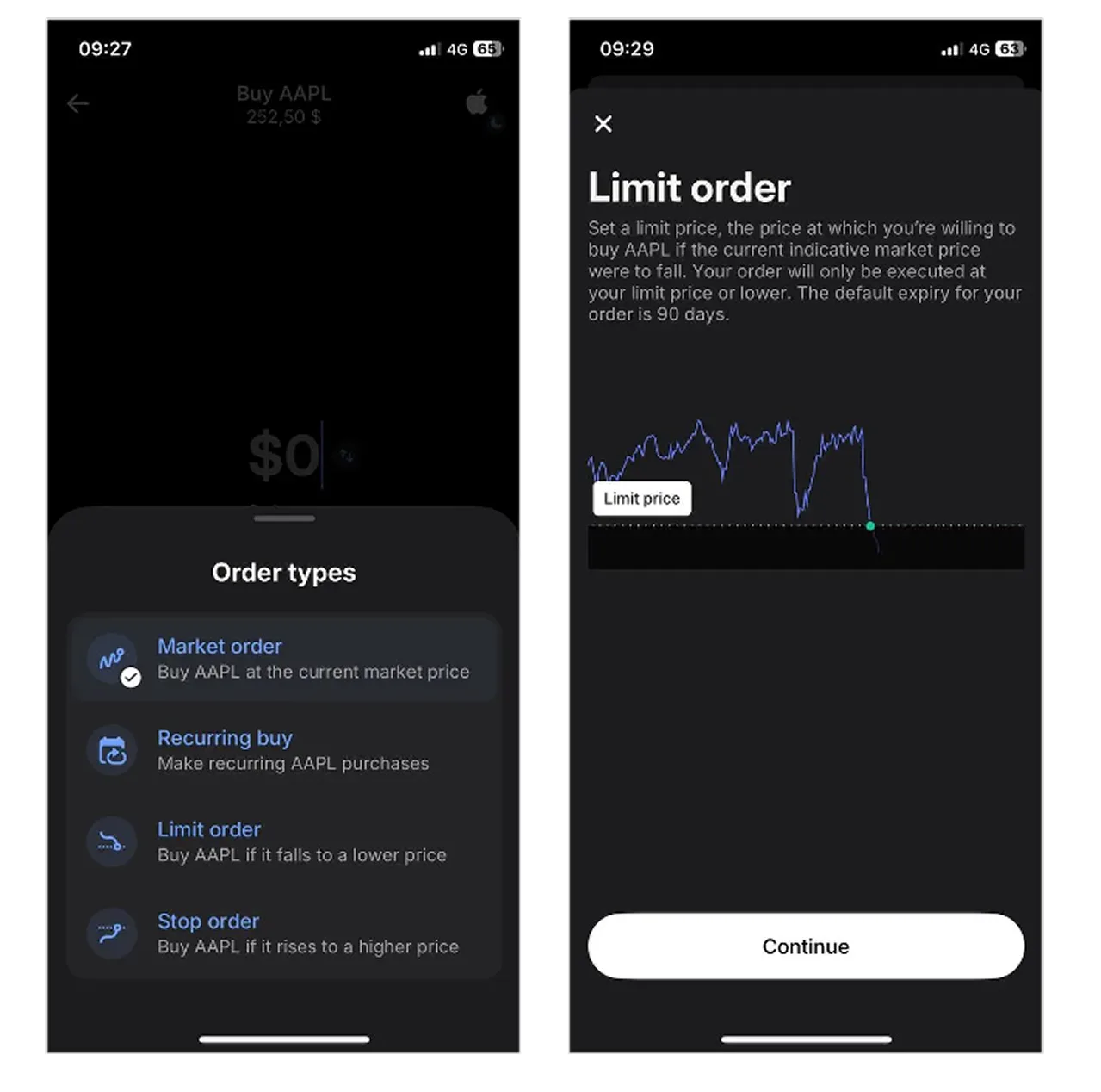
Practice 1. Revolut: explaining order types at the moment of choice
Choosing between market, limit and stop orders requires users to understand how each option affects execution.
Revolut provides two levels of explanation within the same journey. On the order selection screen, each type has a short description that communicates its basic purpose. Users who need more detail can open an extended explanation covering execution logic, price conditions and standard validity periods.
This means a user can quickly recall how an order works without leaving the transaction, while a beginner can access enough detail to make a more informed choice.
Product takeaway: decision support works best when explanations are available exactly where the decision is made, with additional depth available on demand.
Practice 2. IBKR Mobile: adding context to portfolio performance
A portfolio value alone tells users little about why their investments performed a certain way.
IBKR Mobile provides the most detailed tools for monitoring long-term investment performance among the services studied. Users can see returns in monetary and percentage terms, understand how these figures are calculated and analyse portfolio allocation across assets, categories and time periods.
The service also provides stock price forecasts, an investor calendar and transaction history with fees.
Together, these elements help users connect individual investments with overall portfolio performance and interpret results without relying on external tools.
Product takeaway: analytics support decisions when they explain performance, rather than simply displaying more numbers.
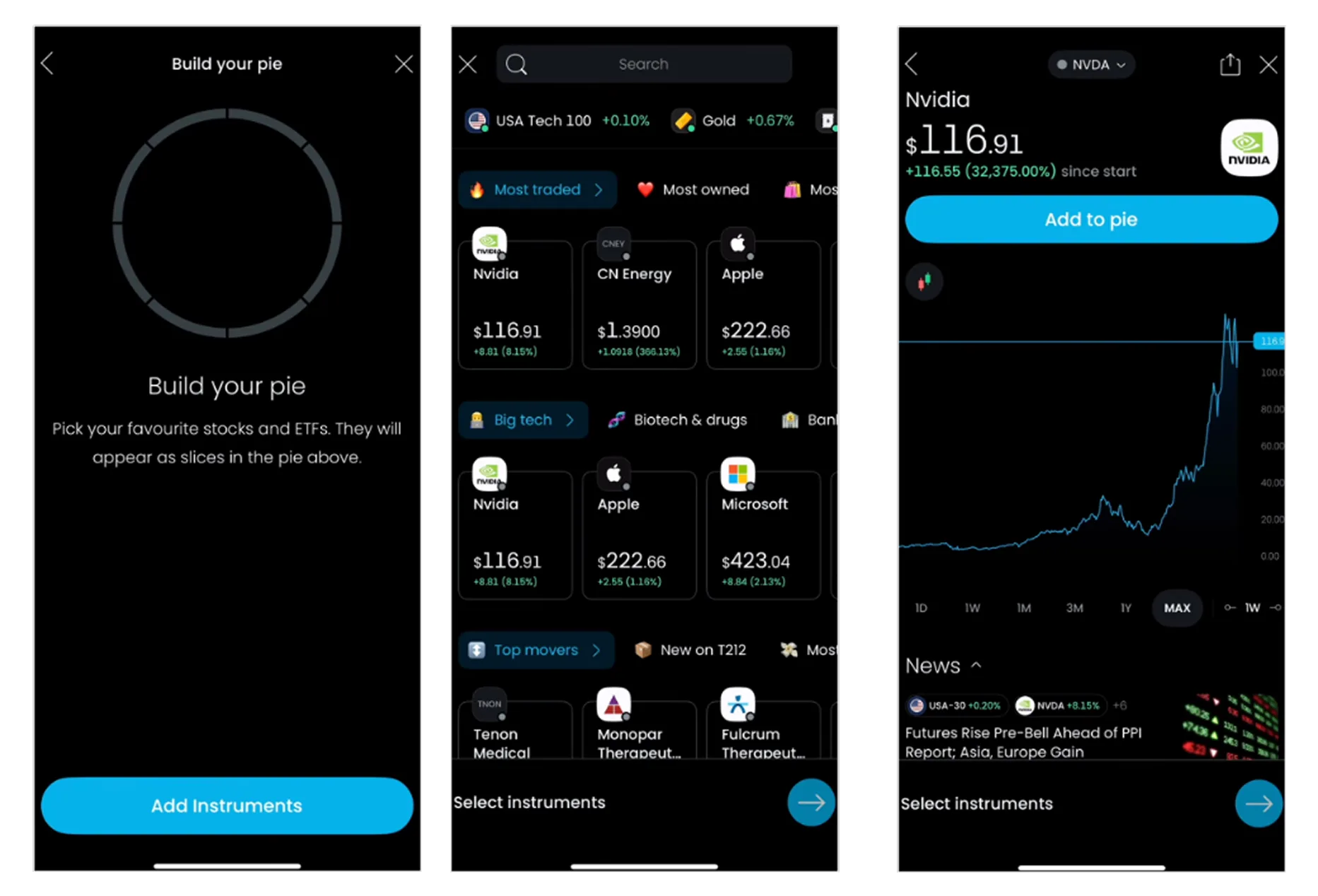
Practice 3. Trading 212: making long-term investment plans easier to evaluate
Setting up a long-term plan requires several connected decisions: which assets to include, how to allocate them, how often to invest and for how long.
Trading 212 brings these decisions together in its Pies feature. Users can combine stocks and ETFs, define the percentage allocation of each asset and immediately see the resulting portfolio structure.
The app then lets users choose between regular automatic contributions and manual funding. A projected-value chart shows how the portfolio could develop based on the selected investment horizon, contribution frequency and starting amount.
Before activation, Trading 212 summarises the key plan parameters, including regular contributions, investment horizon and projected outcome.
Product takeaway: visualising the consequences of selected parameters helps users evaluate a long-term decision before committing to it.
Practice 4. Freedom24: using previous actions as decision context
When an order expires, many platforms treat it as a completed action and make users recreate the trade from the beginning.
Freedom24 keeps the previous decision available. From the expired-order screen, a user can recreate the same order with its original number of assets, limit price and order type.
The cancelled status remains visible, while a dedicated action lets the user create an identical order without searching for the asset or entering the parameters again.
This reduces repetitive work and the risk of input errors while helping users continue an existing trading strategy.
Product takeaway: previous actions can provide valuable context for the next decision and reduce unnecessary repetition.
Practice 5. SaxoInvestor: explaining a complex asset transfer step by step
Asset transfers between brokers are more complex than everyday trading operations. Users need to understand what happens after submitting a request and which party is responsible at each stage.
SaxoInvestor allows users to manage incoming and outgoing portfolio transfers directly from the profile section.
The interface explains the process through four stages, from creating the transfer request to coordination with the receiving broker. The transfer status remains visible throughout the journey, helping users understand what is happening and what to expect next.
Product takeaway: complex financial operations become easier to complete when the interface explains the process, sequence and current status instead of leaving users to interpret them themselves.
The examples show that investment app decision support does not need to become a separate educational layer. It can be embedded directly into transactions, analytics and portfolio-management scenarios.
Put context close to the decision
Revolut explains the order when the user selects it. Trading 212 visualises an investment plan while the user configures it. SaxoInvestor explains a transfer while it is in progress.
The closer the explanation is to the action, the less effort users spend searching for additional information.
Use progressive depth
Not every investor needs the same amount of detail. A compact first layer keeps the interface efficient, while deeper explanations and analytics remain available when needed.
Explain outcomes, not only inputs
Decision support should help users understand what their choices mean. Portfolio analytics, projections and transparent parameters make the consequences of an action easier to evaluate.
Preserve context between actions
Freedom24 shows how previous activity can support the next step. Reusing existing parameters reduces effort and helps maintain continuity across the investor journey.
Investment apps already provide users with large amounts of information. The next UX challenge is making that information useful at the moment of decision.
Revolut adds context to order selection, IBKR Mobile to portfolio performance, Trading 212 to long-term planning, Freedom24 to repeated trades and SaxoInvestor to complex asset transfers.
Together, these practices show that effective decision support is built into the investor journey itself.
Investment app decision support creates value when users can understand an action, evaluate its consequences and move forward without leaving the current scenario.
The examples in this article are based on the State of Digital Investment in Europe 2025–2026 study by Markswebb. More findings and examples are available on the research page.
We respond to all messages as soon as possible.
We’ve evolved dozens of successful financial services and are eager to prove that our expertise can be implemented in other industries and around the world. Have a look at our success stories!


