
Corporate treasury is becoming a real-time function. Faster payments, multiple accounts and legal entities increase the need for a current view of liquidity rather than end-of-day snapshots.
J.P. Morgan names treasury automation and real-time liquidity among the key payment trends for 2026: 87% of organizations have introduced some level of treasury automation, while only 39% consider their systems mostly or fully automated.
At the same time, 24/7 real-time payment infrastructure is expanding globally. For corporate banks, this shifts the UX focus from executing payments to helping treasury teams see liquidity across the business, understand changes and act on them quickly.
Contents
For a large company, cash rarely sits in one account.
Liquidity can be distributed across dozens of accounts, legal entities, banks, currencies and regions. Financial teams need to understand not simply how much money is available, but where it is located, which funds can be used, which payments are coming, where a deficit may arise and where excess liquidity can be allocated.
When these data points are spread across different banking systems, ERP platforms, treasury systems and spreadsheets, even a seemingly simple question — How much liquidity does the group have right now? — can require several manual steps.
Real-time payments make this fragmentation more visible. Traditional treasury processes were often built around predictable settlement windows and end-of-day reporting. Instant payment rails introduce continuous flows: transactions can be initiated and settled outside traditional banking hours, while the cash position can change throughout the day. Finextra notes that the expansion of SEPA Instant, FedNow, Faster Payments, TIPS, RT1 and other real-time rails increases the need for continuous liquidity visibility because settlement accounts must be monitored and funded around the clock.
For corporate clients, the value of real-time treasury therefore comes from several connected capabilities:
The speed of a transaction matters. The speed at which a treasury team can understand what happened and decide what to do next matters just as much.
A traditional corporate banking journey can be described as a sequence of isolated tasks: create a payment, approve it, check its status and later download a statement.
A treasury-oriented experience connects these actions into a wider decision-making flow:
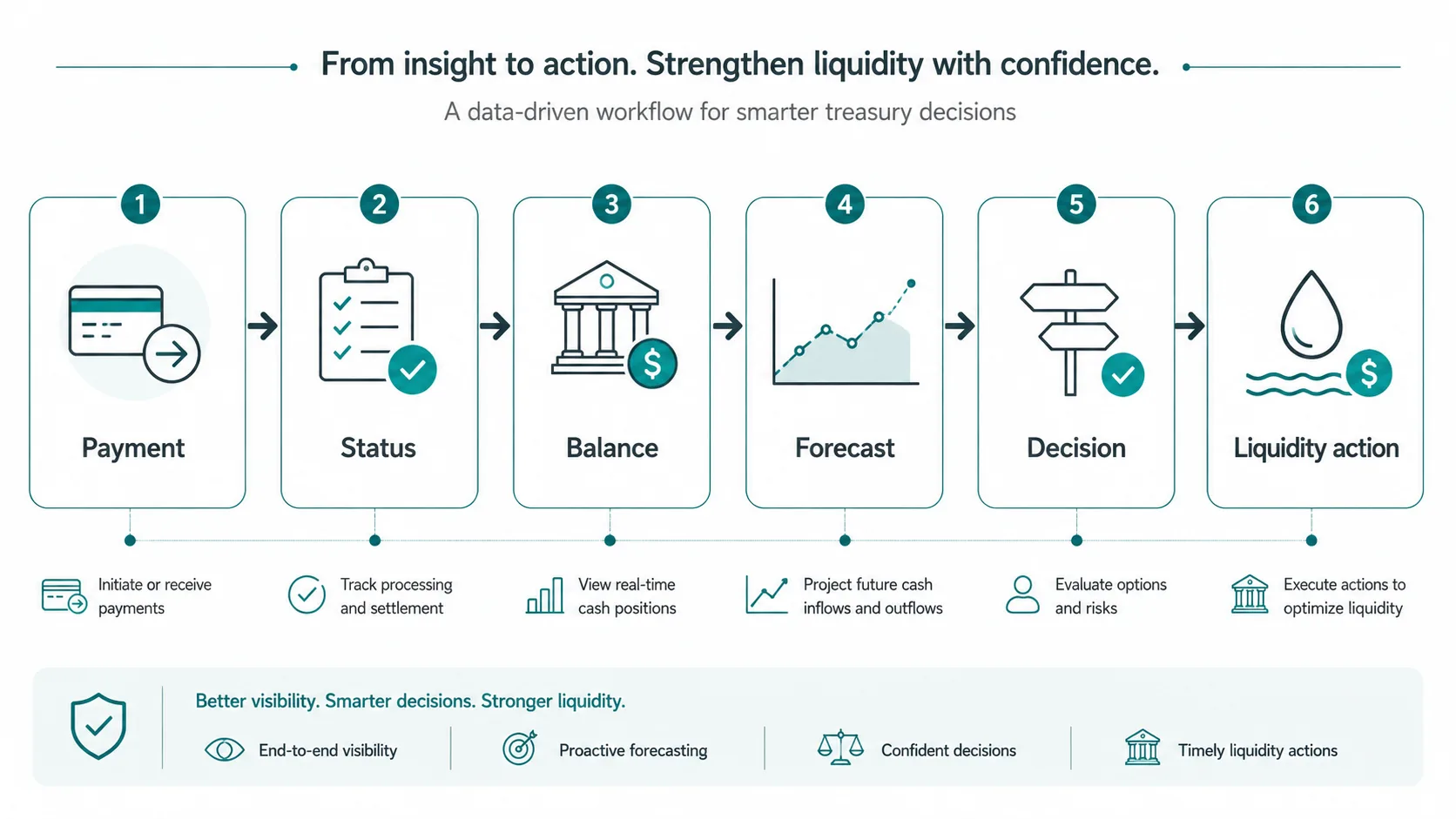
This changes the role of the interface.
Instead of simply showing transactions, the corporate bank can explain their effect on the company’s cash position. Instead of forcing users to switch between several entities or banking systems, it can aggregate balances. Instead of presenting a static list of accounts, it can help the treasurer identify where liquidity is concentrated and where funding will soon be required.
APIs are especially important here. J.P. Morgan describes real-time balance APIs as a way to provide current account data across accounts and regions, allowing treasury teams to move away from next-day reporting and react to intraday changes. Integration with accounting and treasury systems can also make reconciliation and cash reporting more continuous.
ISO 20022 adds another layer. Richer standardized payment data can support more detailed transaction information, automated reconciliation and new real-time services around payments. In 2026, the industry conversation is increasingly moving from ISO 20022 migration itself toward using that structured data in operational processes.
For UX teams, the opportunity is to turn this infrastructure into usable financial context.
The Digital Corporate Banking Rank 2026 findings also show how these capabilities work at the interface level. Several practices from leading corporate banks illustrate how treasury services can reduce fragmentation and bring liquidity management into one digital environment.
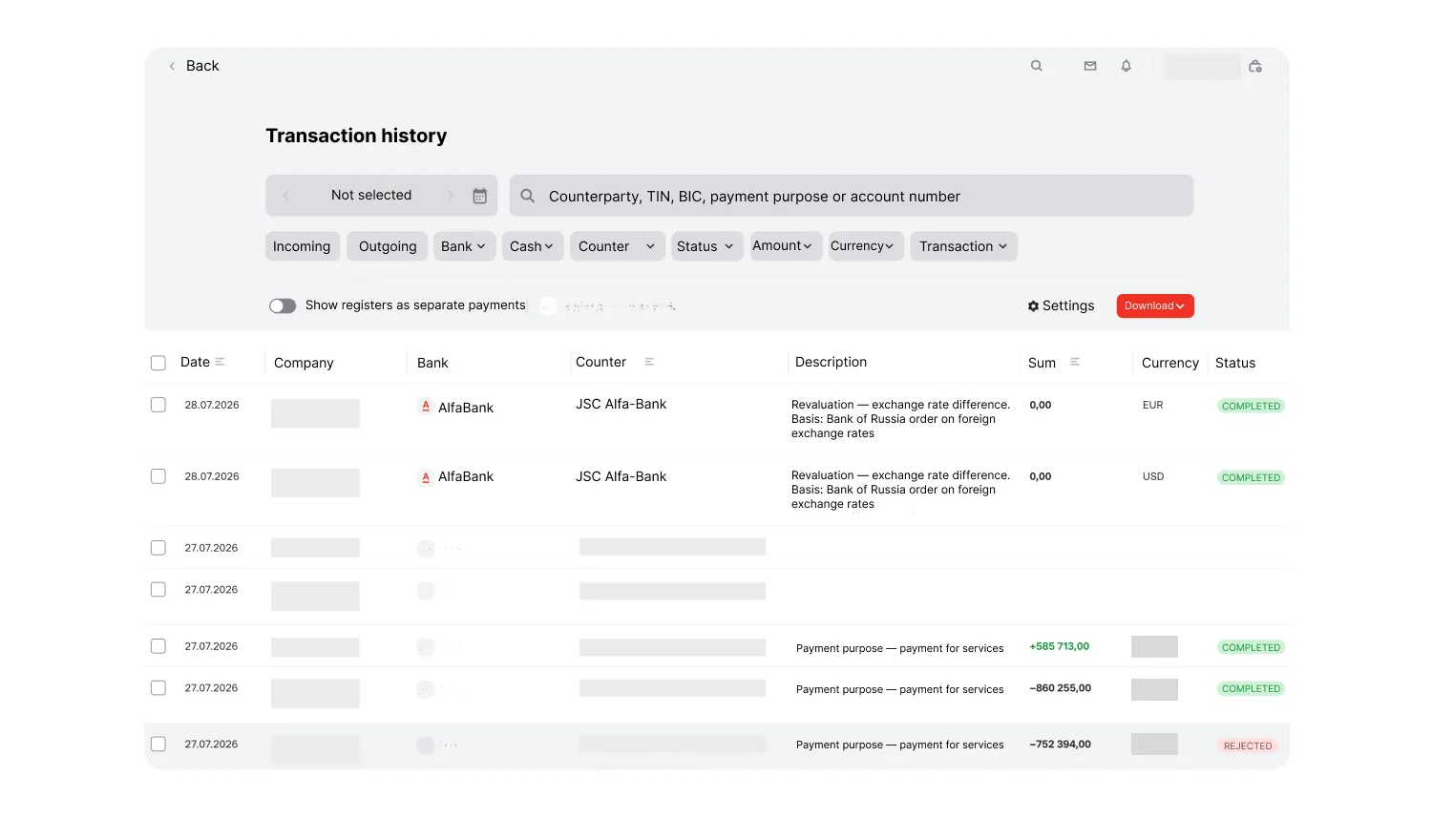
One of the banks studied integrates accounts held at other banks directly into its main corporate banking interface.
Users can see an aggregate balance across accounts and assess the company’s overall liquidity without repeatedly switching between different banking systems. External accounts become part of the same workspace as the bank’s own products and transactions.
This turns multibanking into a practical treasury tool. The user can start with the total cash position, drill down into individual accounts and understand where funds are concentrated before deciding whether liquidity needs to be redistributed.
For real-time treasury UX, this is an important principle: the interface should reflect the company’s financial position as a whole rather than the boundaries of an individual bank.
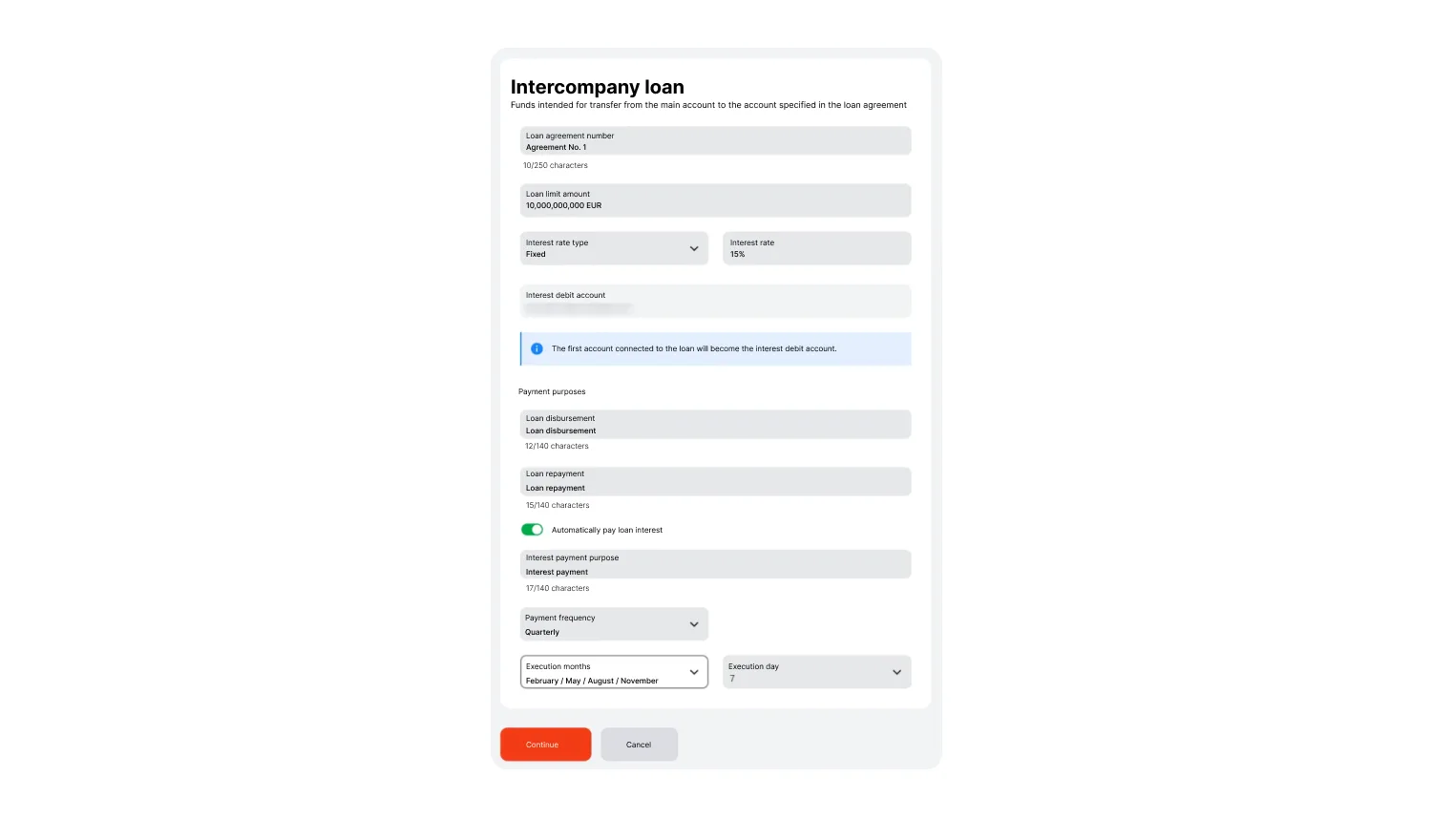
Another advanced practice addresses intercompany loans.
One of the leading banks allows corporate clients to manage financing between legal entities within a group directly through digital banking. Users can specify participants, limits, interest rates and terms, monitor outstanding debt and generate reporting in the same environment.
This is still a relatively rare capability: according to DCBR 2026, digital intercompany loan services are available in only 4 of the 10 banks studied.
The practice closes the gap between visibility and action. Once a treasury team identifies excess liquidity in one entity and a shortage in another, it has a digital mechanism for redistributing funds within the group.
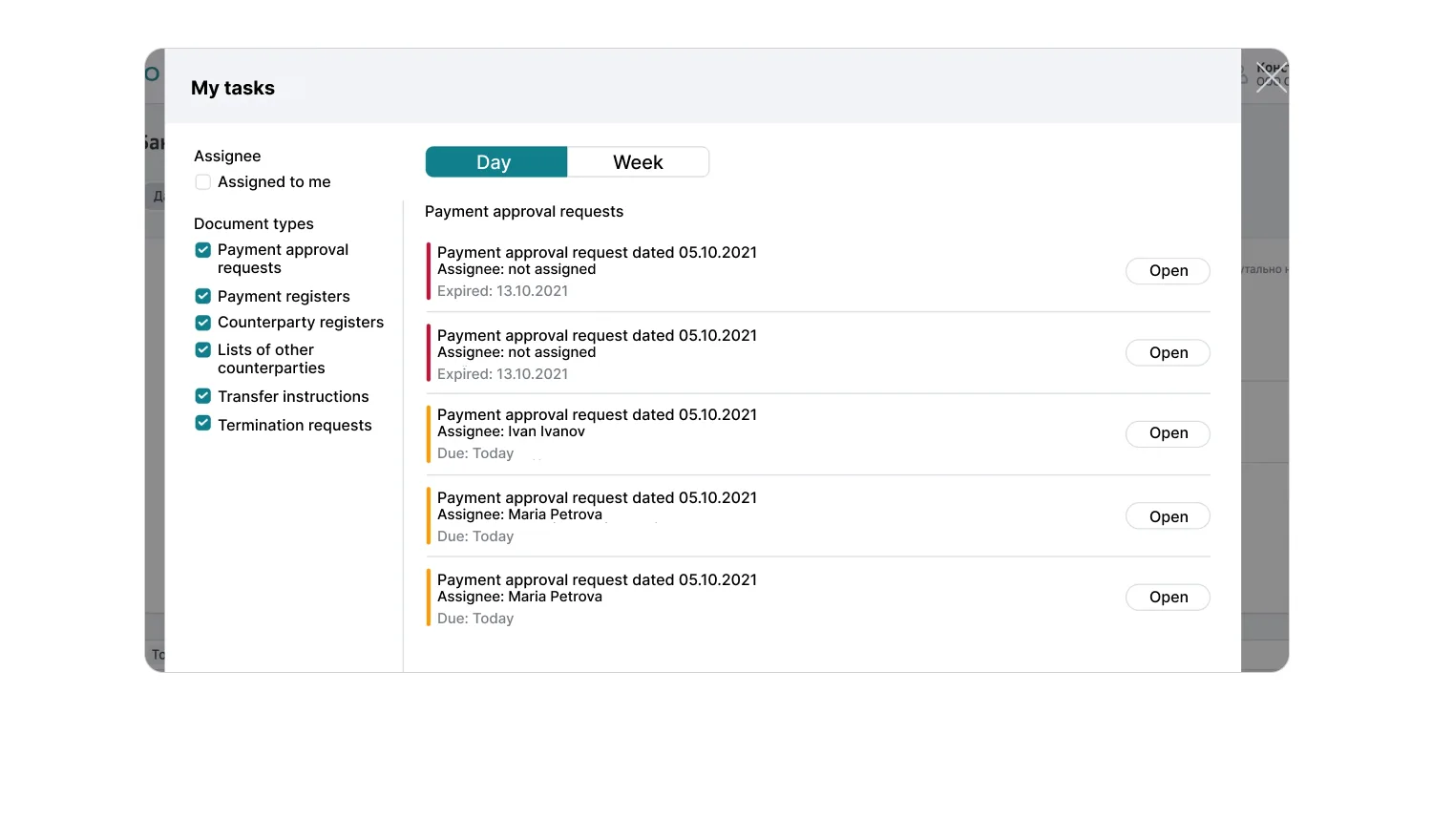
Another bank studied by Markswebb brings payment approval requests into a single operational dashboard.
The user can see who is responsible for an approval, its deadline and current status, open the payment and supporting documents in the same workspace, and process several documents in a batch.
For treasury teams, this provides visibility into future cash outflows before funds actually leave the account. Pending transactions become part of the liquidity picture rather than a separate operational process.
This practice also shows why real-time treasury UX depends on more than balance updates. Users need to understand what is likely to happen next, which payments require action and how upcoming decisions can affect liquidity.
Together, these practices illustrate three layers of a mature treasury experience:
visibility — see liquidity across banks and accounts;
action — redistribute funds across the corporate group;
control — manage payments and future outflows before they affect the cash position.
This combination is what gradually turns corporate banking from a transaction interface into an operating environment for treasury.
Don’t miss new Markswebb insightsFollow Markswebb on LinkedIn to keep track of new articles, benchmarks, and practical UX observations from our research.
The next stage of corporate banking development is unlikely to be defined by one new treasury feature.
The stronger opportunity is to connect existing capabilities into a continuous scenario.
A CFO opens the corporate bank and sees the group’s liquidity across several banks. A potential deficit is visible for one entity because upcoming payments are already reflected in the position. The user drills down, checks the transactions driving the deficit and decides how to cover it. Funds can then be redistributed through cash pooling or an intercompany financing mechanism, with the necessary approvals managнужed in the same environment.
The individual technologies required for this journey already exist in different combinations: real-time payment rails, APIs, structured payment data, multibanking, cash pooling, forecasting and ERP/TMS connectivity. The UX challenge is to make them feel like one workflow.
This direction is also visible in Digital Corporate Banking Rank 2026. Markswebb found that corporate internet banking is increasingly developing into a system of interconnected services with common architecture, UX patterns and dashboards, while leaders compete on the depth of complex corporate scenarios rather than the mere availability of basic banking functions.
That is where the idea of real-time treasury UX becomes strategically important.
Corporate banking can gradually become the operating system for treasury: a space where businesses see money across their organization, understand what is changing, control future flows and take action before liquidity becomes a problem.
In this model, “real-time” describes more than payment speed.
It describes the speed of the management decision.
We respond to all messages as soon as possible.
We’ve evolved dozens of successful financial services and are eager to prove that our expertise can be implemented in other industries and around the world. Have a look at our success stories!


