
Qualitative and quantitative UX research answer different questions about user behavior. Qualitative methods help understand why users act the way they do, while quantitative research measures how many users behave in a certain way and how often. Knowing when to use each approach is essential for building data-driven digital products.
Contents
In 2026, the UX industry finds itself in a paradox that few predicted five years ago. Product teams are surrounded by user stories, interview transcripts, journey maps, empathy canvases, JTBD frameworks, and richly annotated research repositories. Qualitative insight is no longer rare. It is operationalized. Institutionalized. Scaled.
And yet, across mature ecosystems and enterprise digital products, decision-makers increasingly admit something uncomfortable:
They have depth — but not proportion.
They understand individual experiences — but not systemic exposure.
They know why something is wrong — butа not how big the problem actually is.
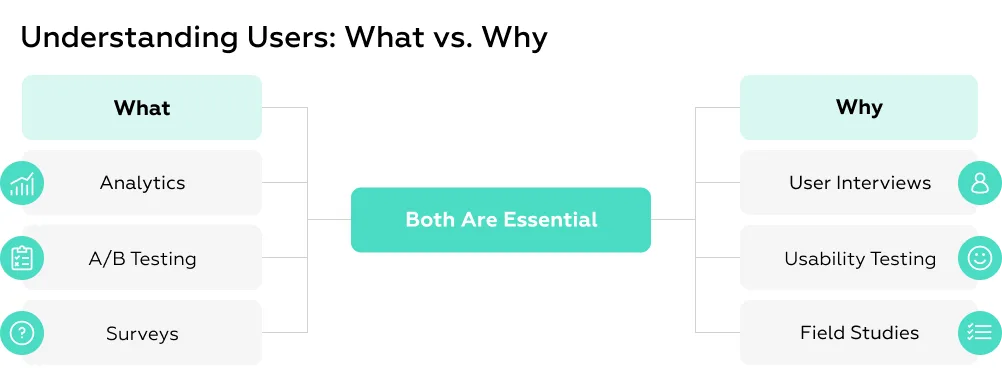
The market today is saturated with qualitative understanding and simultaneously undersupplied with quantitative calibration. Numbers reveal what happens; qualitative methods explain why it happens.
This paradox did not emerge by accident.
Over the last decade, leading research authorities such as the Nielsen Norman Group consistently emphasized that qualitative research uncovers usability failures, unmet needs, and behavioral motivations that analytics alone cannot explain. Their long-standing position has been clear: numbers reveal what happens; qualitative methods explain why it happens. This framing helped correct an earlier industry bias toward dashboards, conversion funnels, and surface-level KPIs.
At the same time, advisory firms like Gartner have repeatedly highlighted that customer-centric product strategy requires contextual understanding and ethnographic depth — not just performance metrics. As organizations moved toward experience-led growth models, qualitative UX research became strategically elevated. Continuous discovery became a default operating model. “Talk to users” became a cultural principle.
This correction was necessary.
Analytics-heavy product cultures of the 2010s often mistook measurement for understanding. Drop-offs were quantified but not interpreted. Churn was tracked but not contextualized. Feature adoption was optimized without questioning relevance. The rise of qualitative UX research restored interpretive depth and human-centered framing.
But by 2025–2026, another imbalance became visible — especially inside large digital ecosystems, telecom operators, banks, superapps, and marketplace platforms.
Product teams accumulated qualitative insight at scale:
What they did not accumulate was structural proportionality.
Without quantitative validation:
Qualitative research answers: What is happening inside this experience?

It does not automatically answer:
In other words, qualitative research reduces interpretation risk — but not scale risk.
And scale risk becomes dominant as products mature.
Early-stage products face uncertainty: “Are we solving the right problem?”
Growth-stage products face optimization risk: “How do we improve performance?”
Mature ecosystems face structural risk: “Where is systemic experience debt accumulating, and how large is it?”
In the past three months especially, industry conversations have noticeably shifted back toward large-scale UX measurement, benchmarking frameworks, friction taxonomies, and statistical validation models. This is not a rejection of qualitative research. It is a reaction to accumulated ambiguity.
Businesses discovered that qualitative saturation does not equal strategic clarity.
When every team has compelling user quotes, prioritization becomes political. When every friction point is “important,” none are strategically ranked. When research narratives multiply without quantitative anchoring, executive trust erodes.
This is the paradox of 2026:
The industry once believed quantitative research was impersonal and qualitative research was human.
In reality, quantitative research provides systemic objectivity — and qualitative research provides contextual meaning.
One without the other distorts risk perception.
Quantitative research answers: How big is the fire?
Qualitative research answers: Why did it start?
When qualitative insights are detached from quantitative context, they risk overgeneralization. A powerful story from five interviews can unconsciously be treated as market truth. Without statistical framing, even rigorous qualitative work can unintentionally inflate or mis-rank risks.
This is precisely where structured UX measurement systems become critical. Large-scale statistical mapping of recurring UX failures — such as those presented in the UX Problems Guide (UXPG) — provide the macro-context within which qualitative diagnostics gain objectivity. Quantitative distribution of problem types establishes structural hierarchy. Qualitative research then explains mechanisms and behavioral triggers inside that hierarchy.
Objectivity in qualitative UX research is not achieved by sample size alone.
It is achieved by contextual calibration.
The core issue today is not “qualitative vs quantitative.” It is methodological overextension.
No method is inherently flawed.
Methods become flawed when applied at the wrong stage of product maturity.
The industry’s current discomfort is not about abandoning qualitative research. It is about rediscovering proportionality.
Qualitative insight without quantitative structure creates narrative richness without strategic ranking.
Quantitative data without qualitative depth creates statistical clarity without causal understanding.
The market in 2026 is not choosing between methods.
It is relearning that research is a risk management system.
And the first step toward restoring balance is recognizing the paradox itself.
Quantitative UX research does one thing exceptionally well: it transforms isolated experience signals into systemic visibility.
Where qualitative research captures depth, quantitative research captures distribution. It tells you how widespread a problem is, how frequently it occurs, how it trends over time, and how confidently you can prioritize it against competing issues.
Large-scale surveys, behavioral analytics, funnel analysis, A/B testing, benchmark scoring, and structured UX audits provide three critical assets for mature product organizations:
Organizations such as Nielsen Norman Group have repeatedly emphasized that quantitative usability metrics (task success rate, time on task, error rate) are essential when measuring improvements across iterations. Without numbers, optimization remains anecdotal.
Similarly, enterprise product governance frameworks described by Gartner consistently position measurement systems as necessary for scaling digital experience management. In complex ecosystems, qualitative insight alone cannot inform portfolio-level prioritization.
Quantitative UX research reduces scale risk.
It answers: How big is the fire?
And in mature products, that question becomes existential.
Without quantitative diagnostics:
At ecosystem scale, statistical mapping is not a luxury. It is infrastructure.
But this is only half the picture.
Numbers describe behavior.
They do not interpret intention.
A drop in conversion does not explain whether users are confused, skeptical, distracted, overloaded, or strategically avoiding the feature.
An NPS decline does not explain whether dissatisfaction is driven by pricing perception, usability friction, or unmet expectations formed by marketing communication.
Quantitative research answers what changed.
It does not explain why it changed.
This is not a weakness of quantitative methods — it is a structural property.
The danger begins when organizations overextend numeric authority. When statistical confidence is mistaken for interpretive completeness, product decisions detach from lived user context.
This pattern is visible in several well-documented industry cases.
For example, Google launched Google Glass with strong internal data supporting technical viability and early adopter interest. However, large-scale behavioral and social context factors — privacy discomfort, public acceptance norms, and social signaling risk — were underexplored qualitatively. The product was technically measurable but socially miscalibrated.
Similarly, Quibi invested heavily in analytics and mobile consumption modeling, optimizing for predicted short-form engagement patterns. Quantitative forecasts suggested strong demand. What the numbers failed to reveal was contextual behavioral reality: users did not need premium short-form content in a market saturated with free alternatives. Behavioral data modeled a scenario; qualitative ecosystem understanding would have exposed motivation gaps.
In both cases, the failure was not “too much quantitative research.”
It was quantitative research operating without qualitative depth.
Numbers are precise.
But precision without context can be precisely wrong.
Quantitative UX methods become particularly dangerous when treated as universal arbiters of truth.
A/B testing limitations.
A/B tests optimize within defined variables. They are excellent at incremental improvements — button color, layout arrangement, microcopy variations. But they cannot evaluate paradigm shifts or long-term brand impact. Testing only what is easily testable narrows innovation space. Incremental uplift can mask strategic stagnation.
Even leading experimentation cultures, such as those at Amazon, have publicly acknowledged that experimentation must be paired with long-term thinking; otherwise, local optimization can conflict with ecosystem coherence.
NPS blind spots.
Net Promoter Score aggregates sentiment into a single number. While useful for trend tracking, it flattens multidimensional experience into a binary loyalty index. High NPS can coexist with severe usability debt in specific journeys. Low NPS can be driven by factors unrelated to UX. Treating NPS as a diagnostic tool rather than a directional signal often leads to misprioritization.
Behavioral analytics misinterpretation.
Funnels show where users drop off. Heatmaps show where they click. Session replays show what they did. None of these tools reveal cognitive reasoning. Behavioral data without qualitative validation risks post-hoc storytelling — analysts project explanations onto patterns.
The core pitfall is methodological absolutism.
When quantitative UX research operates in isolation, it creates an illusion of objectivity while silently transferring interpretive risk to analysts and stakeholders.
Quantitative research alone often performs well in stable optimization environments. It performs poorly in ambiguity.
Consider cases where products were optimized for engagement metrics at the expense of long-term trust or usability clarity. Social platforms across the industry — including Facebook (now Meta) — heavily optimized for measurable engagement signals. While metrics improved, broader qualitative concerns around user well-being, content trust, and platform perception escalated. The numbers signaled success; the experience signaled fragility.
The pattern repeats across industries:
Quantitative research reduces scale uncertainty.
It does not eliminate interpretation uncertainty.
And this brings us back to the central thesis of this article.
The current market correction toward quantitative UX research is understandable. Businesses cannot operate solely on qualitative depth. Mature ecosystems require statistical structure. Portfolio prioritization demands proportional visibility.
But replacing qualitative research with quantitative research is not a solution. It is merely a pendulum swing in the opposite direction.
The market cannot survive on qualitative insight alone.
It also cannot survive on quantitative measurement alone.
Quantitative UX research provides structural clarity.
Qualitative UX research provides causal meaning.
Used in isolation, each introduces its own blind spots.
Used together, they form a risk-balanced research system.
And that system — not methodological preference — is what modern product governance requires.
If quantitative UX research reduces scale risk, qualitative UX research reduces meaning risk.
Numbers describe patterns.
Qualitative research explains mechanisms.
Every product metric — conversion, retention, feature adoption, churn — reflects deeper cognitive and emotional processes. Users do not simply “drop off at step three.” They hesitate, misinterpret, mistrust, overload, or disengage. Analytics captures the event. Qualitative inquiry reveals the cause.
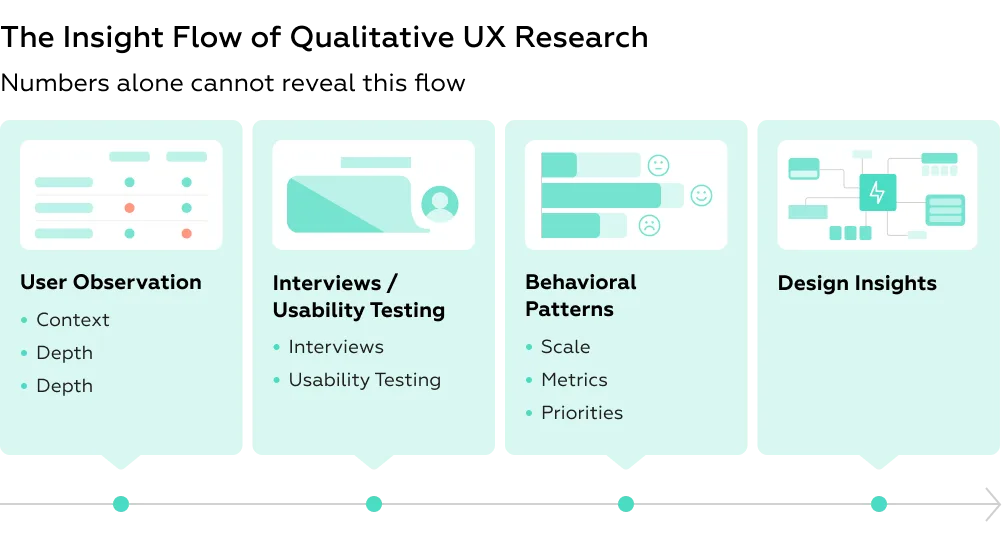
For decades, organizations such as Nielsen Norman Group have shown that usability testing consistently exposes critical interaction failures invisible in analytics. Behavioral data signals friction; moderated sessions reveal misunderstanding. Surveys show dissatisfaction; interviews expose expectation gaps.
Qualitative UX research uniquely captures:
These layers are interpretive rather than purely measurable.
In risk terms, qualitative research prevents misdiagnosis.
Without it, organizations risk treating symptoms instead of causes.
Quantitative systems rely on predefined variables — you must know what to measure before measurement begins. Yet in complex product ecosystems, the most critical risks often emerge outside predefined hypotheses.
Qualitative research reveals:
For example, qualitative interviews often detect trust erosion before churn rises. Usability testing exposes frustration before NPS declines. Contextual research may reveal that a feature never fits real workflows long before analytics shows abandonment.
Quantitative research measures outcomes.
Qualitative research discovers emerging risk.
This structural difference explains why even highly data-driven organizations such as Google and Microsoft maintain extensive usability labs. Innovation and systemic correction require insight beyond dashboards.
Quantitative data validates hypotheses.
Qualitative research generates them.
Without hypothesis generation, measurement becomes blind optimization.
Qualitative research derives its strength from methodological diversity.
User interviews reveal intention frameworks — how users define value, compare options, and justify decisions.
Moderated usability testing exposes interaction mismatches where interface logic conflicts with user mental models.
Contextual inquiry situates behavior within real environments — multitasking, device switching, social constraints, and time pressure.
Each method reduces a specific interpretation risk:
Together, these methods build explanatory models of behavior.
These models later become the foundation for quantitative measurement systems. You can track clicks, but you cannot measure confusion until you first understand how confusion manifests.
Quantitative instruments are only as meaningful as the conceptual models behind them.
And those models originate in qualitative research.
The renewed demand for quantitative UX research is understandable. Mature ecosystems require scalable diagnostics, statistical credibility, and portfolio visibility.
However, a structural sequencing rule remains:
You cannot measure what you do not conceptually understand.
The “Qual First” principle does not mean “qual only.”
It means qualitative research defines the problem space before quantitative systems measure it.
When measurement precedes understanding:
When qualitative insight precedes quantification:
This sequencing is especially critical in large-scale UX benchmarking or ecosystem diagnostics. Problem categories cannot emerge from analytics alone — they require qualitative discovery.
Quantitative UX research cannot function autonomously.
It requires qualitative calibration.
As organizations expand measurement systems, the cost of poorly defined metrics grows. Miscalibrated KPIs shape product roadmaps for years and institutionalize flawed assumptions.
Qualitative research therefore is not a preliminary step.
It is foundational architecture.
Quantitative research reduces scale risk.
Qualitative research reduces meaning risk.
But scale can only be measured correctly once meaning is understood.
The debate between qualitative and quantitative UX research disappears the moment product governance becomes systemic.
In isolated features, you can afford methodological bias.
In ecosystems, you cannot.
Large digital ecosystems — telecom operators, superapps, financial platforms — combine dozens of services, cross-channel journeys, multi-role users, and layered task structures. Friction does not exist in one interface. It accumulates across journeys. Risk is no longer local. It becomes structural.
This is where a dual-layer research architecture becomes mandatory.
In the ecosystem benchmark project for МТС, Markswebb faced a typical ecosystem challenge: how do you objectively evaluate experience quality across heterogeneous services and task types?
A purely qualitative approach would have generated rich journey insights but no systemic comparability.
A purely quantitative approach would have produced structured scores detached from behavioral meaning.
The solution required integration.
First, qualitative research defined:
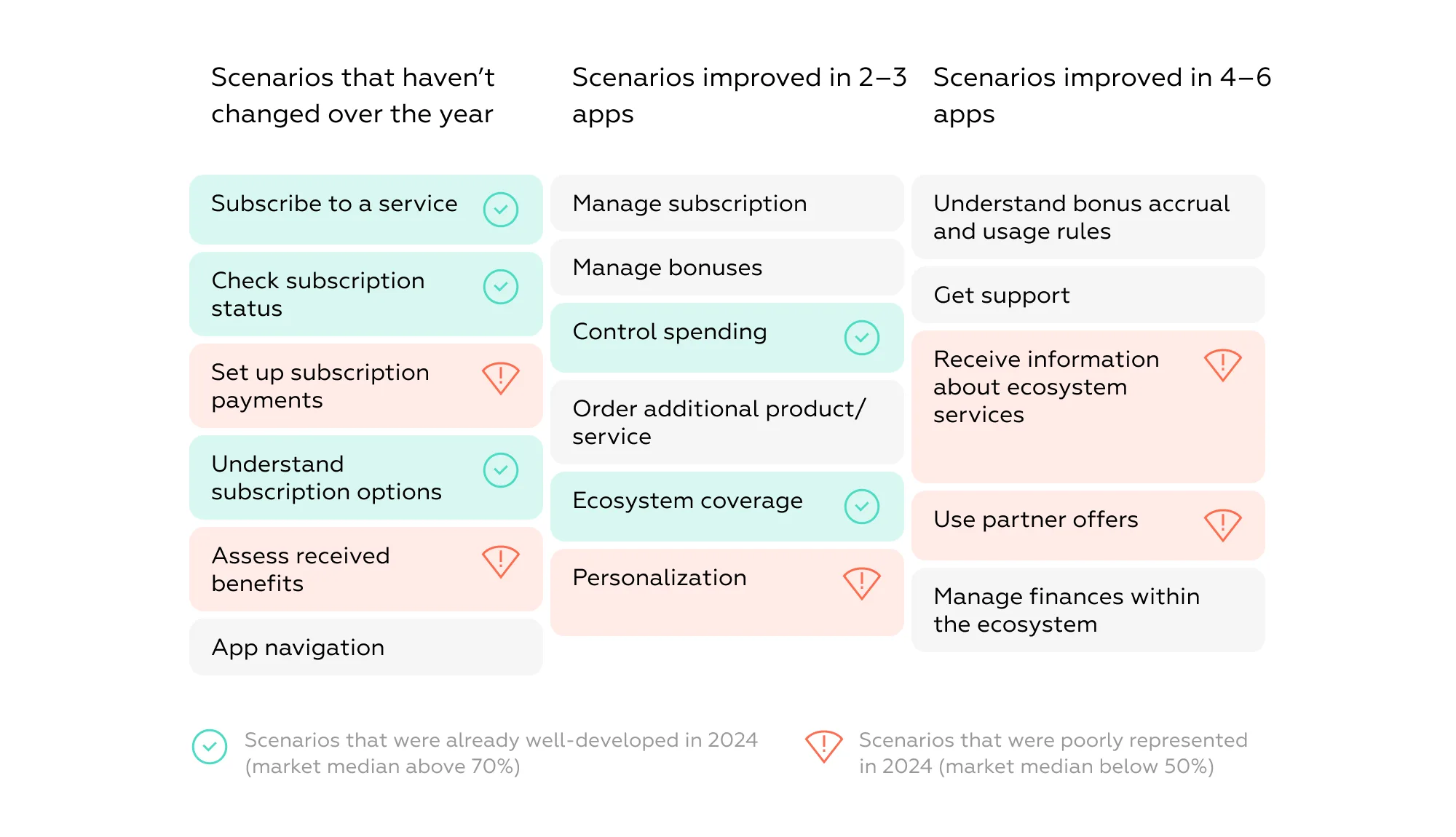
Binary criteria were developed for each task group — measurable yes/no indicators of friction presence. But crucially, not all criteria were equal. Some friction types affected retention more severely than others. Some tasks carried higher strategic importance.
Quantitative studies were then used to:

In other words:
Qualitative research defined what matters.
Quantitative research defined how much it matters.
Without qualitative groundwork, binary criteria would have reflected internal assumptions.
Without quantitative weighting, qualitative insights would have remained narrative.
Together, they formed a defensible, risk-oriented benchmark model.
This is the core of the Markswebb framework: qualitative architecture + quantitative calibration.
Ecosystems amplify research blind spots.
In single-product environments, qualitative research alone may seem sufficient. But as soon as dozens of services interact, narrative prioritization becomes unstable. Teams advocate for their own journey improvements. Every friction feels urgent. Without quantitative hierarchy, systemic focus collapses.
At the same time, purely quantitative dashboards in ecosystems create a different distortion: they flatten complexity. Binary success metrics ignore cognitive load. Aggregated scores hide behavioral nuance. Optimization becomes mechanical.
The MTC case demonstrated that statistical rigor without qualitative intelligence is fragile. And qualitative insight without statistical structure is politically vulnerable.
This pattern is not unique.
Leading global organizations operate on similar principles.
Airbnb pairs large-scale behavioral analytics with deep ethnographic research to understand trust dynamics in host–guest interactions. Analytics detects booking friction; qualitative studies uncover perception asymmetries and emotional barriers.
Microsoft integrates telemetry data from millions of users with qualitative lab testing to understand cognitive overload in enterprise software. Metrics reveal drop-offs; moderated sessions reveal mental model breakdown.
In both cases, scale does not replace depth.
Scale amplifies the need for depth.
The framework rests on four principles:
This is not a 50/50 split.
It is a sequencing logic.
Qualitative research precedes structural design.
Quantitative research stabilizes prioritization.
Neither replaces the other.
The renewed demand for quantitative UX research is justified. Mature digital products require defensible prioritization. Executive decision-making requires scale visibility. Ecosystem benchmarking requires comparability.
But quantitative systems cannot be constructed in a vacuum.

Without qualitative grounding:
Without quantitative calibration:
The market’s mistake would be to treat the current quantitative momentum as a replacement strategy.
The correct response is architectural integration.
In ecosystem diagnostics — such as the MTC benchmark — quantitative research made the model defensible. Qualitative research made it meaningful.
And that combination is not methodological compromise.
It is risk governance.
The debate between qualitative and quantitative UX research often appears strategic, but in reality it is a false choice. These methods do not compete — they address different types of uncertainty.
Quantitative research reduces scale uncertainty, showing how widespread problems are and where systemic risks accumulate.
Qualitative research reduces meaning uncertainty, explaining why those problems occur and which behavioral mechanisms drive them.
Issues emerge when the methods are applied in isolation or in the wrong sequence. Quantitative data without qualitative grounding can produce statistically sound conclusions that lack behavioral context. Qualitative insights without quantitative calibration may generate compelling narratives but leave teams unsure about priority and scale.
The real question is not which method is better, but which uncertainty needs to be reduced first. In mature UX systems, qualitative discovery defines the problem space, and quantitative measurement maps its scale.
At Markswebb, we focus on qualitative UX research not to replace quantitative methods, but to make them actionable.
Most organizations already have strong quantitative infrastructure — analytics systems, A/B testing frameworks, experimentation platforms, or data science teams. These tools provide scale visibility, but they often lack interpretive architecture — the layer that transforms numbers into strategic insight.
Qualitative research provides that layer. It reveals mental models behind behavior, identifies friction mechanisms, structures task hierarchies, and defines which variables should be measured.
In large ecosystem projects — such as the benchmark for MTC — qualitative diagnostics established the conceptual foundation for quantitative evaluation. Task hierarchies, friction categories, and evaluation criteria were defined through qualitative analysis before statistical weighting was applied.
This is the Markswebb contribution: we do not compete with quantitative research capabilities — we make them strategically intelligent.
Quantitative data shows where friction exists.
Qualitative research explains why it happens and how to fix it.
A mature quantitative UX research function — analytics dashboards, surveys, funnel monitoring, experimentation teams — is a strong foundation. But numbers alone show patterns, not mechanisms.
Markswebb qualitative UX research gives those numbers a voice.
We translate statistical signals into behavioral explanations, turn friction clusters into design hypotheses, and transform measurement systems into decision frameworks.
The future of UX research is not choosing between qualitative and quantitative methods. It is architected integration: quantitative systems provide scale visibility, while qualitative research delivers interpretive depth.
If you already measure, we help you understand.
If you already optimize, we help you prioritize.
If you already collect data, we help you extract meaning.
Your quantitative UX research shows where to look.
With Markswebb qualitative insight, you know what to change.
We respond to all messages as soon as possible.
We’ve evolved dozens of successful financial services and are eager to prove that our expertise can be implemented in other industries and around the world. Have a look at our success stories!