
Investment apps often focus heavily on two moments: opening an account and making the first investment. But the digital investor journey continues long after the first trade.
As users gain experience, their needs expand. They start monitoring portfolio performance, setting up regular investments, managing orders, separating portfolios by goal, moving assets between brokers and adjusting their strategy.
This makes investor journey optimization a broader product task. Strong investment app UX connects individual functions into one continuous experience, so each completed action makes the next step easier.
In the State of Digital Investment in Europe study, Markswebb analysed 20 investment apps across the full investment lifecycle — from onboarding and market research to portfolio management and account operations.
Contents
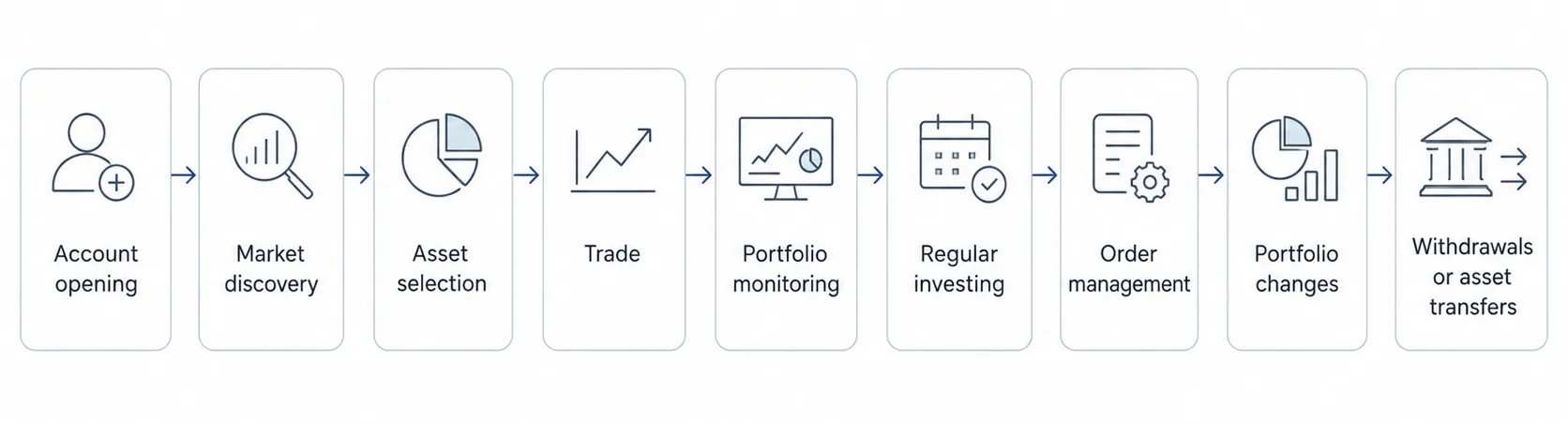
A first investment is only one point on the customer journey map.
Before it, users need to open an account, understand the product and explore available instruments. After it, they need to understand performance, manage positions, invest regularly and make more complex decisions.
A typical digital investor journey can include:
The challenge for product teams is not simply to make each stage work independently. The stages need to connect.
A user who has researched an asset should be able to move naturally towards a transaction. Portfolio data should support the next investment decision. Previous orders should remain useful after they expire. More experienced users should not have to leave the platform when their needs become more complex.
Continuity often breaks between otherwise well-designed features.
Onboarding may end without guiding the user towards a useful first action. Market research may provide plenty of information but offer a weak transition to trading. An order history may record what happened without helping the user act on it.
The same problem appears later in the journey. Investment automation may be limited to a single asset, additional portfolios may require separate accounts, and asset transfers may move users to support or an external channel.
These gaps create extra navigation and repeated actions. More importantly, they make the service feel like a collection of features rather than one investment environment.
A continuous experience gives users a clear next step while preserving the context of what they have already done.
During investment app onboarding, this means showing progress and making account-opening conditions clear before the process begins. During market research, it means helping users organise assets around the way they invest. At the trading stage, explanations should appear directly within the transaction.
Later in the journey, portfolio management UX becomes more important. Users need analytics that help them interpret results, tools for managing different goals and efficient ways to continue or change previous actions.
The strongest services also bring less frequent but important operations — such as opening additional accounts or transferring securities — into the same digital journey.
The examples below come from SaxoInvestor, Revolut, IBKR Mobile, Trading 212 and Freedom24 — the five leaders in the speculative-investing assessment of the State of Digital Investment in Europe study.
Trading 212 leads the account-opening scenario in the study with a score of 81.2.
Its onboarding combines several elements that help users understand the process before and during registration. The form provides automatic address suggestions, users can track their progress, and information about fees and pricing is available before account opening begins.
These elements solve different parts of the same problem. Address suggestions reduce manual input, the progress indicator makes the length of the journey predictable, and upfront pricing gives users important context before they commit.
The result is an onboarding flow in which the user understands both the current step and what comes next.
Product takeaway: account opening works better as the beginning of the investor journey when users can see its scope, requirements and conditions from the start.
Investment research becomes more useful when users can organise information according to the way they make decisions.
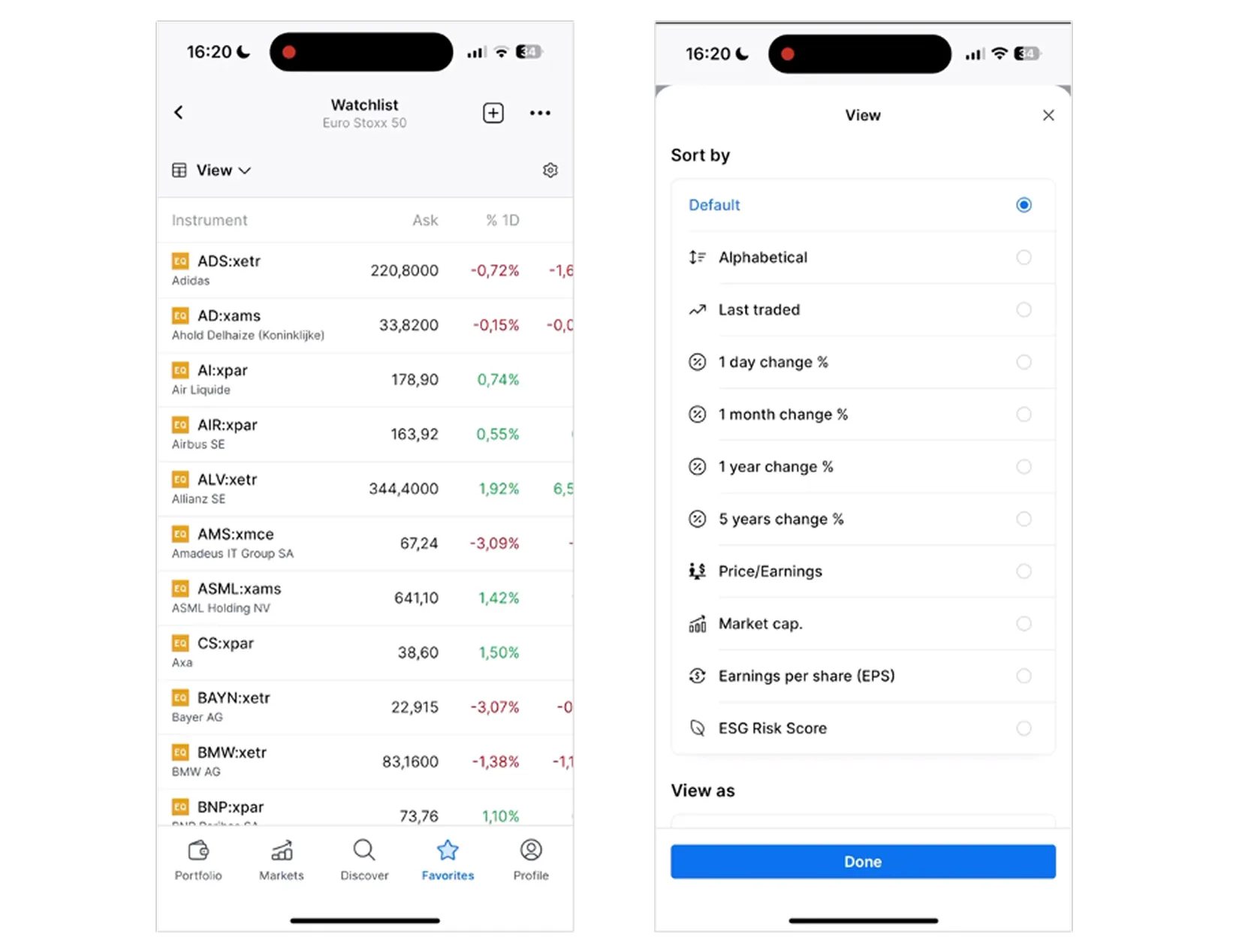
SaxoInvestor turns the favourites list into an analytical tool through flexible sorting. Active investors can organise assets by daily or monthly price change, while fundamentally oriented users can sort by metrics such as P/E or market capitalization. Long-term investors can focus on one-year or five-year performance.
This keeps the same collection of assets relevant across different stages and strategies. A watchlist is no longer only a place to save instruments — it becomes a working environment for deciding what deserves attention next.
The journey also continues after assets enter the portfolio. SaxoInvestor supports portfolio monitoring and allows users to initiate incoming and outgoing asset transfers directly in the app. The transfer process is explained across four stages, with status visibility throughout.
Product takeaway: continuity improves when discovery, portfolio management and later account operations remain part of the same product environment.
The transition from research to trading can break when users encounter terminology they do not fully understand.
Revolut addresses this directly inside the order flow. Market, limit and stop orders have concise explanations on the selection screen. Users who need more information can open detailed descriptions covering execution logic, price conditions and order duration.
The user does not need to leave the trade, search a help centre and then return to the transaction. Learning and action remain part of the same journey.
For an experienced investor, the short explanation works as a quick reminder. For a less experienced user, additional detail is available without making the default interface heavier.
Product takeaway: the transition from learning to action becomes smoother when support is embedded directly into the transaction.
As users gain experience, simply showing a total portfolio balance is no longer enough.
IBKR Mobile leads the portfolio-status scenario in the study. It allows users to review returns in both monetary and percentage terms, understand how those values are calculated and analyse portfolio structure by assets, categories and time periods. The service also includes price forecasts, an investor calendar and transaction history with fees.
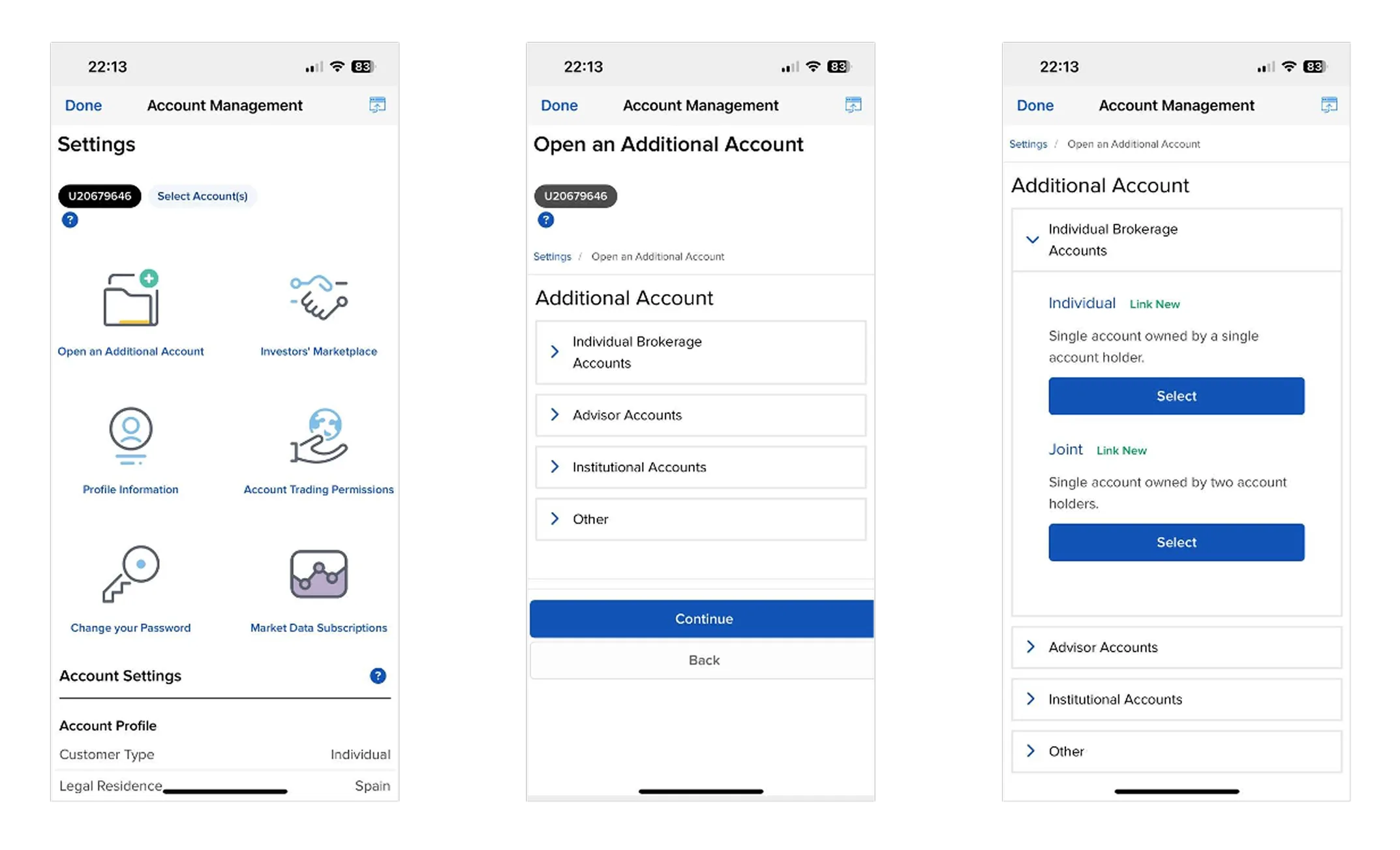
The product supports another stage of investor maturity through additional account types.
IBKR Mobile lets users open accounts for different scenarios, including individual and joint accounts. It also provides a family account model that can be used to manage accounts for up to five family members while maintaining separate legal ownership.
This lets users separate investment goals without moving them to another platform or forcing every scenario into one portfolio.
Product takeaway: investor journey optimization should account for growing complexity. The product needs to expand with the user rather than serving only the initial investment scenario.
An unsuccessful or expired transaction should not necessarily become the end of the journey.
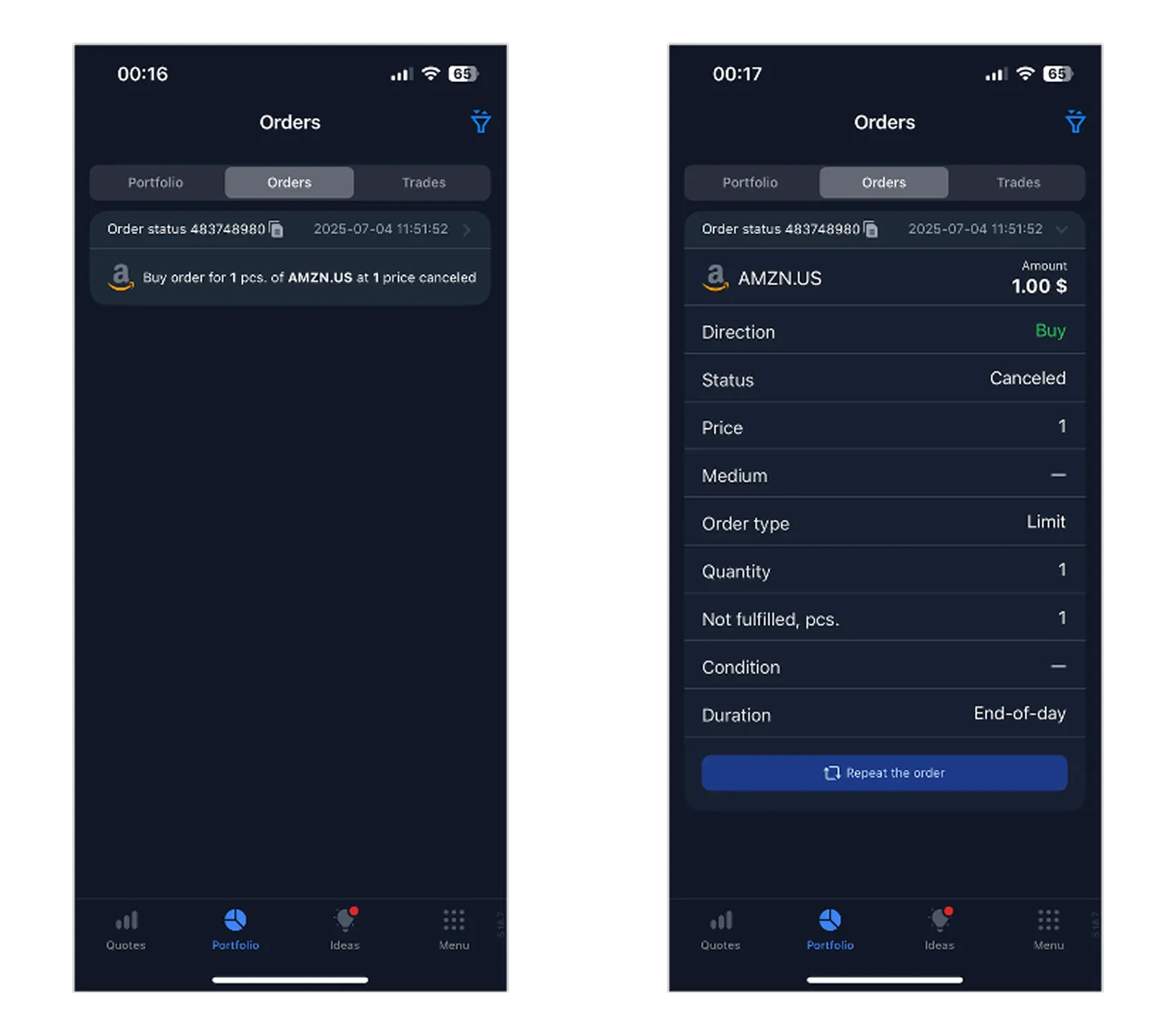
Freedom24 allows users to recreate an expired order directly from its details. The service preserves the number of assets, limit price and order type, while clearly showing that the original order was cancelled.
Instead of searching for the asset again and recreating the transaction manually, the user can continue from the previous action.
This makes order history functional rather than purely informational. Previous activity becomes the starting point for what the user wants to do next.
Product takeaway: continuity means preserving useful context between actions, including when the previous action was not completed.
The strongest digital investor journeys have one characteristic in common: individual features reinforce each other.
Onboarding should prepare the user for investing rather than simply create an account. Market discovery should lead naturally towards action. Portfolio analytics should help users decide what to do next. Previous transactions should remain useful context, and advanced account operations should stay inside the digital product where possible.
This changes the way teams can approach the customer journey map. Instead of evaluating only whether each scenario exists, it is useful to examine the transitions between them:
What does the user see after completing this step? Is previous context preserved? Is the next relevant action available? Does the user have to start again somewhere else?
These transition points often reveal UX gaps that are difficult to see when individual functions are evaluated separately.
A strong investment app supports users before, during and after a trade.
Trading 212 structures the beginning of the journey, SaxoInvestor connects market discovery with portfolio operations, Revolut links explanation with execution, IBKR Mobile supports increasingly complex portfolio needs, and Freedom24 preserves continuity after an expired transaction.
Together, these practices show that investor journey optimization is less about adding more isolated features and more about connecting them.
The strongest investment apps turn individual actions into one continuous investor journey, where each completed step makes the next one easier, clearer and more relevant.
The examples in this article are based on the State of Digital Investment in Europe 2025–2026 study by Markswebb. More details are available on the research page.
We respond to all messages as soon as possible.
We’ve evolved dozens of successful financial services and are eager to prove that our expertise can be implemented in other industries and around the world. Have a look at our success stories!


