
In the fast-growing E-grocery Delivery market, user experience has become the core competitive driver. Price and assortment are no longer sufficient. The quality of digital interaction increasingly defines which delivery services customers consider the best and which online grocery services lose retention.
For the second year in a row, a leading regional retailer partnered with Markswebb to benchmark its Delivery service against the market. We evaluated digital maturity across key delivery scenarios, identified structural gaps, and developed a prioritized UX roadmap focused on high-impact improvements for online grocery services.
As a result of systematic UX work, the retailer’s apps now rank among the leading E-grocery Delivery services in our assessment.
In this case study, we explain:
Contents
This was the second wave of our digital service UX research for the retailer in CIS region. Last year, we evaluated two apps across Android and iOS, benchmarked them against the market using our proprietary scoring system, and provided 126 recommendations per app.
A year later, the retailer returned to understand how these improvements enhanced the digital experience, which scenarios still had potential for optimization, and what competitors had introduced that could be adopted.
“Developing mobile services for our customers is one of our strategic priorities. Smooth search, order placement, and fulfillment are key to delivering a seamless experience. Beyond improving standard functionality, we focus on personalization, including tailored recommendations and curated offers. Gamification elements also help make the experience more engaging. Markswebb’s research enabled us to measure our progress,” explained the retailer’s Director of Digital Product Development (NDA).
The research scope included 10 of the largest food delivery apps in the region, assessed against 500+ criteria grouped by key user tasks—from app entry to order completion and post-purchase interactions.
“A newcomer to the ranking showed strong performance in initial experience scenarios, such as ease of navigation, clear purchase analytics, and personalized recommendations. This sets a solid foundation for developing advanced service functions, where our client already has proven practices,” noted the UX team lead of Markswebb, Maria Kushnerova
The retailer received:
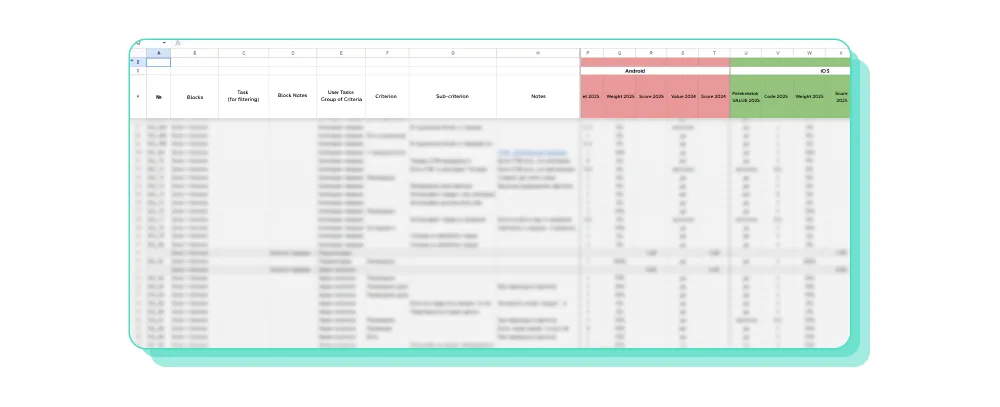
We applied our proprietary UX evaluation system, allowing an objective comparison despite differences in app features and scenarios.
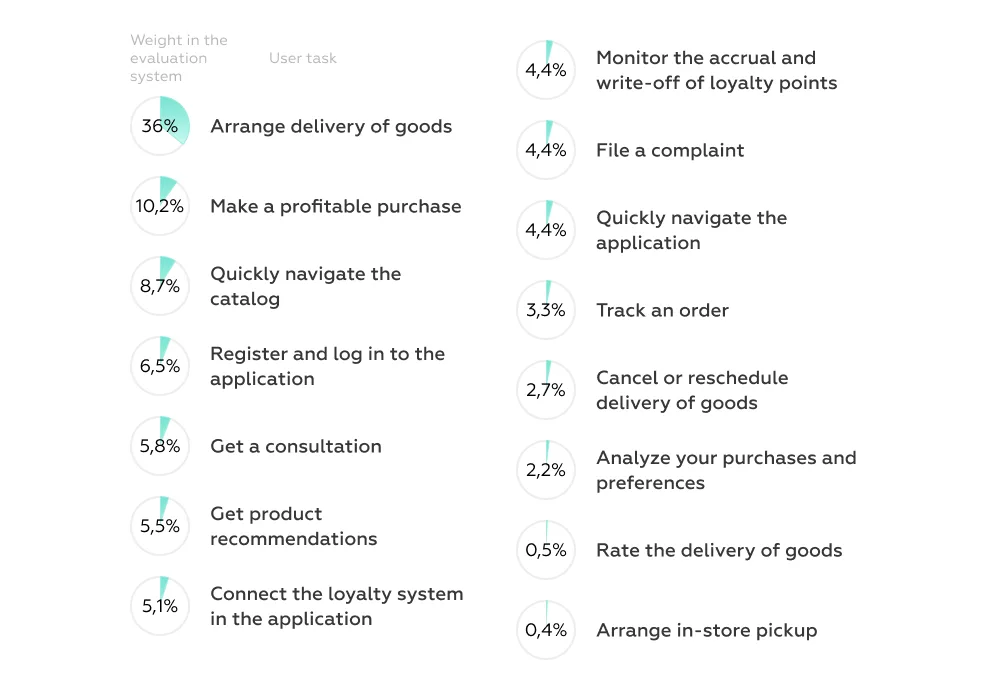
We created full user environments in all apps: placing orders, saving addresses, using bonuses, interacting with personalized offers and notifications. The experience was assessed across 14 task blocks, with 500+ binary criteria (yes/no). Task weights were assigned based on:
The final score is the sum of weighted criteria, reflecting not only the presence of features but their real impact on users. The same system used last year allowed for direct year-over-year comparison, with scores normalized from 0 to 100.
Our 2025 research shows that the E-grocery Delivery market is entering a phase of UX standardization. Core delivery scenarios — product search, cart management, checkout, and delivery slot selection — are implemented at comparable levels across most online services.
Competition is shifting toward:
Today, leadership in E-grocery Delivery services depends less on feature quantity and more on consistency across the entire online journey.
Gap analysis reveals which scenarios create differentiation and identifies client service strengths and weaknesses.
For example, in the “Get support” task block, the retailer’s apps slightly exceeded market growth (+2.7 vs. +2.3), reflecting stable support quality without major functional changes. They lead in providing multiple communication channels—chatbots, live chat, call centers, and FAQs.
Other services, despite lagging overall, showed significant improvement (+18.3 points) by enhancing chat interaction scenarios and support interface usability.
Market dynamics indicate that 2024–2025 growth was concentrated in service and post-delivery scenarios, while blocks related to purchase incentives and spending analytics saw little to no progress.
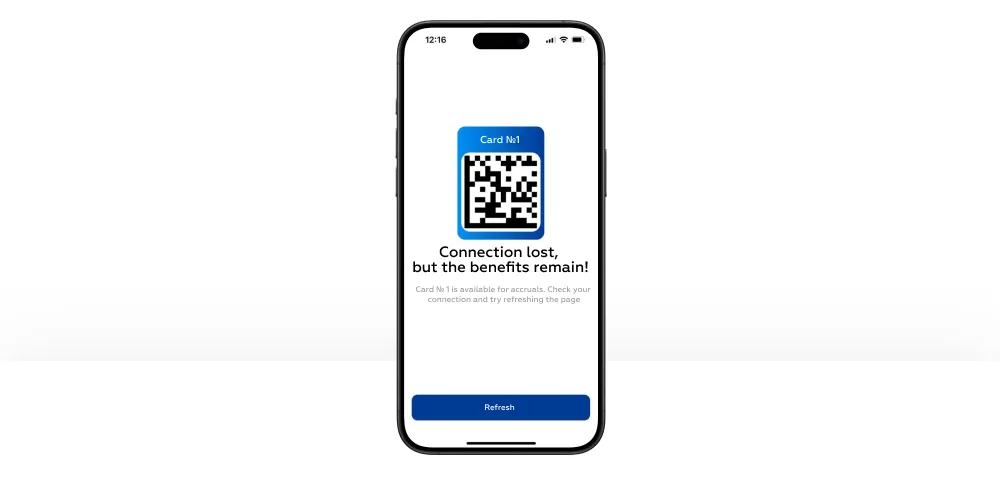
From the 126 recommendations given last year, the client implemented roughly two-thirds fully or partially. Even this partial implementation, combined with other UX enhancements, was sufficient to achieve top scores across most tasks.
Significant improvements were seen in notification functionality, cross-app search, and onboarding of new features, raising scores by up to 75 points in some areas. One app enhanced its “Find items quickly and conveniently” block by nearly 10 points through comprehensive improvements to favorites, order history, sorting, and search. Personalized recommendations increased by 22.3 points thanks to curated offers based on previous orders and family loyalty program access.
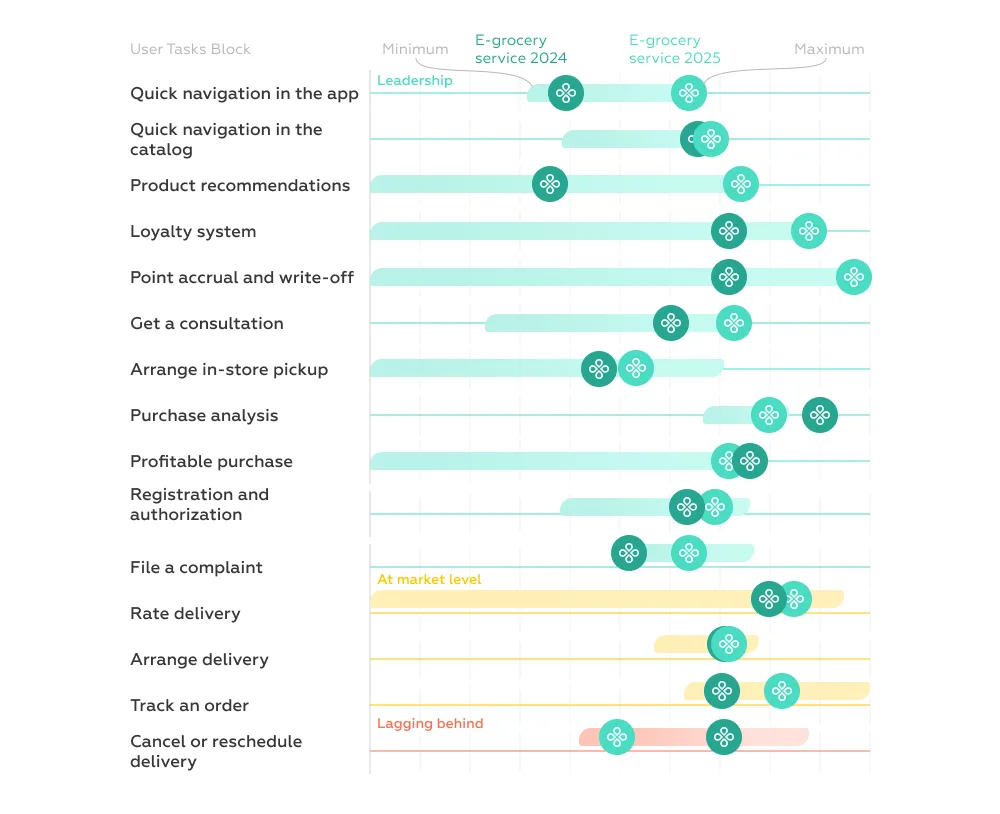
Based on rankings, gap analysis, and trend dynamics, we formulate recommendation blocks—not just feature lists, but directions for system-level UX development. This allows the client to understand which tasks to prioritize for maximum impact.
Additionally, we provided a set of ready-to-implement practices selected by two criteria: high user impact and low implementation cost. Each recommendation clearly shows:
In mature E-grocery Delivery markets, leadership is no longer achieved through rapid feature expansion. It is built through systematic UX refinement across delivery and service scenarios.
Even partial implementation of structured UX recommendations nearly doubled the app’s performance growth compared to the market average.
For online grocery services, continuous benchmarking and scenario-level analysis are essential. UX quickly becomes the baseline — and only structured improvement allows delivery services to remain competitive.
For benchmarking, competitive analysis, or E-grocery Delivery UX research, contact us via your preferred messenger or submit an inquiry through our website.
Contact us via WhatsApp, send an email, or fill out the form below to learn more.
Every year we conduct up to 15 studies of digital services. These are industry benchmarks that reflect the state of the market and trends.